Review
. 2018 Jan 2;19(1):3-12.
doi: 10.1080/15384047.2017.1394538. Epub 2017 Dec 8.

Modulating secreted components of tumor microenvironment: A masterstroke in tumor therapeutics

Affiliations
Review

Modulating secreted components of tumor microenvironment: A masterstroke in tumor therapeutics

Himadri Patel et al. Cancer Biol Ther. .

Abstract

The microenvironment in which cancer resides plays an important role in regulating cancer survival, progression, malignancy and drug resistance. Tumor microenvironment (TME) consists of heterogeneous number and types of cellular and non-cellular components that vary in relation to tumor phenotype and genotype. In recent, non-cellular secreted components of microenvironmental heterogeneity have been suggested to contain various growth factors, cytokines, RNA, DNA, metabolites, structural matrix and matricellular proteins. These non-cellular components have been indicated to orchestrate numerous ways to support cancer survival and progression by providing metabolites, energy, growth signals, evading immune surveillance, drug resistance environment, metastatic and angiogenesis cues. Thus, switching action from pro-cancer to anti-cancer activities of these secreted components of TME has been considered as a new avenue in cancer therapeutics and drug resistance. In this report, we summarize the recent pre-clinical and clinical evidences to emphasize the importance of non-cellular components of TME in achieving precision therapeutics and biomarker study.

Keywords: Biomarkers Immunosurveillance; Chemotherapy; Genomic instability; Heterogeneity; Microenvironment; Tumor.


Figures
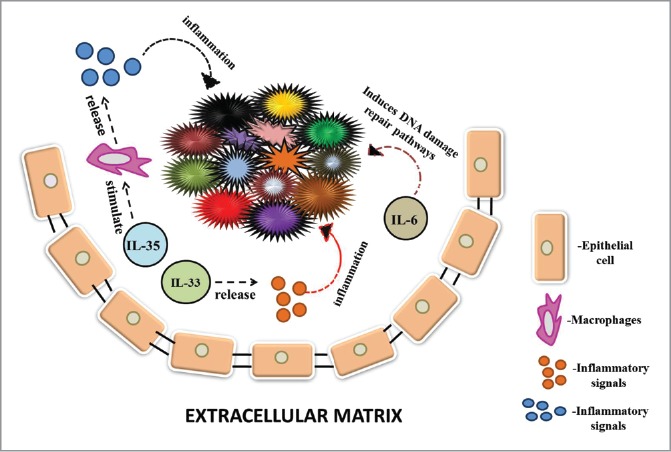
Figure 1.
Figure 1.
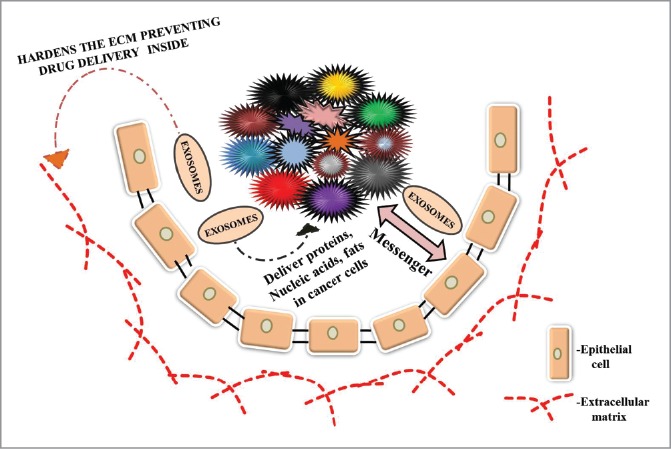
This figure depicts the role of cytokines in cancer growth, invasion and drug-resistance. IL-6, an interleukin enhances tumour survival and progression by inducing various DNA damage repair pathways in cancer cells. IL-33 releases various inflammatory factors that cause inflammation in the tumour cells. IL-35 stimulates macrophages to produce many inflammatory signals that cause inflammation.
Figure 2.
Figure 2.
This figure illustrates the role of exosomes in cancer progression, malignancy and drug-resistance. Exosomes are secreted by normal and cancer cells. These exosomes act as a mediator of communication between cancer and normal cells acting as a messenger. They are also involved in transport of proteins, nucleic acids and lipids to cancer cells. Exosomes released by cancer cells toughen the extracellular matrix acting as a barrier to entry of drugs inside the cancer cells leading to drug resistance.
Figure 3.
Figure 3.
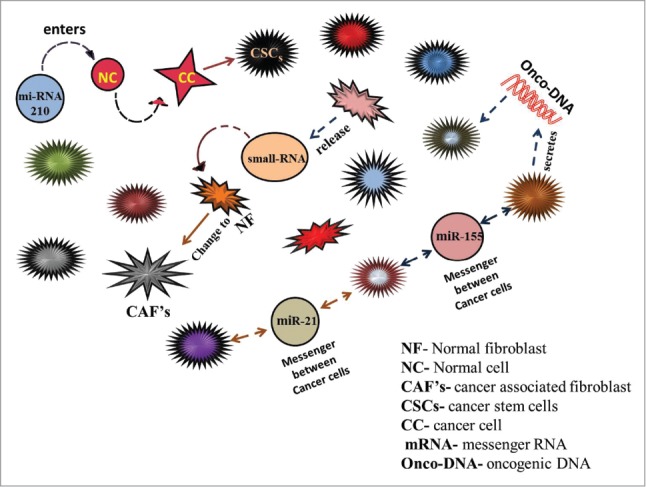
This figure describes the role of extracellular secreted RNAs (small RNAs and mRNA) and DNAs in tumor growth, transformation, progression and communication. MiRNA 210 is released by cancer developing cells and normal cells in tumor derived exosomes. MiRNA 210 is taken by normal cells leading to change in Mi-RNA levels further leading to transformation of normal cells to cancer cells. MiRNA21 and miRNA155 are released by normal and cancer cells which act as messenger between different cells of the tumor playing a role in communication. Cancer cells also secrete oncogenic DNA which converts normal cells to tumor cells.

References

    1. Adjei IM, and Blanka S. Modulation of the Tumor Microenvironment for Cancer Treatment: A Biomaterials Approach. J Funct Biomater. 2015;6(1):81–103. doi: 10.3390/jfb6010081. - DOI - PMC - PubMed
    1. Ahuja N, Sharma AR, Baylin SB. Epigenetic Therapeutics: A New Weapon in the War Against Cancer. Annu Rev Med. 2016;67:73–89. doi: 10.1146/annurev-med-111314-035900. - DOI - PMC - PubMed
    1. Alizadeh AA, Aranda V, Bardelli A, Blanpain C, Bock C, Borowski C. Toward understanding and exploiting tumor heterogeneity. Nat Med. 2015;21(8):846–53. doi: 10.1038/nm.3915. - DOI - PMC - PubMed
    1. Andreuzzi E, Colladel R, Pellicani R, Tarticchio G, Cannizzaro R, Spessotto P, Bussolati B, Brossa A, De Paoli P, Canzonieri V, Iozzo RV, Colombatti A, Mongiat M. The angiostatic molecule Multimerin 2 is processed by MMP-9 to allow sprouting angiogenesis. Matrix Biol. 2017. doi: 10.1016/j.matbio.2017.04.002. - DOI - PubMed
    1. Azmi AS, Bao B, Sarkar FH. Exosomes in cancer development, metastasis, and drug resistance: a comprehensive review. Cancer Metastasis Rev. 2013;32(3–4):623–42. doi: 10.1007/s10555-013-9441-9. - DOI - PMC - PubMed

Publication types

MeSH terms