


doi: 10.1371/journal.pone.0189220.
eCollection 2017.
Reinforcement learning account of network reciprocity
Affiliations
- PMID: 29220413
- PMCID: PMC5722284
- DOI: 10.1371/journal.pone.0189220
Item in Clipboard
Reinforcement learning account of network reciprocity
PLoS One.
.
Abstract
Evolutionary game theory predicts that cooperation in social dilemma games is promoted when agents are connected as a network. However, when networks are fixed over time, humans do not necessarily show enhanced mutual cooperation. Here we show that reinforcement learning (specifically, the so-called Bush-Mosteller model) approximately explains the experimentally observed network reciprocity and the lack thereof in a parameter region spanned by the benefit-to-cost ratio and the node's degree. Thus, we significantly extend previously obtained numerical results.
Conflict of interest statement
Figures

The player represented by a black circle is adjacent to k players represented by gray circles. (a) k = 2. (b) k = 6.
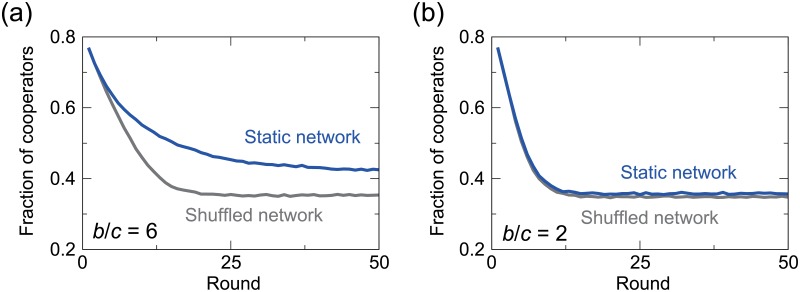
We set k = 2, N = 100, tmax = 50, β = 0.2, A = 1.0, and ϵ = 0.05. (a) b/c = 6. (b) b/c = 2.
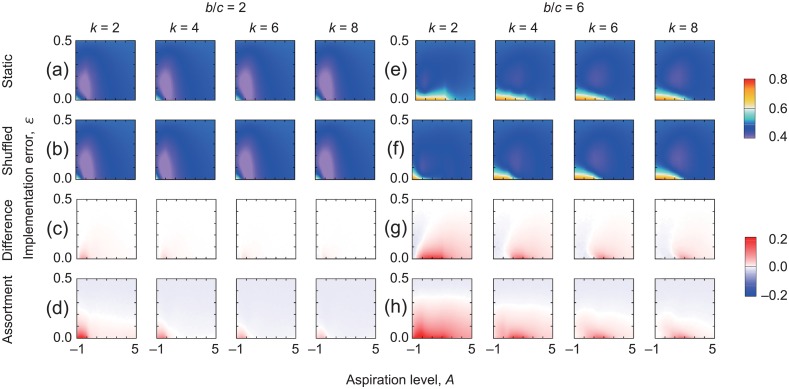
The difference between the fraction of cooperation in the static and shuffled networks is shown in (c) and (g). The assortment for the static networks is shown in (d) and (h). We set N = 100 and β = 0.2. (a)–(d) b/c = 2. (e)–(h) b/c = 6. To calculate the fraction of cooperators and the assortment, we take averages over the first 25 rounds and 103 simulations.
References
-
- Dawes RM. Social dilemmas. Annu Rev Psychol. 1980;31(1):169–193. doi: 10.1146/annurev.ps.31.020180.001125 - DOI
-
- Axelrod R. The Evolution of Cooperation. New York: Basic Books; 1984.
-
- Kollock P. Social dilemmas: The anatomy of cooperation. Annu Rev Sociol. 1998;24(1):183–214. doi: 10.1146/annurev.soc.24.1.183 - DOI
-
- Nowak MA. Five rules for the evolution of cooperation. Science. 2006;314(5805):1560–1563. doi: 10.1126/science.1133755 - DOI - PMC - PubMed
-
- Sigmund K. The Calculus of Selfishness. Princeton: Princeton University Press; 2010.
MeSH terms
LinkOut - more resources
Full Text Sources
Other Literature Sources
