


Improving taxonomic accuracy for fungi in public sequence databases: applying 'one name one species' in well-defined genera with Trichoderma/Hypocrea as a test case
- PMID: 29220466
- PMCID: PMC5641268
- DOI: 10.1093/database/bax072
Improving taxonomic accuracy for fungi in public sequence databases: applying 'one name one species' in well-defined genera with Trichoderma/Hypocrea as a test case
Abstract
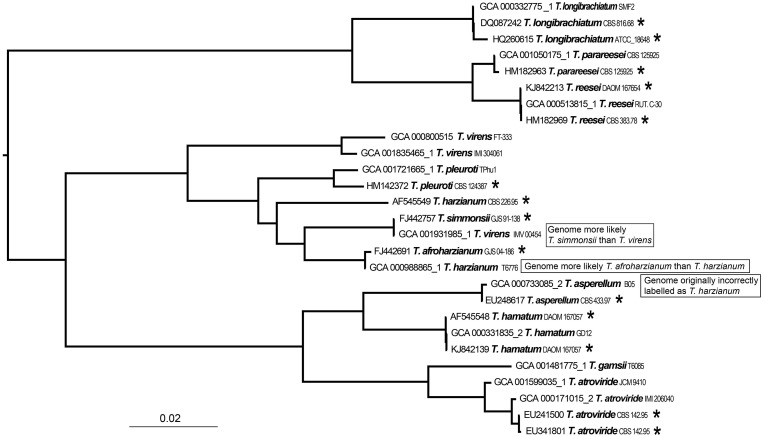
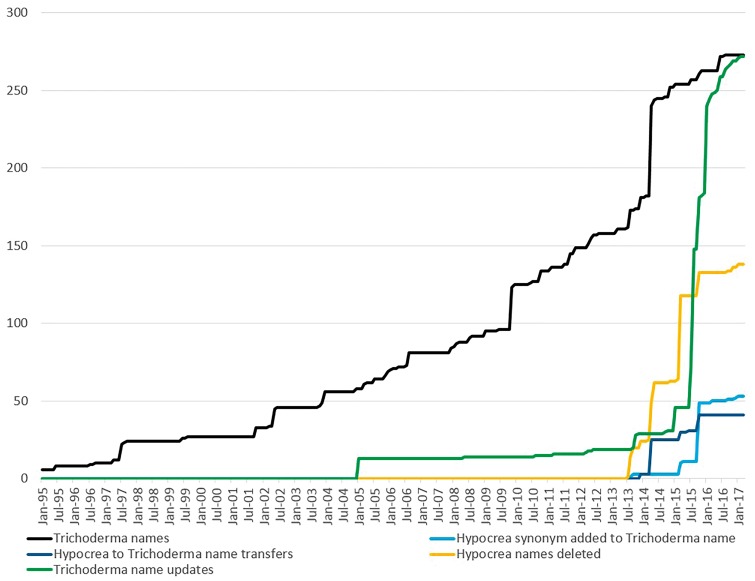
The ITS (nuclear ribosomal internal transcribed spacer) RefSeq database at the National Center for Biotechnology Information (NCBI) is dedicated to the clear association between name, specimen and sequence data. This database is focused on sequences obtained from type material stored in public collections. While the initial ITS sequence curation effort together with numerous fungal taxonomy experts attempted to cover as many orders as possible, we extended our latest focus to the family and genus ranks. We focused on Trichoderma for several reasons, mainly because the asexual and sexual synonyms were well documented, and a list of proposed names and type material were recently proposed and published. In this case study the recent taxonomic information was applied to do a complete taxonomic audit for the genus Trichoderma in the NCBI Taxonomy database. A name status report is available here: https://www.ncbi.nlm.nih.gov/Taxonomy/TaxIdentifier/tax_identifier.cgi. As a result, the ITS RefSeq Targeted Loci database at NCBI has been augmented with more sequences from type and verified material from Trichoderma species. Additionally, to aid in the cross referencing of data from single loci and genomes we have collected a list of quality records of the RPB2 gene obtained from type material in GenBank that could help validate future submissions. During the process of curation misidentified genomes were discovered, and sequence records from type material were found hidden under previous classifications. Source metadata curation, although more cumbersome, proved to be useful as confirmation of the type material designation. Database URL:http://www.ncbi.nlm.nih.gov/bioproject/PRJNA177353
© Crown copyright 2017.
Figures
References
-
- Nagy L.G., Petkovits T., Kovács G.M.. et al. (2011) Where is the unseen fungal diversity hidden? A study of Mortierella reveals a large contribution of reference collections to the identification of fungal environmental sequences. New Phytol., 191, 789–794. - PubMed
-
- O'Donnell K., Humber R.A., Geiser D.M.. et al. (2012) Phylogenetic diversity of insecticolous fusaria inferred from multilocus DNA sequence data and their molecular identification via FUSARIUM-ID and Fusarium MLST. Mycologia, 104, 427–445. - PubMed
-
- Irinyi L., Serena C., Garcia-Hermoso D.. et al. (2015) International Society of Human and Animal Mycology (ISHAM)-ITS reference DNA barcoding database–the quality controlled standard tool for routine identification of human and animal pathogenic fungi. Med. Mycol., 53, 313–337. - PubMed
-
- Kopchinskiy A., Komon M., Kubicek C.P.. et al. (2005) TrichoBLAST: a multilocus database for Trichoderma and Hypocrea identifications. Mycol. Res., 109, 658–660. - PubMed
Publication types
MeSH terms
Substances
LinkOut - more resources
Full Text Sources
Other Literature Sources
Research Materials
