


Catheter-related blood stream infections in hemodialysis patients: a prospective cohort study
- PMID: 29221439
- PMCID: PMC5723103
- DOI: 10.1186/s12882-017-0773-5
Catheter-related blood stream infections in hemodialysis patients: a prospective cohort study
Abstract
Background: For people requiring hemodialysis, infectious mortality is independently associated with geographic distance from a nephrologist. We aimed to determine if differential management of catheter-related blood stream infections (CRBSIs) could explain poorer outcomes.
Methods: We prospectively collected data from adults initiating hemodialysis with a central venous catheter between 2005 and 2015 in Alberta, Canada. We collected indicators of CRBSI management (timely catheter removal, relapsing bacteremia); frequency of CRBSIs; hospitalizations; predictors of CRBSIs, and bacteremia. We evaluated indicators and infectious episodes as a function of the shortest distance by road to the closest nephrologist's practice: <50 (referent); 50-99; and ≥100 km.
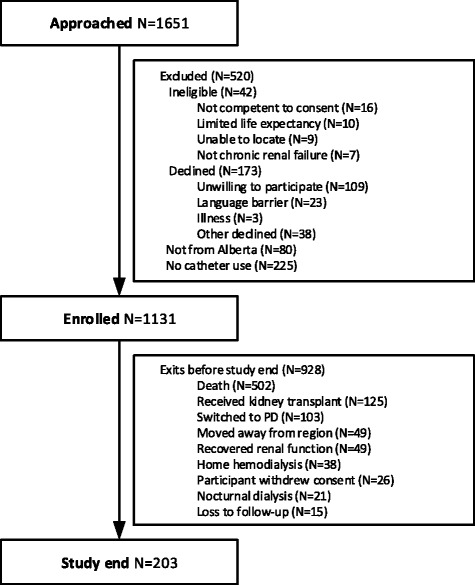
Results: One thousand one hundred thirty-one participants were followed for a median of 755 days (interquartile range (IQR) 219, 1465) and used dialysis catheters for a median of 565 days (IQR 176, 1288). Compared to the referent group, there was no significant difference in the rate ratio (RR) of CRBSI in the 50-100 and >100 km distance categories: RR 1.63; 95% confidence interval (CI) (0.91, 2.91); RR 0.84 (95% CI 0.44, 1.58); p = 0.87, respectively or in bacteremia: RR 1.42; (95% CI 0.83, 2.45); RR 0.79 (95% CI 0.45,1.39) p = 0.74, respectively. There were no differences in indicators of appropriate CRBSI management or hospitalizations according to distance. The overall incidence of CRBSIs was low (0.19 per 1000 catheter days) as was the frequency of relapse. Only liver disease was independently associated with CRBSI (RR 2.11; 95% CI 1.15, 3.86).
Conclusions: The frequency and management of CRBSIs did not differ by location; however, event rates were low.
Keywords: Bacteremia; Catheter; Hemodialysis; Residence location.
Conflict of interest statement
Ethics approval and consent to participate
Written informed consent was obtained from participants and research ethics boards of the Universities of Alberta and Calgary approved the study.
Consent for publication
Not applicable.
Competing interests
The authors declare that they have no competing interests.
Publisher’s Note
Springer Nature remains neutral with regard to jurisdictional claims in published maps and institutional affiliations.
Figures
References
-
- Lin G, Allan DE, Penning MJ. Examining distance effects on hospitalizations using GIS: a study of three health regions in British Columbia, Canada. Environ. Plan. London: A. SAGE PublicationsSage UK; 2002. pp. 2037–2053.
-
- Clark RA, Driscoll A, Nottage J, McLennan S, Coombe DM, Bamford EJ, et al. Inequitable provision of optimal services for patients with chronic heart failure: a national geo-mapping study. Med J Aust. 2007;186:169–173. - PubMed
MeSH terms
Grants and funding
LinkOut - more resources
Full Text Sources
Other Literature Sources
Medical
