


Cataract surgery and environmental sustainability: Waste and lifecycle assessment of phacoemulsification at a private healthcare facility
- PMID: 29223227
- PMCID: PMC5728421
- DOI: 10.1016/j.jcrs.2017.08.017
Cataract surgery and environmental sustainability: Waste and lifecycle assessment of phacoemulsification at a private healthcare facility
Abstract
Purpose: To measure the waste generation and lifecycle environmental emissions from cataract surgery via phacoemulsification in a recognized resource-efficient setting.
Setting: Two tertiary care centers of the Aravind Eye Care System in southern India.
Design: Observational case series.
Methods: Manual waste audits, purchasing data, and interviews with Aravind staff were used in a hybrid environmental lifecycle assessment framework to quantify the environmental emissions associated with cataract surgery. Kilograms of solid waste generated and midpoint emissions in a variety of impact categories (eg, kilograms of carbon dioxide equivalents).
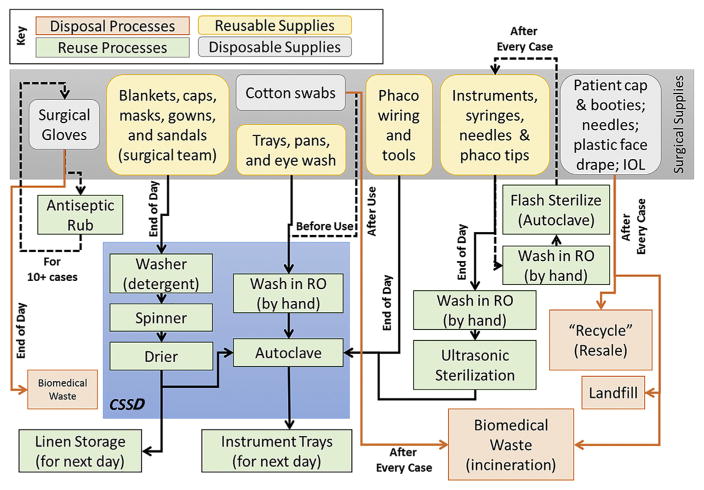
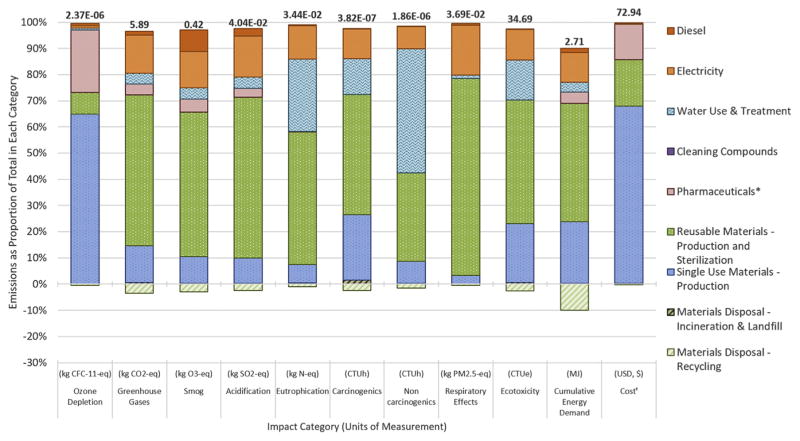
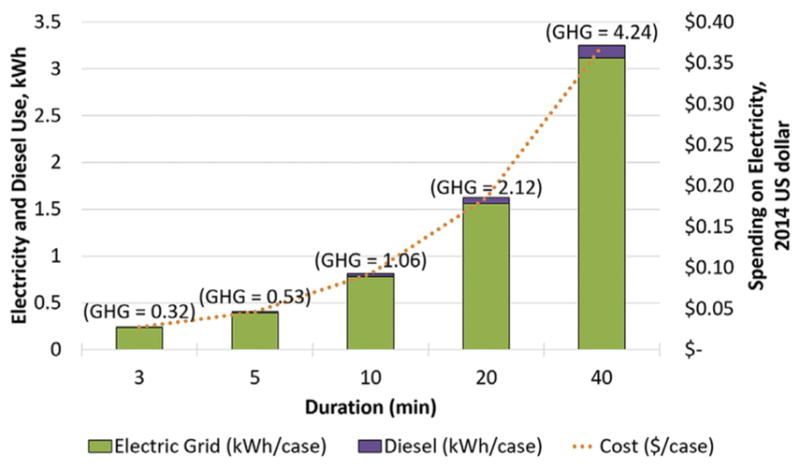
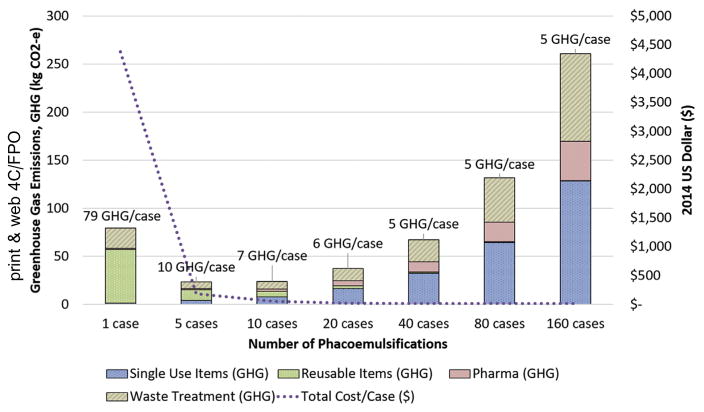
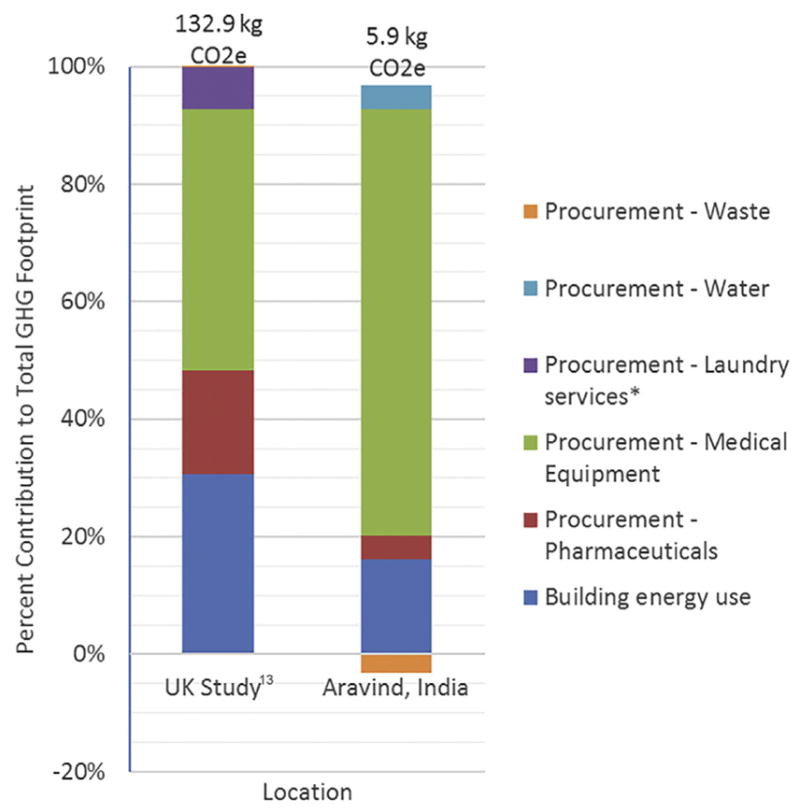
Results: Aravind generates 250 grams of waste per phacoemulsification and nearly 6 kilograms of carbon dioxide-equivalents in greenhouse gases. This is approximately 5% of the United Kingdom's phaco carbon footprint with comparable outcomes. A majority of Aravind's lifecycle environmental emissions occur in the sterilization process of reusable instruments because their surgical system uses largely reusable instruments and materials. Electricity use in the operating room and the Central Sterile Services Department (CSSD) accounts for 10% to 25% of most environmental emissions.
Conclusions: Surgical systems in most developed countries and, in particular their use of materials, are unsustainable. Results show that ophthalmologists and other medical specialists can reduce material use and emissions in medical procedures using the system described here.
Copyright © 2017 ASCRS and ESCRS. Published by Elsevier Inc. All rights reserved.
Conflict of interest statement
Figures
Comment in
-
Reducing the environmental impact of cataract surgery: Sustainability versus safety: A tradeoff?J Cataract Refract Surg. 2018 Jan;44(1):1-2. doi: 10.1016/j.jcrs.2018.01.001. J Cataract Refract Surg. 2018. PMID: 29502595 No abstract available.
References
-
- Esaki RK, Macario A. Wastage of supplies and drugs in the operating room. Medscape Anesthesiology. 2009
-
- McGain F, Clark M, Williams T, Wardlaw T. Recycling plastics from the operating suite [letter] Anaesth Intensive Care. 2008;36:913–914. - PubMed
-
- Tieszen ME, Gruenberg JC. A quantitative, qualitative, and critical assessment of surgical waste; surgeons venture through the trash can. [Accessed September 25, 2017];JAMA. 1992 267:2765–2768. Available at: http://infohouse.p2ric.org/ref/39/38843.pdf. - PubMed
-
- Thiel CL, Eckelman M, Guido R, Huddleston M, Landis AE, Sherman J, Shrake SO, Copley-Woods N, Bilec MM. Environmental impacts of surgical procedures: life cycle assessment of hysterectomy in the United States. [Accessed September 25, 2017];Environ Sci Technol. 2015 49:1779–1786. Available at: http://pubs.acs.org/doi/pdf/10.1021/es504719g. - DOI - PMC - PubMed
-
- Campion N, Thiel CL, DeBlois J, Woods NC, Landis AE, Bilec MM. Life cycle assessment perspectives on delivering an infant in the US. [Accessed September 25, 2017];Sci Total Environ. 2012 425:191–198. Available at: https://www.ncbi.nlm.nih.gov/pmc/articles/PMC3563327/pdf/nihms364803.pdf. - PMC - PubMed
Publication types
MeSH terms
Substances
Grants and funding
LinkOut - more resources
Full Text Sources
Other Literature Sources
