. 2018 May 5;28(5):266-273.
doi: 10.2188/jea.JE20170017. Epub 2017 Dec 9.

Long-term Impact of Cardiorespiratory Fitness on Type 2 Diabetes Incidence: A Cohort Study of Japanese Men

Affiliations

Long-term Impact of Cardiorespiratory Fitness on Type 2 Diabetes Incidence: A Cohort Study of Japanese Men

Ryoko Kawakami et al. J Epidemiol. .

Abstract

Background: We sought to examine the association between cardiorespiratory fitness (CRF) and incidence of type 2 diabetes considering the follow-up period in a cohort of Japanese men with a maximum follow-up period of 23 years.

Methods: This study enrolled 7,804 male workers free of diabetes in 1986. CRF was measured using a cycle ergometer, and maximal oxygen uptake was estimated. During 1986-2009, participants were followed for development of type 2 diabetes, which was diagnosed using fasting blood tests, self-administered questionnaires, or oral glucose tolerance tests after urinary tests from annual health checkups. Hazard ratios for the incidence of type 2 diabetes were estimated using Cox proportional hazards models.

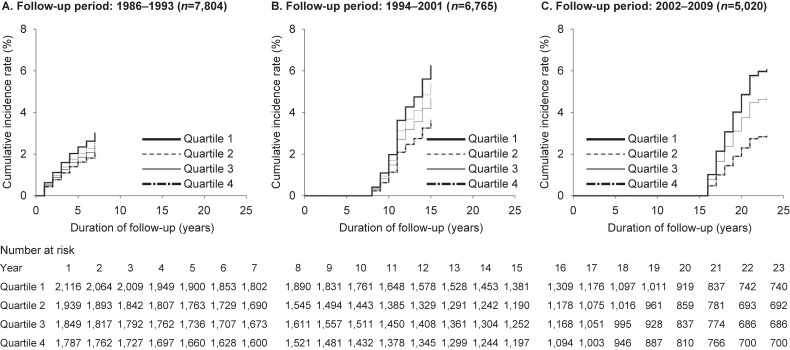
Results: During the follow-up period, 1,047 men developed type 2 diabetes. In analyses by follow-up periods (1986-1993, 1994-2001, and 2002-2009), there was an inverse dose-response relationship between CRF and the development of type 2 diabetes for all three follow-up periods (P for trend 0.019, <0.001, and 0.001, respectively), and the association between CRF at baseline and the incidence of type 2 diabetes did not weaken with longer follow-up period. Compared with the lowest CRF group, hazard ratios of developing type 2 diabetes were 0.69 (95% confidence interval [CI], 0.49-0.97) for the highest CRF group in 1986-1993, 0.57 (95% CI, 0.42-0.79) for the highest CRF in 1994-2001, and 0.47 (95% CI, 0.30-0.74) for the highest CRF in 2002-2009.

Conclusion: High CRF is associated with a lower risk of the incidence of type 2 diabetes over an extended period of >20 years among men.

Keywords: cohort study; epidemiology; exercise test; hyperglycemia; physical fitness.


Figures
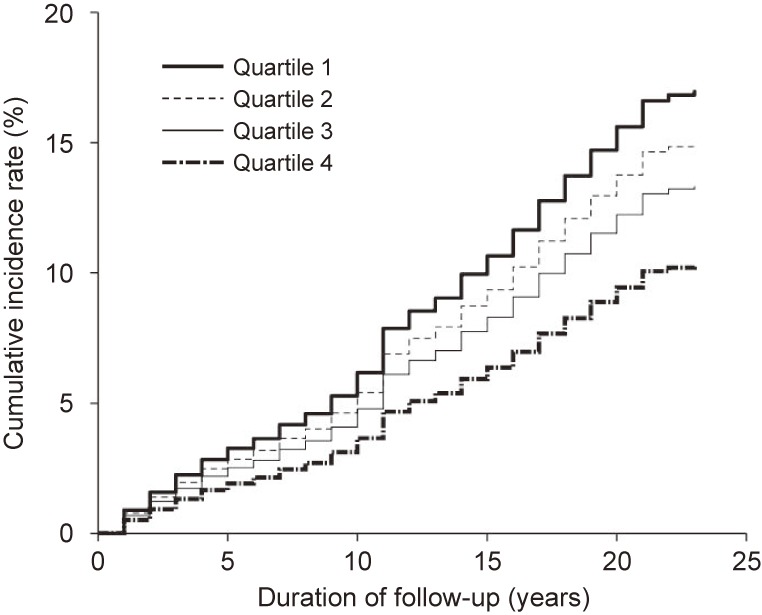
Figure 1.
Figure 1.. Multivariable-adjusted cumulative incidence curve for type 2 diabetes according to cardiorespiratory fitness category in 1986–2009. Adjusted for age (continuous variable), body mass index (continuous variable), systolic blood pressure (continuous variable), smoking habit (non-smoker, past smoking, 1–20 cigarettes/day, or ≥21 cigarettes/day), drinking habit (none, 1–20 g/day, or ≥21 g/day), and family history of diabetes (yes or no).
Figure 2.
Figure 2.. Multivariable-adjusted cumulative incidence curve for type 2 diabetes according to cardiorespiratory fitness category by follow-up period (1986–1993 (A), 1994–2001 (B), and 2002–2009 (C)). Adjusted for age (continuous variable), body mass index (continuous variable), systolic blood pressure (continuous variable), smoking habit (non-smoker, past smoking, 1–20 cigarettes/day, or ≥21 cigarettes/day), drinking habit (none, 1–20 g/day, or ≥21 g/day), and family history of diabetes (yes or no).
Figure 3.
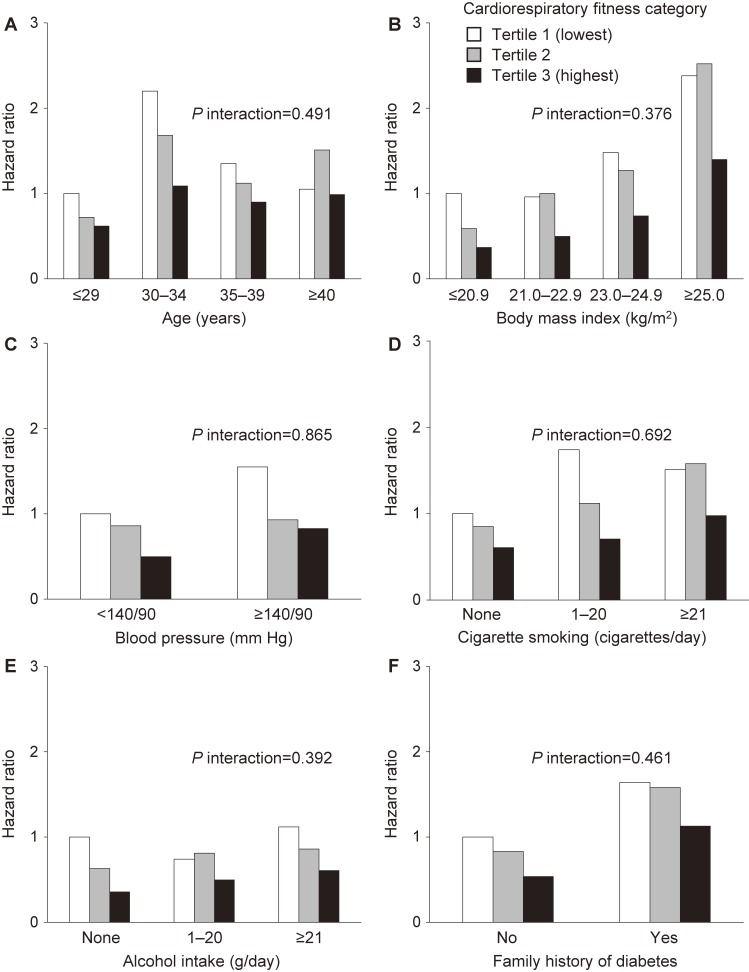
Figure 3.. Multivariable-adjusted hazard ratios for incidence of type 2 diabetes according to cardiorespiratory fitness category in analysis stratified by potential risk factors (age (A), body mass index (B), blood pressure (C), cigarette smoking (D), alcohol intake (E), and family history of diabetes (F)), 2002–2009 (n = 5,020). Adjusted for all items in the figure.

References

    1. International Diabetes Federation. Diabetes Atlas. 7th ed. Brussels, Belgium: International Diabetes Federation; 2015.
    1. Wei M, Gibbons LW, Mitchell TL, Kampert JB, Lee CD, Blair SN. The association between cardiorespiratory fitness and impaired fasting glucose and type 2 diabetes mellitus in men. Ann Intern Med. 1999;130:89–96. 10.7326/0003-4819-130-2-199901190-00002 - DOI - PubMed
    1. Carnethon MR, Gidding SS, Nehgme R, Sidney S, Jacobs DR Jr, Liu K. Cardiorespiratory fitness in young adulthood and the development of cardiovascular disease risk factors. JAMA. 2003;290:3092–3100. 10.1001/jama.290.23.3092 - DOI - PubMed
    1. Sawada SS, Lee IM, Muto T, Matuszaki K, Blair SN. Cardiorespiratory fitness and the incidence of type 2 diabetes: prospective study of Japanese men. Diabetes Care. 2003;26:2918–2922. 10.2337/diacare.26.10.2918 - DOI - PubMed
    1. Sui X, Hooker SP, Lee IM, et al. . A prospective study of cardiorespiratory fitness and risk of type 2 diabetes in women. Diabetes Care. 2008;31:550–555. 10.2337/dc07-1870 - DOI - PMC - PubMed