. 2017 Sep;89(9):1223-1249.
doi: 10.1515/pac-2016-1025. Epub 2017 Jan 11.

Tailoring Trehalose for Biomedical and Biotechnological Applications

Affiliations

Tailoring Trehalose for Biomedical and Biotechnological Applications

Mara K O'Neill et al. Pure Appl Chem. 2017 Sep.

Abstract

Trehalose is a non-reducing sugar whose ability to stabilize biomolecules has brought about its widespread use in biological preservation applications. Trehalose is also an essential metabolite in a number of pathogens, most significantly the global pathogen Mycobacterium tuberculosis, though it is absent in humans and other mammals. Recently, there has been a surge of interest in modifying the structure of trehalose to generate analogues that have applications in biomedical research and biotechnology. Non-degradable trehalose analogues could have a number of advantages as bioprotectants and food additives. Trehalose-based imaging probes and inhibitors are already useful as research tools and may have future value in the diagnosis and treatment of tuberculosis, among other uses. Underlying the advancements made in these areas are novel synthetic methods that facilitate access to and evaluation of trehalose analogues. In this review, we focus on both aspects of the development of this class of molecules. First, we consider the chemical and chemoenzymatic methods that have been used to prepare trehalose analogues and discuss their prospects for synthesis on commercially relevant scales. Second, we describe ongoing efforts to develop and deploy detectable trehalose analogues, trehalose-based inhibitors, and non-digestible trehalose analogues. The current and potential future uses of these compounds are discussed, with an emphasis on their roles in understanding and combatting mycobacterial infection.

Keywords: Trehalose; analogue; biocatalysis; biopreservation; chemical synthesis; chemoenzymatic synthesis; imaging; inhibitors; mycobacteria.


Figures
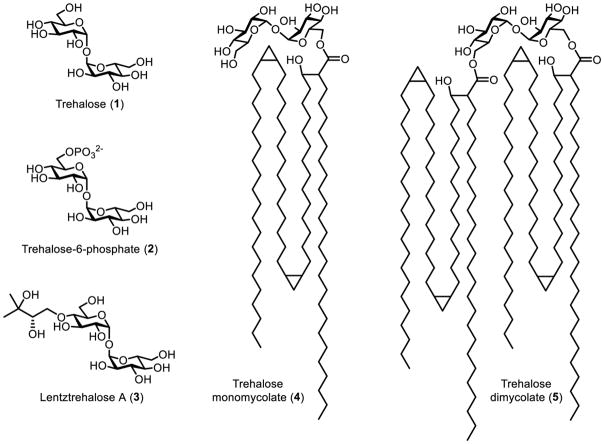
Figure 1
Figure 1
Structures of trehalose and a few naturally occurring trehalose derivatives.
Figure 2
Figure 2
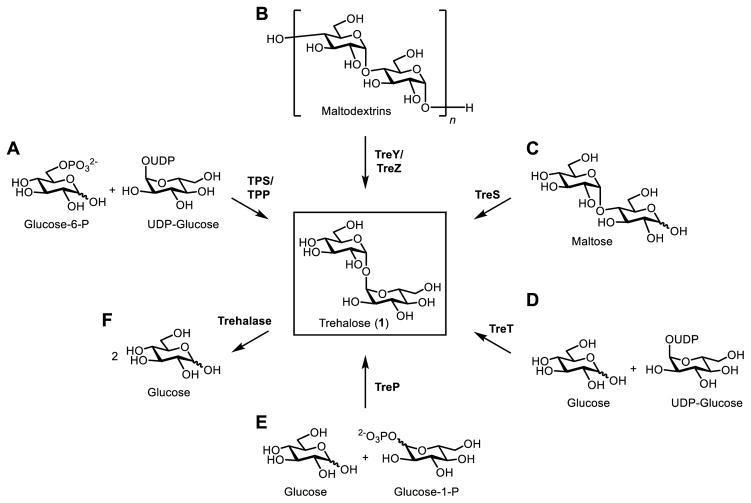
Known trehalose biosynthesis (A–E) and degradation (F) pathways existing in nature. Note: TreP may catalyze both trehalose biosynthesis and trehalose degradation.
Figure 3
Figure 3
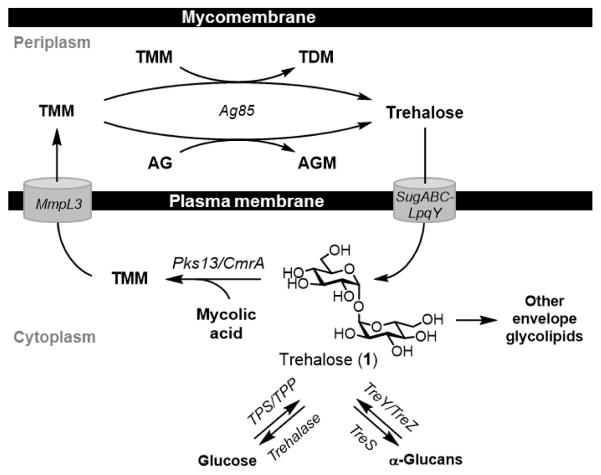
Mycobacterial trehalose metabolism.
Figure 4
Figure 4
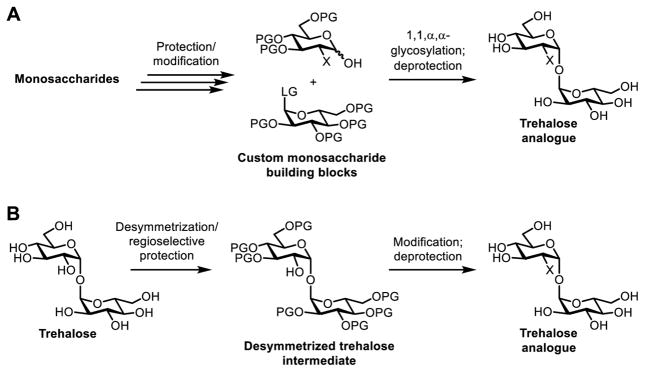
Chemical synthesis of trehalose analogues via (A) 1,1-α,α-glycosylation between monosaccharide derivatives and (B) regioselective functionalization of trehalose. LG, leaving group; PG, protecting group; X, structural modification.
Figure 5
Figure 5
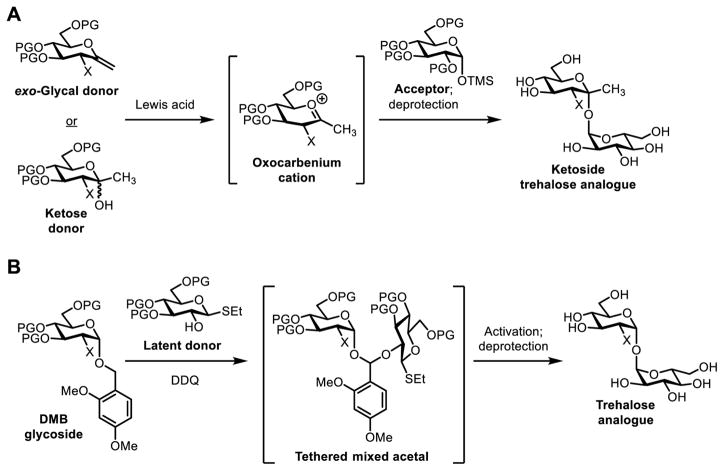
1,1-α,α-Glycosylation strategies using (A) ketoside formation and (B) intramolecular aglycon delivery to control stereochemical outcome. DMB, dimethoxybenzyl; TMS, trimethylsilyl.
Figure 6
Figure 6
Chemoenzymatic synthesis of fluorine-modified trehalose analogue 19F-2-FDTre (9) from the corresponding glucose analogue 19F-2-FDG (6) using a three-step method based on the TPS/TPP pathway.
Figure 7
Figure 7
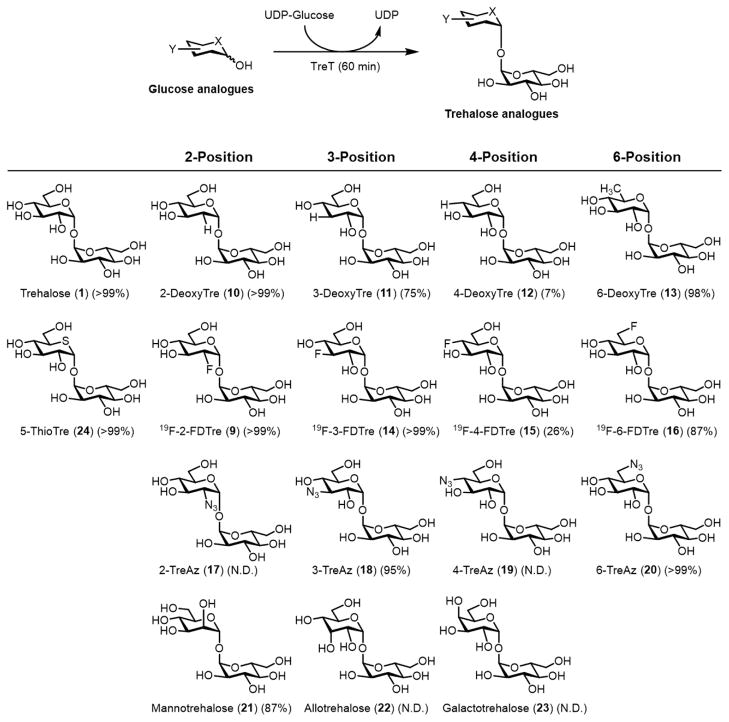
One-step TreT-catalyzed synthesis of trehalose analogues (924). Yields were determined by HPLC. X and Y represent structural modifications. N.D., not detected.
Figure 8
Figure 8
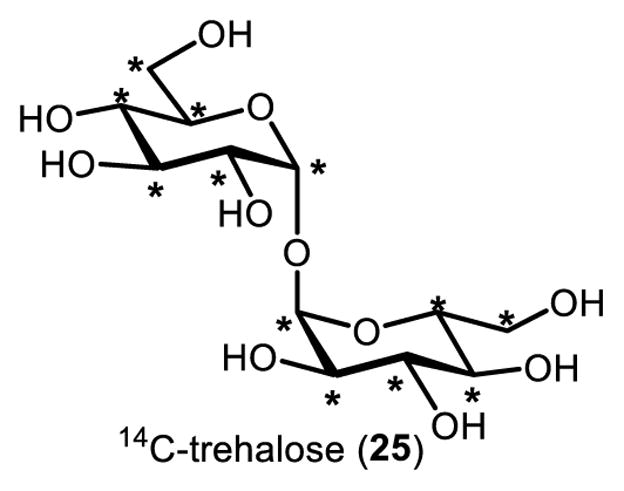
Uniformly labeled 14C-trehalose. Asterisk (*) indicates a 14C-labeled atom.
Figure 9
Figure 9
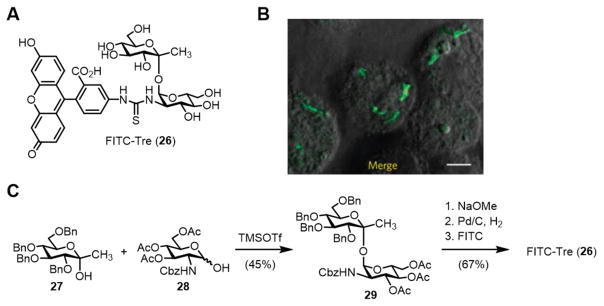
(A) Structure of FITC-Tre (26). (B) Metabolic labeling of M. tuberculosis within host macrophages using FITC-Tre (image reprinted from ref. with permission). Scale bar, 5μm. (C) Final steps in the chemical synthesis of FITC-Tre. Cbz, carboxybenzyl; FITC, fluorescein isothiocyanate; TMSOTf, trimethylsilyl trifluoromethanesulfonate.
Figure 10
Figure 10
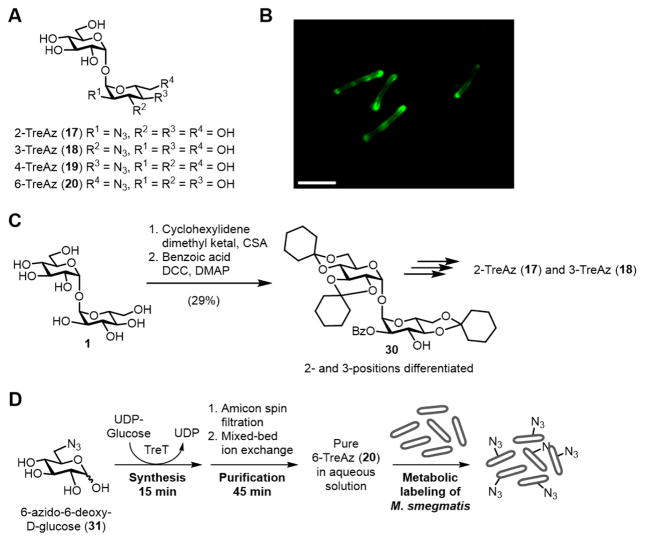
(A) Structures of 2-, 3-, 4-, and 6-TreAz (1720). (B) Metabolic labeling of M. smegmatis with TreAz followed by CuAAC with an alkyne-modified fluorophore (image reprinted with permission from ref. 100). Scale bar, 5 μm. (C) An example of the approach used to synthesize TreAz analogues. Differentiation of the 2- and 3-O-positions of trehalose (1) was accomplished in two steps, giving an intermediate (30), which was elaborated to 2- and 3-TreAz (17 and 18). (D) Rapid TreT-catalyzed synthesis, purification, and administration of 6-TreAz (20) to M. smegmatis for a metabolic labeling experiment. CSA, camphor sulfonic acid; DCC, N,N’-dicyclohexylcarbodiimide; DMAP, 4-dimethylaminopyridine.
Figure 11
Figure 11
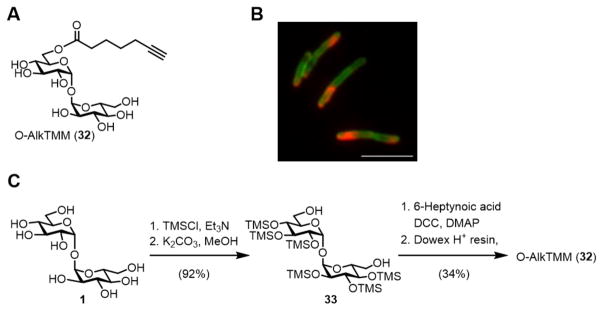
(A) Structure of O-mycoloylation probe O-AlkTMM (32). (B) Simultaneous metabolic labeling of M. smegmatis with 6-TreAz and O-AlkTMM followed by sequential SPAAC and CuAAC reactions to deliver different fluorophores to trehalose glycolipids and AGM (image reprinted with permission from ref. 104). Scale bar, 5 μm. (C) Chemical synthesis of O-AlkTMM using a 4-step trehalose desymmetrization approach.
Figure 12
Figure 12
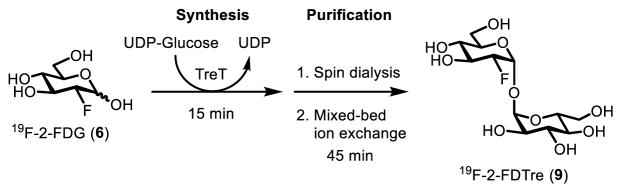
Rapid TreT-catalyzed synthesis of 19F-2-FDTre (9).
Figure 13
Figure 13
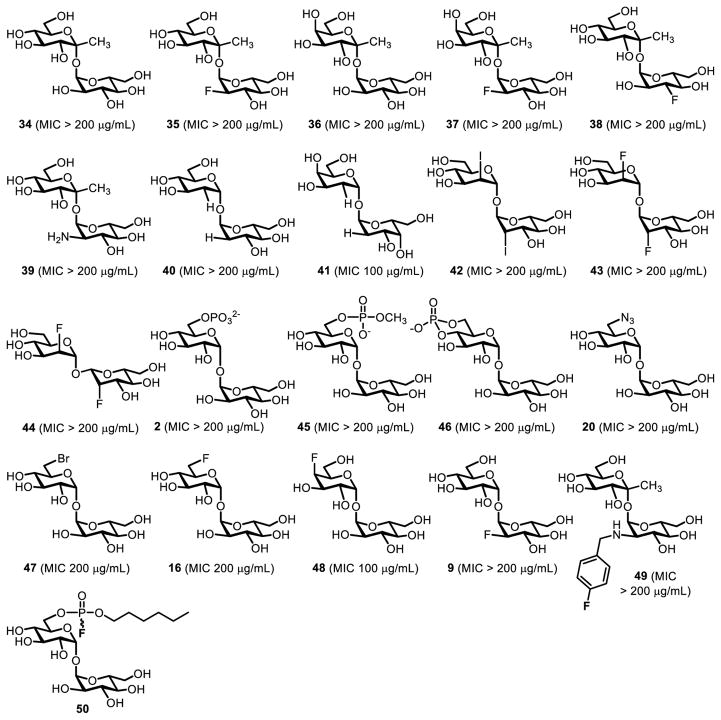
Panel of trehalose analogues evaluated for inhibition of M. tuberculosis growth in ref. . The MIC value for each compound is given in parentheses.
Figure 14
Figure 14
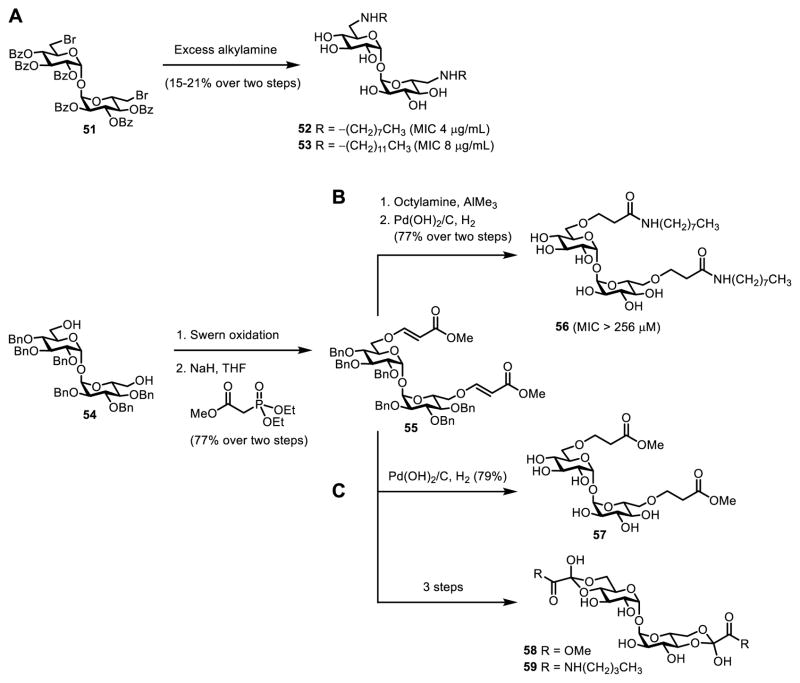
TDM analogues developed as potential inhibitiors of mycobacterial growth. (A) N,N’-dialkylated 6,6’-diamino-6,6’-dideoxytrehalose derivatives 52 and 53 from ref. (accessed through N-substitution of dibromide 51) exhibited good activity against an attenuated strain of M. tuberculosis. (B) TDM analogue 56 bearing a “reversed” acyl linkage from ref. showed moderate activity against M. smegmatis. (C) TDM analogues 5759 from ref. displayed no activity against M. smegmatis.
Figure 15
Figure 15
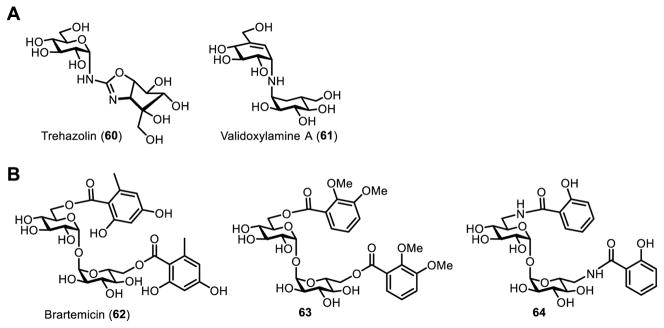
(A) Naturally occurring trehalase inhibitors trehazolin (60) and validoxylamine A (61). (B) Brartemicin (62) and synthetic analogues (63 and 64) are being investigated as anti-invasive compounds with possible cancer chemotherapy applications.
Figure 16
Figure 16
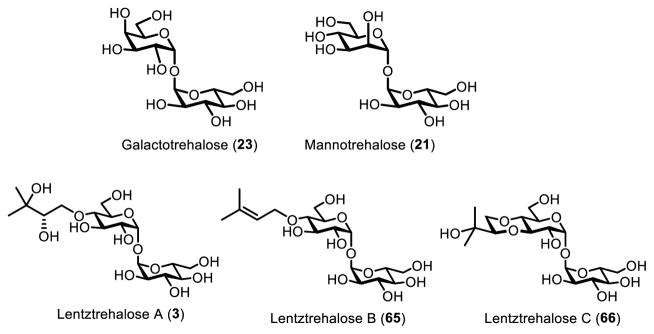
Trehalose analogues that are resistant to degradation by trehalase, including trehalose epimers 21 and 23 and naturally occurring lentztrehaloses A–C (3, 65, 66).

References

    1. Elbein AD, Pan YT, Pastuszak I, Carroll D. Glycobiology. 2003;13:17R. - PubMed
    1. Ohtake S, Wang YJ. J Pharm Sci. 2011;100:2020. - PubMed
    1. Thompson SN. Adv Insect Physiol. 2003;31:205.
    1. Van Dijck P, Thevelein JM, Avonce N, Leyman B, Iturriaga G. Plant Physiol. 2004;136:3649. - PMC - PubMed
    1. Wada S, Ohba S, Someno T, Hatano M, Nomoto A. J Antibiot. 2014;67:319. - PubMed