


Syndecans in chronic inflammatory and autoimmune diseases: Pathological insights and therapeutic opportunities
- PMID: 29226950
- PMCID: PMC6679927
- DOI: 10.1002/jcp.26388
Syndecans in chronic inflammatory and autoimmune diseases: Pathological insights and therapeutic opportunities
Abstract
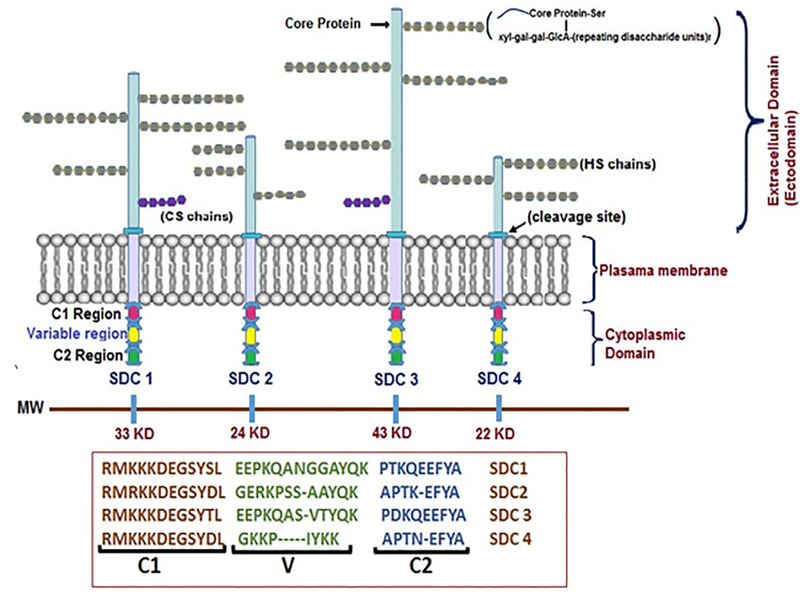
Syndecans (SDCs) are a family of heparan sulfate proteoglycans (HSPGs) glycoproteins ubiquitously expressed on the cell surfaces and extracellular matrix of all mammalian tissues. There are four mammalian syndecans, SDC-1 thorough 4, which play a critical role in cell adhesion, migration, proliferation, differentiation, and angiogenesis through independent and growth factor mediated signaling. An altered expression of SDCs is often observed in autoimmune disorders, cancer, HIV infection, and many other pathological conditions. SDCs modulate disease progression by interacting with a diverse array of ligands, receptors, and other proteins, including extracellular matrix, glycoproteins, integrins, morphogens, and various growth factors and chemokines, along with their receptors and kinases. Specifically, SDCs present on cell surface can bind directly to chemokines to enhance their binding to receptors, downstream signaling, and migration. Alternatively, SDCs can be cleaved and shed to mediate negative regulation of chemokine and growth factor signaling pathways and ligand sequestration. Importantly, SDC shedding may be a biomarker of inflammation, especially in chronic inflammatory diseases. While the current therapies for cancer and several autoimmune disorders have revolutionized treatment outcomes, understanding the pathophysiological role of SDCs and the use of HSPG mimetic or antagonists on cytokine signaling networks may uncover potentially novel targeted therapeutic approaches. This review mainly summarizes the current findings on the role of individual SDCs in disease processes, mechanisms through which SDCs mediate their biological functions, and the possibility of targeting SDCs as future potential therapeutic approaches.
Keywords: autoimmune diseases; cancer; heparan sulfate proteoglycans; signaling pathways; syndecans; therapeutics.
© 2017 Wiley Periodicals, Inc.
Conflict of interest statement
CONFLICTS OF INTEREST
The authors declare that there is no conflict of interest related to this work.
Figures
References
-
- Afratis NA, Nikitovic D, Multhaupt HA, Theocharis AD, Couchman JR, & Karamanos NK (2017). Syndecans−key regulators of cell signaling and biological functions. FEBS Journal, 284(1), 27–41. - PubMed
-
- Alexander CM, Reichsman F, Hinkes MT, Lincecum J, Becker KA, Cumberledge S, & Bernfield M (2000). Syndecan-1 is required for Wnt-1-induced mammary tumorigenesis in mice. Nature Genetics, 25(3), 329–332. - PubMed
-
- Anttonen A, Heikkila P, Kajanti M, Jalkanen M, & Joensuu H (2001). High syndecan-1 expression is associated with favourable outcome in squamous cell lung carcinoma treated with radical surgery. Lung Cancer, 32(3), 297–305. - PubMed
-
- Baba F, Swartz K, van Buren R, Eickhoff J, Zhang Y, Wolberg W, & Friedl A (2006). Syndecan-1 and syndecan-4 are overexpressed in an estrogen receptor-negative, highly proliferative breast carcinoma subtype. Breast Cancer Research and Treatment, 98(1), 91–98. - PubMed
-
- Baietti MF, Zhang Z, Mortier E, Melchior A, Degeest G, Geeraerts A, … David G (2012). Syndecan-syntenin-ALIX regulates the biogenesis of exosomes. Nature Cell Biology, 14(7), 677–685. - PubMed
Publication types
MeSH terms
Substances
Grants and funding
LinkOut - more resources
Full Text Sources
Other Literature Sources
Medical
Miscellaneous
