Disrupted functional connectivity between perirhinal and parahippocampal cortices with hippocampal subfields in patients with mild cognitive impairment and Alzheimer's disease
- PMID: 29228757
- PMCID: PMC5716797
- DOI: 10.18632/oncotarget.17944
Disrupted functional connectivity between perirhinal and parahippocampal cortices with hippocampal subfields in patients with mild cognitive impairment and Alzheimer's disease
Abstract
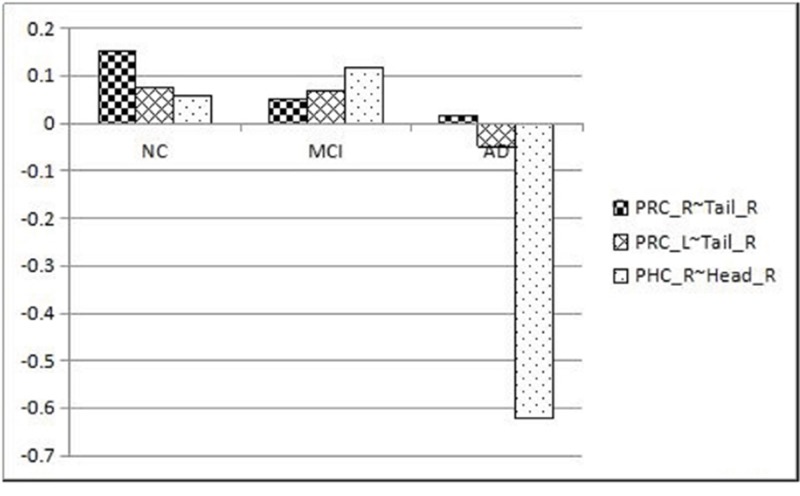
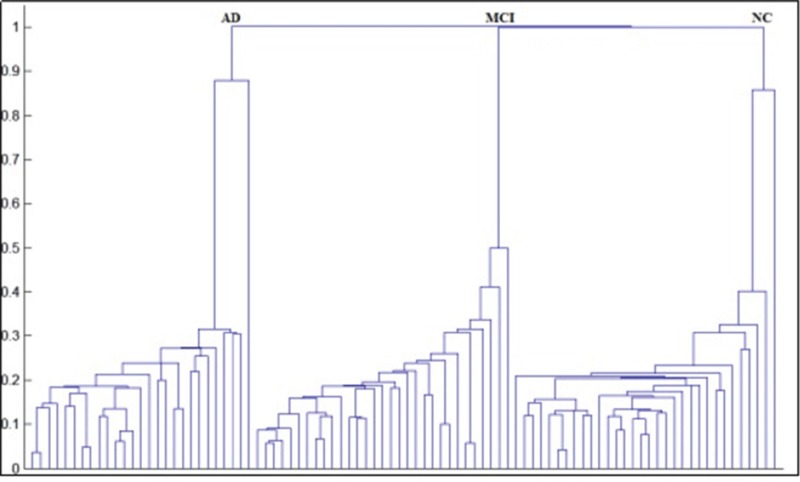
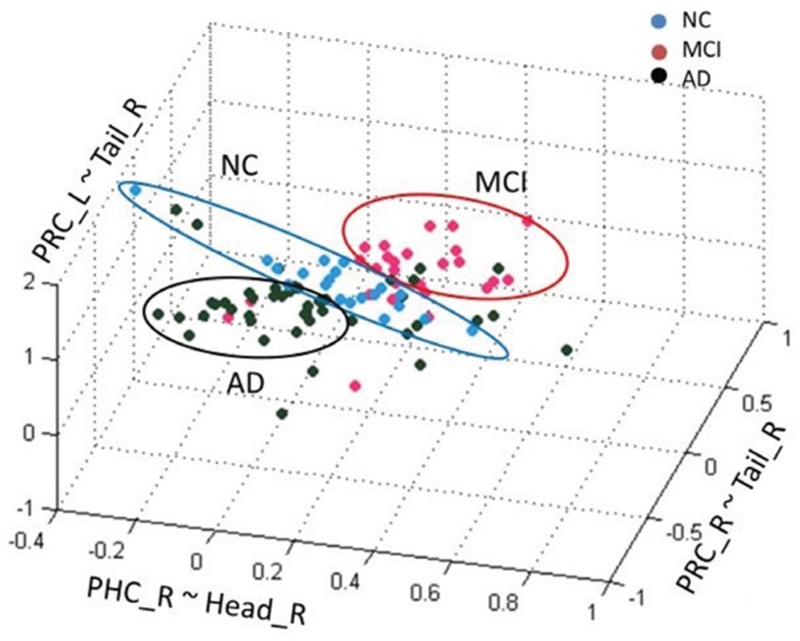
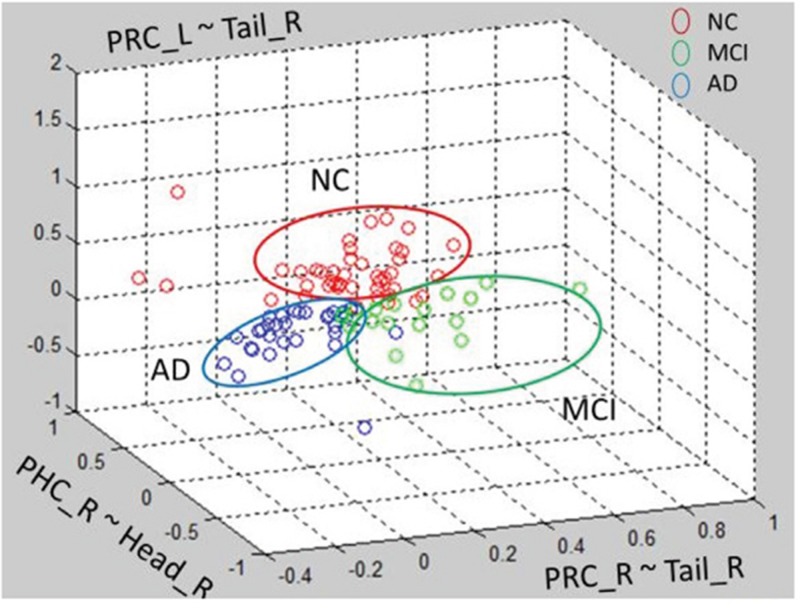
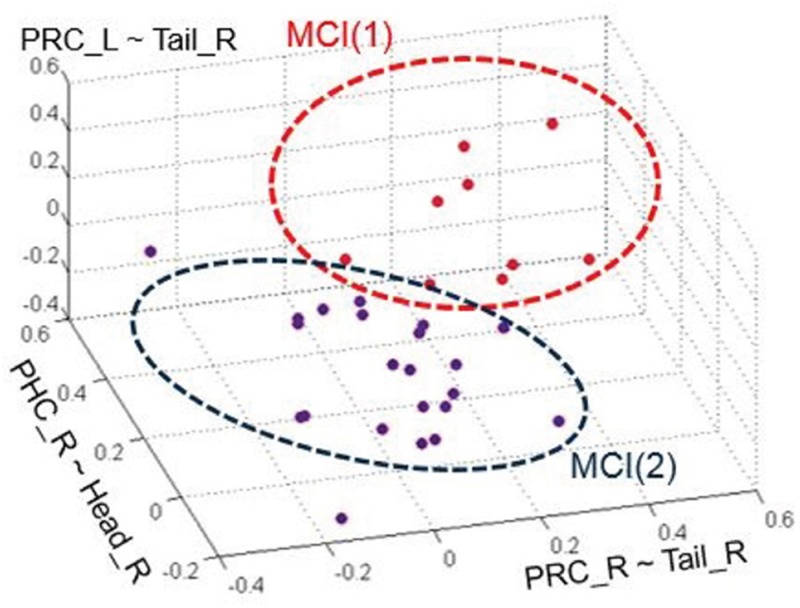
Most patients with mild cognitive impairment and Alzheimer's disease can initially present memory loss. The medial temporal lobes are the brain regions most associated with declarative memory function. As sub-components of the MTL, the perirhinal cortex, parahippocampal cortex and hippocampus have also been identified as playing important roles in memory. The functional connectivity between hippocampus subfields and perirhnial cortices as well as parahippocampal cortices among normal cognition controls (NC group, n=33), mild cognitive impairment (MCI group, n=31) and Alzheimer's disease (AD group, n=27) was investigated in this study. The result shows significant differences of functional connectivity in 3 pairs of regions among NC group, MCI group and AD group: right perirhinal cortex with right hippocampus tail, left perirhinal cortex with right hippocampus tail, and right parahippocampal cortex with right hippocampus head. Clustering methods were used to classify NC group, MCI group and AD group (accuracy=100%) as well as different subtypes of mild cognitive impairment patients based on functional alterations. Functional connectivity disrupted between perirhinal and parahippocampal cortex with hippocampal subfields, which may provide a better understanding of the neurodegenerative progress of MCI and AD.
Keywords: AD; MCI; functional connectivity; parahippocampal cortex; perirhinal cortex.
Conflict of interest statement
CONFLICTS OF INTEREST I would like to declare on behalf of my co-authors that the work described was original research that has not been published previously, and not under consideration for publication elsewhere, in whole or in part. All the authors listed have approved the manuscript that is enclosed. I would also verify on behalf of my co-authors that NO organization may stand to gain financially now or in the future by the study. NO actual or potential conflicts of interest including any financial, personal or other relationships with other people or organizations within three years of beginning the work submitted that could inappropriately influence (bias) their work. All patients in our study provided written informed consent and the study was conducted according to the provisions of the Helsinki declaration.
Figures
References
-
- Burns A, Iliffe S, Maurer K. Alzheimer's disease. BMJ. 2009;338:b158. - PubMed
-
- Grundman M, Petersen RC, Ferris SH, Thomas RG, Aisen PS, Bennett DA, Foster NL, Jack CR, Jr, Galasko DR, Doody R, Kaye J, Sano M, Mohs R, et al. Alzheimer's Disease Cooperative Study Mild cognitive impairment can be distinguished from Alzheimer disease and normal aging for clinical trials. Arch Neurol. 2004;61:59–66. - PubMed
-
- Winblad B, Palmer K, Kivipelto M, Jelic V, Fratiglioni L, Wahlund LO, Nordberg A, Bäckman L, Albert M, Almkvist O, Arai H, Basun H, Blennow K, et al. Mild cognitive impairment—beyond controversies, towards a consensus: report of the International Working Group on Mild Cognitive Impairment. J Intern Med. 2004;256:240–46. - PubMed
-
- Petersen RC, Doody R, Kurz A, Mohs RC, Morris JC, Rabins PV, Ritchie K, Rossor M, Thal L, Winblad B. Current concepts in mild cognitive impairment. Arch Neurol. 2001;58:1985–92. - PubMed
LinkOut - more resources
Full Text Sources
Other Literature Sources
Research Materials