


Adenocarcinoma risk in gastric atrophy and intestinal metaplasia: a systematic review
- PMID: 29228909
- PMCID: PMC5725642
- DOI: 10.1186/s12876-017-0708-4
Adenocarcinoma risk in gastric atrophy and intestinal metaplasia: a systematic review
Abstract
Background: Gastric cancer (GC) has a poor prognosis with wide variation in survival rates across the world. Several studies have shown premalignant lesions gastric atrophy (GA) and intestinal metaplasia (IM) influence gastric cancer risk. This systematic review examines all available evidence of the risk of GC in patients with GA or IM and explores the geographical variation between countries.
Methods: EMBASE, MEDLINE, Web of Science and the Cochrane Library were searched for relevant articles published to June 2016 investigating the risk of GC in individuals with GA or IM. Analysis was performed to determine variation based on geographical location. Study quality was assessed using the Newcastle-Ottawa Scale and heterogeneity between studies was also evaluated.
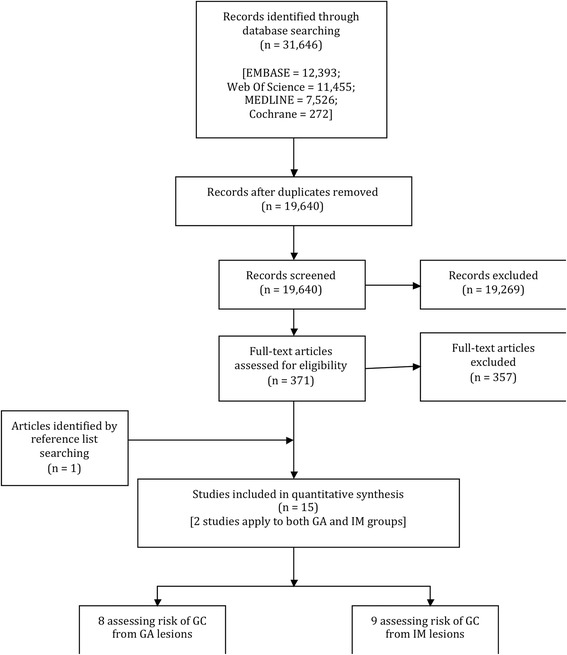
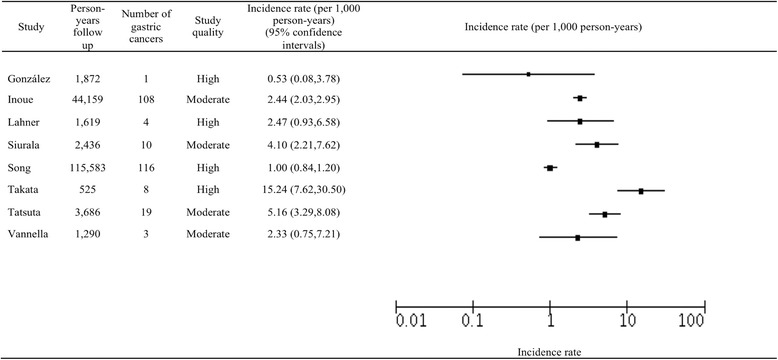
Results: Fifteen relevant articles were identified, in which there were eight studies of GC incidence in GA and nine in IM cohorts (two articles investigated both GA and IM). The incidence rate of GC in patients with GA ranged from 0.53 to 15.24 per 1000 person years, whereas there was more variation in GC incidence in patients with IM (0.38 to 17.08 per 1000 person years). The greatest GC incidence rates were in Asian countries, for patients with GA, and the USA for those with IM (15.24 and 17.08 per 1000 person years, respectively). The largest studies (four over 25,000 person years) had an incidence rate range of 1.0-2.5 per 1000 person years, however, in general, study quality was poor and there was marked heterogeneity.
Conclusion: Overall there is a wide variation in annual incidence rate of GC from premalignant lesions. With the recent introduction of surveillance guidelines for gastric atrophy and intestinal metaplasia in the Western world, future assessment of this risk should be performed. Furthermore, substantial heterogeneity supports the need for more robust studies in order to pool results and determine the overall incidence rate of gastric cancer for patients with these premalignant lesions.
Keywords: Gastric atrophy; Gastric cancer; Intestinal metaplasia; Premalignant; Progression.
Conflict of interest statement
Authors’ information
AS, CC, UMcM, BH, LM and HC are based in the Cancer Epidemiology and Health Services Research Group, Centre for Public Health, Queen’s University Belfast, Belfast, Northern Ireland, United Kingdom. BJ is based at the Belfast Health and Social Care Trust, Belfast, Northern Ireland, United Kingdom.
Ethics approval and consent to participate
Not applicable.
Consent for publication
Not applicable.
Competing interests
The authors declare that they have no competing interests.
Publisher’s Note
Springer Nature remains neutral with regard to jurisdictional claims in published maps and institutional affiliations.
Figures

References
-
- World Health Organisation. GLOBOCAN 2012: Estimated Cancer Incidence, Mortality and Prevalence Worldwide; 2012 n.d. http://globocan.iarc.fr/Pages/fact_sheets_cancer.aspx (accessed June 20, 2016).
-
- Correa P. Human gastric carcinogenesis: a multistep and multifactorial process--first American Cancer Society award lecture on cancer epidemiology and prevention. Cancer Res. 1992;52:6735–6740. - PubMed
Publication types
MeSH terms
Grants and funding
LinkOut - more resources
Full Text Sources
Other Literature Sources
Medical
Miscellaneous
