Review
. 2018 Oct:33:161-175.
doi: 10.1016/j.dcn.2017.12.002. Epub 2017 Dec 7.

Diffusion MRI of white matter microstructure development in childhood and adolescence: Methods, challenges and progress

Affiliations
Review

Diffusion MRI of white matter microstructure development in childhood and adolescence: Methods, challenges and progress

Christian K Tamnes et al. Dev Cogn Neurosci. 2018 Oct.

Abstract

Diffusion magnetic resonance imaging (dMRI) continues to grow in popularity as a useful neuroimaging method to study brain development, and longitudinal studies that track the same individuals over time are emerging. Over the last decade, seminal work using dMRI has provided new insights into the development of brain white matter (WM) microstructure, connections and networks throughout childhood and adolescence. This review provides an introduction to dMRI, both diffusion tensor imaging (DTI) and other dMRI models, as well as common acquisition and analysis approaches. We highlight the difficulties associated with ascribing these imaging measurements and their changes over time to specific underlying cellular and molecular events. We also discuss selected methodological challenges that are of particular relevance for studies of development, including critical choices related to image acquisition, image analysis, quality control assessment, and the within-subject and longitudinal reliability of dMRI measurements. Next, we review the exciting progress in the characterization and understanding of brain development that has resulted from dMRI studies in childhood and adolescence, including brief overviews and discussions of studies focusing on sex and individual differences. Finally, we outline future directions that will be beneficial to the field.

Keywords: Brain development; DTI; Longitudinal; Maturation; Neuroimaging; White matter.


Figures

Fig. 1
Fig. 1
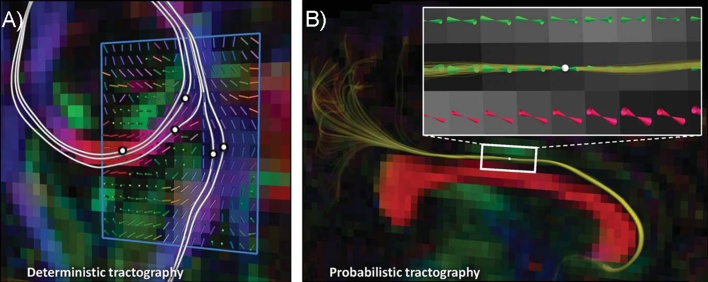
Conceptual examples of deterministic and probabilistic tractography based on the diffusion tensor model. A) Example of deterministic tractography where the white lines represent fiber tract pathways that were reconstructed by following the principal diffusion directions in consecutive steps, initiated bidirectionally at the indicated locations (seed points). For each of the pathways, there is no information available about the precision/dispersion that is associated with their tract propagation. B) Example of probabilistic tractography where the set of multiple lines provides a feel for the degree of uncertainty related to the tract reconstruction initiated from the single seed point. Adapted with permission from Tournier et al. (2011).
Fig. 2
Fig. 2
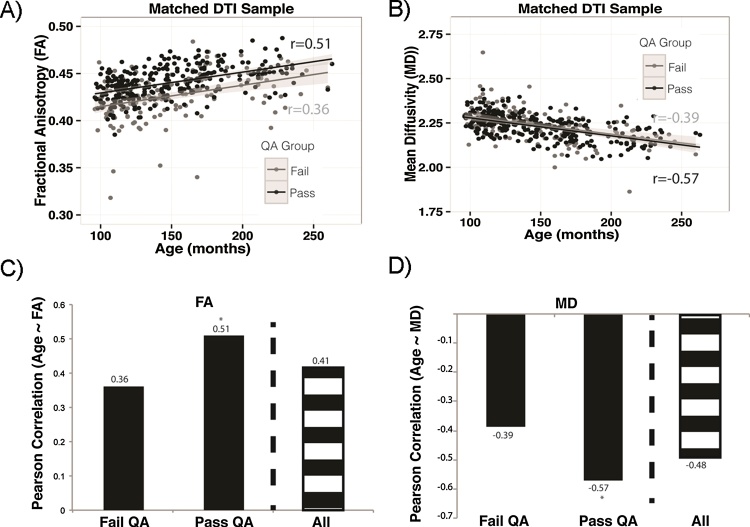
Age-related differences in diffusion tensor imaging (DTI) metrics in individuals aged 8–21 years in data that fails or passes quality assessment (QA). A) Data that failed QA had a significantly lower correlation between age and FA than data that passed QA. B) Data that failed QA also had a significantly lower correlation between age and MD than data that passed QA. C) & D). Summary plots of the correlations between age and DTI metrics in data failing QA, passing QA and all data combined. Adapted with permission from Roalf et al. (2016).
Fig. 3
Fig. 3
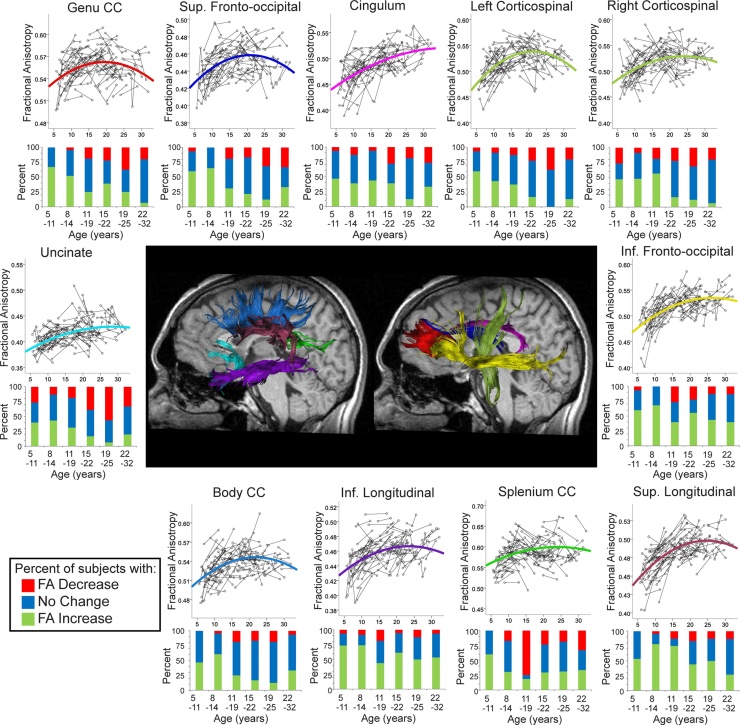
Longitudinal age-related changes of fractional anisotropy (FA) in healthy individuals aged 5–32 years. Spaghetti plots with the best fitting models and bar graphs depicting the percentage of subjects whose FA increased (green), decreased (red), or did not change (blue) in six age groupings are shown for different WM fibers, derived using a deterministic tractography method. Adapted with permission from Lebel and Beaulieu (2011). (For interpretation of the references to colour in this figure legend, the reader is referred to the web version of this article.)
Fig. 4
Fig. 4
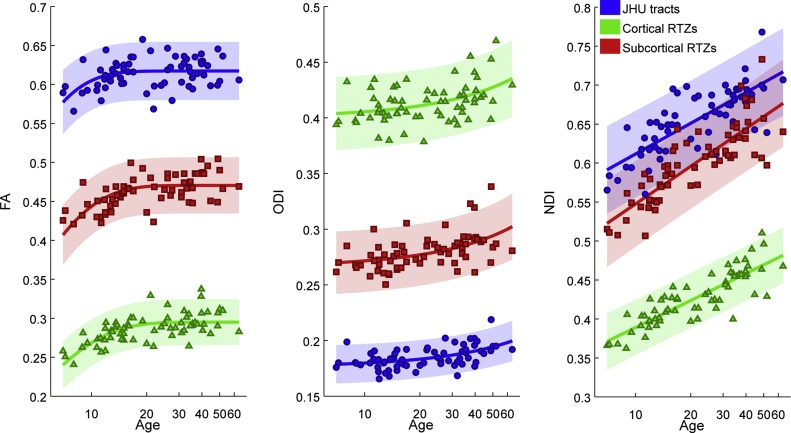
Age-related differences in average fractional anisotropy (FA), orientation dispersion index (ODI), and neurite density index (NDI) in the age-range 7–63 years across the WM skeleton in atlas defined tracts (JHU) (blue), cortical regional termination zones (RTZs) (green), and subcortical regional termination zones (RTZs) (red). Shaded regions represent 95% confidence intervals. Adapted with permission from Chang et al. (2015). (For interpretation of the references to colour in this figure legend, the reader is referred to the web version of this article.)

References

    1. Aarnink S.H., Vos S.B., Leemans A., Jernigan T.L., Madsen K.S., Baare W.F. Automated longitudinal intra-subject analysis (ALISA) for diffusion MRI tractography. Neuroimage. 2014;86:404–416. - PubMed
    1. Achterberg M., Peper J.S., van Duijvenvoorde A.C., Mandl R.C., Crone E.A. Frontostriatal white matter integrity predicts development of delay of gratification: a longitudinal study. J. Neurosci. 2016;36:1954–1961. - PMC - PubMed
    1. Aksoy M., Forman C., Straka M., Skare S., Holdsworth S., Hornegger J., Bammer R. Real-time optical motion correction for diffusion tensor imaging. Magn. Reson. Med. 2011;66:366–378. - PMC - PubMed
    1. Albaugh M.D., Ducharme S., Karama S., Watts R., Lewis J.D., Orr C., Brain Development Cooperative Group Anxious/depressed symptoms are related to microstructural maturation of white matter in typically developing youths. Dev. Psychopathol. 2016:1–8. - PubMed
    1. Alexander A.L., Hasan K.M., Lazar M., Tsuruda J.S., Parker D.L. Analysis of partial volume effects in diffusion-tensor MRI. Magn. Reson. Med. 2001;45:770–780. - PubMed

MeSH terms

LinkOut - more resources