


WHO Parents Skills Training (PST) programme for children with developmental disorders and delays delivered by Family Volunteers in rural Pakistan: study protocol for effectiveness implementation hybrid cluster randomized controlled trial
- PMID: 29230307
- PMCID: PMC5719472
- DOI: 10.1017/gmh.2017.7
WHO Parents Skills Training (PST) programme for children with developmental disorders and delays delivered by Family Volunteers in rural Pakistan: study protocol for effectiveness implementation hybrid cluster randomized controlled trial
Abstract
Background: Development disorders and delays are recognised as a public health priority and included in the WHO mental health gap action programme (mhGAP). Parents Skills Training (PST) is recommended as a key intervention for such conditions under the WHO mhGAP intervention guide. However, sustainable and scalable delivery of such evidence based interventions remains a challenge. This study aims to evaluate the effectiveness and scaled-up implementation of locally adapted WHO PST programme delivered by family volunteers in rural Pakistan.
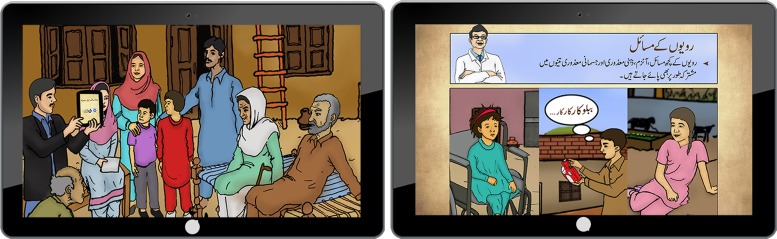
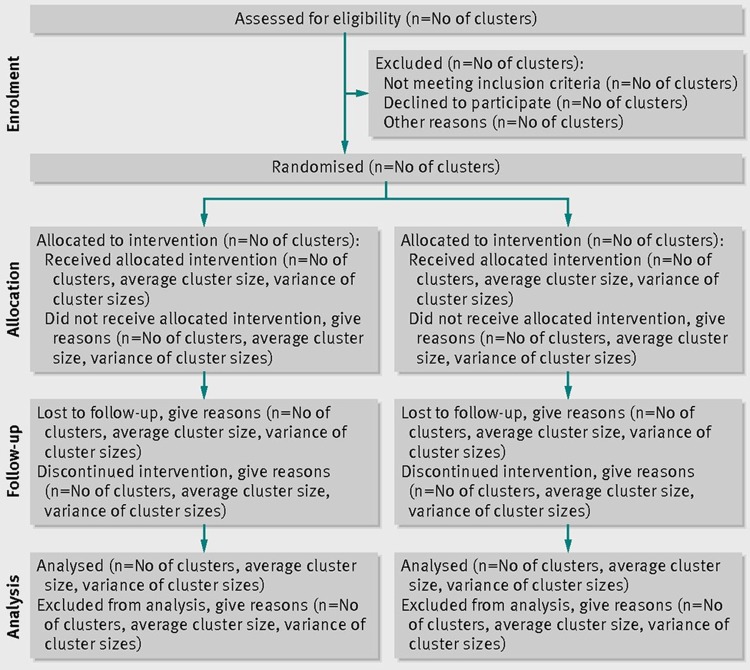
Methods: The study is a two arm single-blind effectiveness implementation-hybrid cluster randomised controlled trial. WHO PST programme will be delivered by 'family volunteers' to the caregivers of children with developmental disorders and delays in community-based settings. The intervention consists of the WHO PST along with the WHO mhGAP intervention for developmental disorders adapted for delivery using the android application on a tablet device. A total of 540 parent-child dyads will be recruited from 30 clusters. The primary outcome is child's functioning, measured by WHO Disability Assessment Schedule - child version (WHODAS-Child) at 6 months post intervention. Secondary outcomes include children's social communication and joint engagement with their caregiver, social emotional well-being, parental health related quality of life, family empowerment and stigmatizing experiences. Mixed method will be used to collect data on implementation outcomes. Trial has been retrospectively registered at ClinicalTrials.gov (NCT02792894).
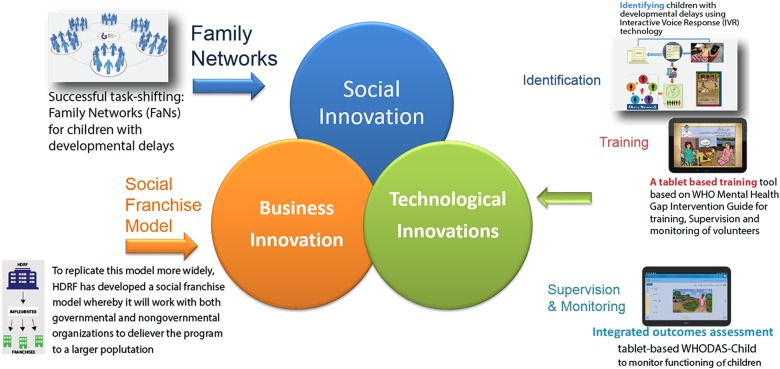
Discussion: This study addresses implementation challenges in the real world by incorporating evidence-based intervention strategies with social, technological and business innovations. If proven effective, the study will contribute to scaled-up implementation of evidence-based packages for public mental health in low resource settings.
Trial registration: Registered with ClinicalTrials.gov as Family Networks (FaNs) for Children with Developmental Disorders and Delays. Identifier: NCT02792894 Registered on 6 July 2016.
Keywords: Autism spectrum disorders; child mental health; developmental disorders; family volunteers; global mental health; implementation effectiveness hybrid trial; intellectual disability; low income settings; mental health gap; parent skills training; technology assisted training and supervision.
Figures
References
-
- Baggett KM, Carta JJ, Horn EM (2009). Indicator of Parent-Child Interaction (IPCI) User's Manual. Department of Special Education, University of Kansas, University of Kansas, USA.
-
- Chisholm D, Knapp MR, Knudsen HC, Amaddeo F, Gaite L, Van Wijngaarden B (2000). Client socio-demographic and service receipt inventory-European version: development of an instrument for international research EPSILON Study 5. British Journal of Psychiatry 177, s28–s33. - PubMed
-
- Dua T, Barbui C, Clark N, Fleischmann A, Poznyak V, Van Ommeren M, Yasamy MT, Ayuso-Mateos JL, Birbeck GL, Drummond C (2011). Evidence-based guidelines for mental, neurological, and substance use disorders in low-and middle-income countries: summary of WHO recommendations. PLoS Medicine 8, e1001122. - PMC - PubMed
-
- Durkin MS, Wang W, Shrout PE, Zaman SS, Hasan Z, Desai P, Davidson L (1995). Evaluating a ten questions screen for childhood disability: reliability and internal structure in different cultures. Journal of Clinical Epidemiology 48, 657–666. - PubMed
Associated data
LinkOut - more resources
Full Text Sources
Other Literature Sources
Medical
Miscellaneous