Review
. 2017 Nov 27:7:286.
doi: 10.3389/fonc.2017.00286. eCollection 2017.

Non-Canonical Mechanisms Regulating Hypoxia-Inducible Factor 1 Alpha in Cancer

Affiliations
Review

Non-Canonical Mechanisms Regulating Hypoxia-Inducible Factor 1 Alpha in Cancer

Luisa Iommarini et al. Front Oncol. .

Abstract

Hypoxia-inducible factor 1 alpha (HIF-1α) orchestrates cellular adaptation to low oxygen and nutrient-deprived environment and drives progression to malignancy in human solid cancers. Its canonical regulation involves prolyl hydroxylases (PHDs), which in normoxia induce degradation, whereas in hypoxia allow stabilization of HIF-1α. However, in certain circumstances, HIF-1α regulation goes beyond the actual external oxygen levels and involves PHD-independent mechanisms. Here, we gather and discuss the evidence on the non-canonical HIF-1α regulation, focusing in particular on the consequences of mitochondrial respiratory complexes damage on stabilization of this pleiotropic transcription factor.

Keywords: cancer; electron transport chain; hypoxia-inducible factor 1 alpha; mitochondria; oxidative phosphorylation; prolyl hydroxylases; pseudohypoxia; pseudonormoxia.


Figures
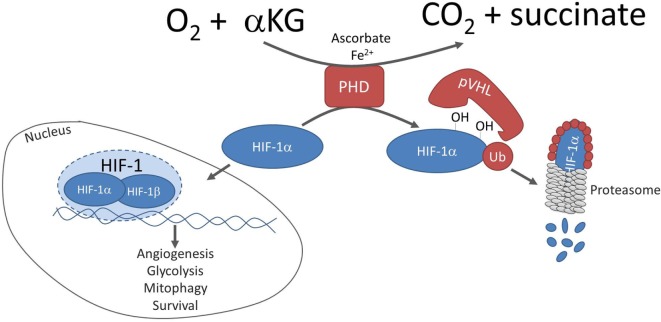
Figure 1
Figure 1
Canonical regulation of HIF-1α stability. In normoxia, prolyl hydroxylases (PHDs) hydroxylate hypoxia-inducible factor 1 alpha (HIF-1α) on two proline residues, triggering pVHL-mediated ubiquitination and proteasomal degradation of hydroxylated HIF-1α. The hydroxylation reaction is coupled to conversion of αKG to succinate and requires co-factors ascorbate and ferrous iron. In hypoxia, hydroxylation is inhibited and HIF-1α dimerizes with constitutively expressed HIF-1β, creating an active HIF-1 complex, which transcribes genes promoting angiogenesis, glycolytic metabolism, mitophagy, and survival.
Figure 2
Figure 2
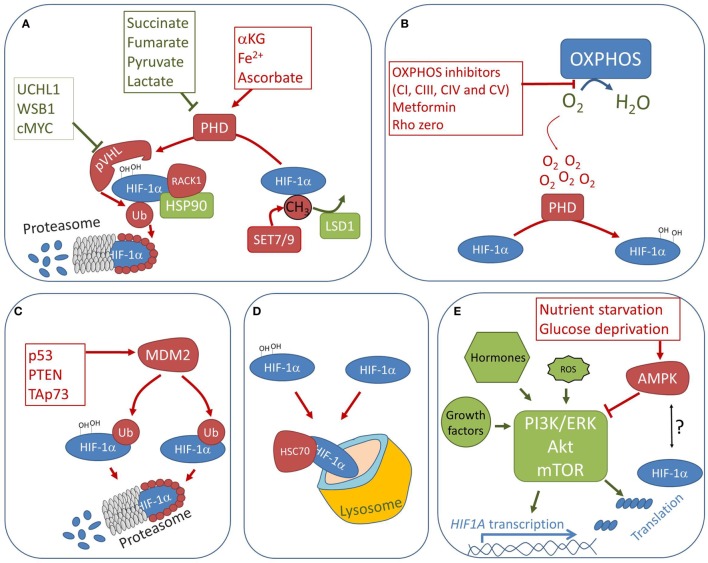
Non-canonical regulation of HIF-1α stability. Factors promoting pseudonormoxia and pseudohypoxia are indicated in red and green, respectively. (A) Prolyl hydroxylase (PHD) activity may be blocked by accumulation of Krebs cycle metabolites succinate and fumarate, whereas αKG, and co-factors ascorbate and iron, boost PHDs activity regardless of oxygen levels. Activation of any factor promoting pVHL downregulation in normoxia will also lead to pseudohypoxic stabilization of HIF-1α. Finally, posttranslational modifications, such as methylation by SET7/9, or interactions with proteins, such as receptor of activated protein C kinase (RACK1) and HSP90, may regulate PHD accessibility to HIF-1α and promote or block hydroxylation regardless of oxygen concentrations. (B) Severe damage or inhibition of oxidative phosphorylation (OXPHOS) complexes I, III, IV, or V, reduces oxygen consumption, which in turn may increase intracellular oxygen concentrations and cause pseudonormoxia. (C) MDM2 is an ubiquitine ligase, which promotes HIF-1α degradation in hypoxic environment when associated with tumor suppressor proteins. (D) Proteasome-independent HIF-1α degradation via chaperone-mediated autophagy is mediated by HSC70. (E) PI3K/Akt/mTOR axis is the major pathway involved in promoting HIF1A transcription and translation, regardless of oxygen concentrations and upon numerous protumorigenic stimuli. For example, elevated reactive oxygen species concentrations were shown to promote HIF1A transcription and translation via Akt signaling. On the other hand, conditions counteracting mTOR pathway, such as nutrient starvation, and possibly adenosine monophosphate kinase (AMPK) activation, may lead to HIF-1α downregulation.

References

    1. Dengler VL, Galbraith M, Espinosa JM. Transcriptional regulation by hypoxia inducible factors. Crit Rev Biochem Mol Biol (2014) 49:1–15.10.3109/10409238.2013.838205 - DOI - PMC - PubMed
    1. Semenza GL. Hydroxylation of HIF-1: oxygen sensing at the molecular level. Physiology (Bethesda) (2004) 19:176–82.10.1152/physiol.00001.2004 - DOI - PubMed
    1. Mahon PC, Hirota K, Semenza GL. FIH-1: a novel protein that interacts with HIF-1alpha and VHL to mediate repression of HIF-1 transcriptional activity. Genes Dev (2001) 15:2675–86.10.1101/gad.924501 - DOI - PMC - PubMed
    1. Lando D, Peet DJ, Whelan DA, Gorman JJ, Whitelaw ML. Asparagine hydroxylation of the HIF transactivation domain a hypoxic switch. Science (2002) 295:858–61.10.1126/science.1068592 - DOI - PubMed
    1. Ruas JL, Poellinger L. Hypoxia-dependent activation of HIF into a transcriptional regulator. Semin Cell Dev Biol (2005) 16:514–22.10.1016/j.semcdb.2005.04.001 - DOI - PubMed