


A child with Myhre syndrome presenting with corectopia and tetralogy of Fallot
- PMID: 29230941
- PMCID: PMC5814867
- DOI: 10.1002/ajmg.a.38560
A child with Myhre syndrome presenting with corectopia and tetralogy of Fallot
Abstract
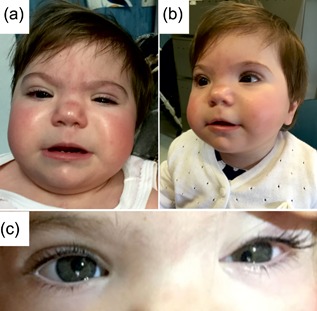
Myhre syndrome is a rare autosomal dominant disorder caused by a narrow spectrum of missense mutations in the SMAD4 gene. Typical features of this disorder are distinctive facial appearance, deafness, intellectual disability, cardiovascular abnormalities, short stature, short hands and feet, compact build, joint stiffness, and skeletal anomalies. The clinical features generally appear during childhood and become more evident in older patients. Therefore, the diagnosis of this syndrome in the first years of life is challenging. We report a 2-year-old girl diagnosed with Myhre syndrome by whole exome sequencing (WES) that revealed the recurrent p.Ile500Val mutation in the SMAD4 gene. Our patient presented with growth deficiency, dysmorphic features, tetralogy of Fallot, and corectopia (also known as ectopia pupillae). The girl we described is the youngest patient with Myhre syndrome. Moreover, corectopia and tetralogy of Fallot have not been previously reported in this disorder.
Keywords: Myhre syndrome; WES; corectopia; tetralogy of Fallot.
© 2017 The Authors. American Journal of Medical Genetics Part A Published by Wiley Periodicals Inc.
Figures
References
-
- Caputo, V. , Bocchinfuso, G. , Castori, M. , Traversa, A. , Pizzuti, A. , Stella, L. , … Tartaglia, M. (2014). Novel SMAD4 mutation causing Myhre syndrome. American Journal Medical Genetics Part A, 164A, 1835–1840. - PubMed
-
- Chandra, A. , Aragon‐Martin, J. A. , Hughes, K. , Gati, S. , Reddy, M. A. , Deshpande, C. , … Arno, G. (2012). A genotype‐phenotype comparison of ADAMTSL4 and FBN1 in isolated ectopia lentis. Investigative Ophthalmology and Visual Science, 53, 4889–4896. - PubMed
Publication types
MeSH terms
Substances
Supplementary concepts
LinkOut - more resources
Full Text Sources
Other Literature Sources
Medical
Miscellaneous
