


Non-invasive vagus nerve stimulation for the acute treatment of episodic and chronic cluster headache: A randomized, double-blind, sham-controlled ACT2 study
- PMID: 29231763
- PMCID: PMC5896689
- DOI: 10.1177/0333102417744362
Non-invasive vagus nerve stimulation for the acute treatment of episodic and chronic cluster headache: A randomized, double-blind, sham-controlled ACT2 study
Abstract
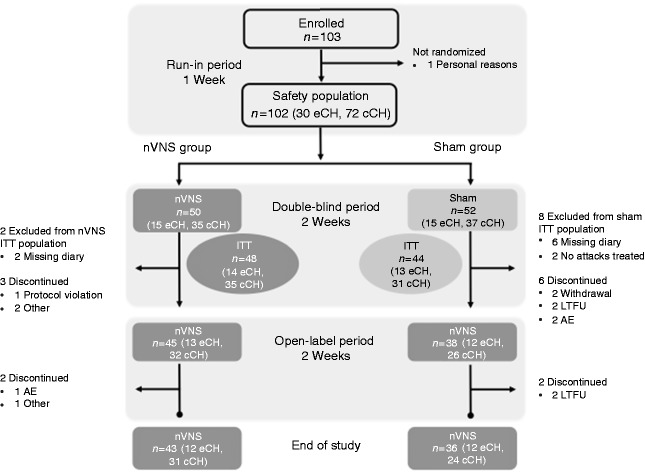
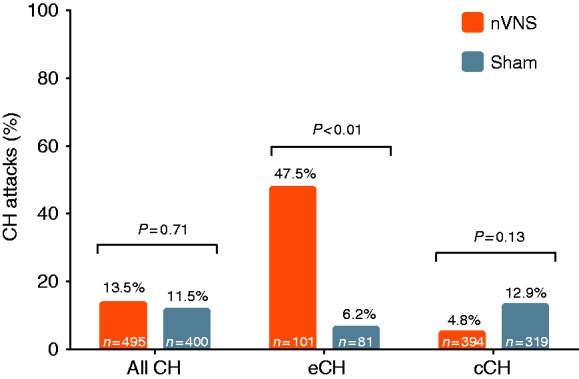
Background Clinical observations and results from recent studies support the use of non-invasive vagus nerve stimulation (nVNS) for treating cluster headache (CH) attacks. This study compared nVNS with a sham device for acute treatment in patients with episodic or chronic CH (eCH, cCH). Methods After completing a 1-week run-in period, subjects were randomly assigned (1:1) to receive nVNS or sham therapy during a 2-week double-blind period. The primary efficacy endpoint was the proportion of all treated attacks that achieved pain-free status within 15 minutes after treatment initiation, without rescue treatment. Results The Full Analysis Set comprised 48 nVNS-treated (14 eCH, 34 cCH) and 44 sham-treated (13 eCH, 31 cCH) subjects. For the primary endpoint, nVNS (14%) and sham (12%) treatments were not significantly different for the total cohort. In the eCH subgroup, nVNS (48%) was superior to sham (6%; p < 0.01). No significant differences between nVNS (5%) and sham (13%) were seen in the cCH subgroup. Conclusions Combing both eCH and cCH patients, nVNS was no different to sham. For the treatment of CH attacks, nVNS was superior to sham therapy in eCH but not in cCH. These results confirm and extend previous findings regarding the efficacy, safety, and tolerability of nVNS for the acute treatment of eCH.
Keywords: Episodic cluster headache; acute treatment; chronic cluster headache; neuromodulation; non-invasive vagus nerve stimulation; randomized controlled trial.
Figures
References
-
- Nesbitt AD, Goadsby PJ. Cluster Headache. Brit Med J 2012; 344: e2407–e2407. - PubMed
-
- Headache Classification Committee of the International Headache Society. The International Classification of Headache Disorders, 3rd edition (beta version). Cephalalgia 2013; 33: 629–808. - PubMed
-
- D’Amico D, Rigamonti A, Solari A, et al. Health-related quality of life in patients with cluster headache during active periods. Cephalalgia 2002; 22: 818–821. - PubMed
-
- The Sumatriptan Cluster Headache Study Group Treatment of acute cluster headache with sumatriptan. New Eng J Med 1991; 325: 322–326. - PubMed
-
- Cittadini E, May A, Straube A, et al. Effectiveness of intranasal zolmitriptan in acute cluster headache. A randomized, placebo-controlled, double-blind crossover study. Arch Neurol 2006; 63: 1537–1542. - PubMed
Publication types
MeSH terms
Substances
LinkOut - more resources
Full Text Sources
Other Literature Sources
