


Self-management of type 2 diabetes in gulf cooperation council countries: A systematic review
- PMID: 29232697
- PMCID: PMC5726716
- DOI: 10.1371/journal.pone.0189160
Self-management of type 2 diabetes in gulf cooperation council countries: A systematic review
Abstract
Aims: This study aimed to systematically review intervention studies on self-management of type 2 diabetes in Gulf Cooperation Council (GCC) countries to determine the most effective self-management strategies for individuals with type 2 diabetes in this region.
Methods: A search strategy was developed using multiple databases: Medline and Embase (via Ovid), CINAHL (via EBSCO), and PubMed. Study and intervention characteristics, intervention structure, content, cultural adaptation, and outcomes were extracted from the included studies. To be included in the review the studies should have met the following criteria: have examined the effectiveness of at least one intervention involving a type 2 DSME programme, have involved participants over 18 years old diagnosed with type 2 diabetes, have taken place to in a GCC country, have a study design that was observational, quasi-experimental or controlled, have reported at least one individual and have a quantitative outcome. A narrative data synthesis was used to describe the studies and comment on their methodological quality.
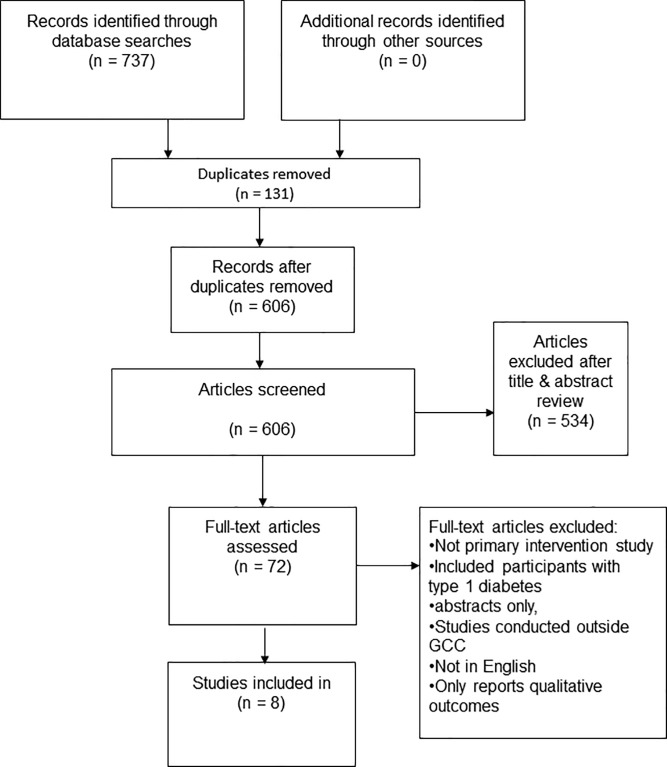
Results: Of the 737 retrieved papers, only eight met the inclusion criteria. Only one study was a randomised controlled trial. A statistically significant improvement in HbA1c was reported in five of the eight studies. There was a significant improvement in physical activity levels as reported in four of the eight studies. Only three studies referred to aspects of cultural design or adaptation of the intervention implemented.
Conclusions: Self-management interventions may have a positive impact on HbA1 levels in patients with type 2 diabetes in the GCC area. A greater emphasis placed on culturally appropriate self-management programmes may improve the effectiveness of self-management interventions for adults with type 2 diabetes in the GCC.
Conflict of interest statement
Figures
References
-
- World Health Organisation. (2016). Global Report on Diabetes. From http://apps.who.int/iris/bitstream/10665/204871/1/9789241565257_eng.pdf
-
- International Diabetes Federation. (2015). IDF Diabetes Atlas. Retrieved Seventh Edition
-
- World Health Organisation. (2015). World Diabetes Day. from http://www.who.int/diabetes/wdd_2015/en/
-
- Abuyassin B., & Laher I. (2016). Diabetes epidemic sweeping the Arab world. World Journal of Diabetes, 7(8), 165 doi: 10.4239/wjd.v7.i8.165 - DOI - PMC - PubMed
-
- Omar M. S., Khudada K., Safarini S., Mehanna S., & Nafach J. (2016). DiabCare survey of diabetes management and complications in the Gulf countries. Indian Journal of Endocrinology and Metabolism, 20(2), 219 doi: 10.4103/2230-8210.176347 - DOI - PMC - PubMed
Publication types
MeSH terms
LinkOut - more resources
Full Text Sources
Other Literature Sources
Medical
Miscellaneous
