. 2017 Dec 9;5(4):49.
doi: 10.3390/vaccines5040049.

A Burkholderia pseudomallei Outer Membrane Vesicle Vaccine Provides Cross Protection against Inhalational Glanders in Mice and Non-Human Primates

Affiliations

A Burkholderia pseudomallei Outer Membrane Vesicle Vaccine Provides Cross Protection against Inhalational Glanders in Mice and Non-Human Primates

Sarah M Baker et al. Vaccines (Basel). .

Abstract

Burkholderia mallei is a Gram-negative, non-motile, facultative intracellular bacillus and the causative agent of glanders, a highly contagious zoonotic disease. B. mallei is naturally resistant to multiple antibiotics and there is concern for its potential use as a bioweapon, making the development of a vaccine against B. mallei of critical importance. We have previously demonstrated that immunization with multivalent outer membrane vesicles (OMV) derived from B. pseudomallei provide significant protection against pneumonic melioidosis. Given that many virulence determinants are highly conserved between the two species, we sought to determine if the B. pseudomallei OMV vaccine could cross-protect against B. mallei. We immunized C57Bl/6 mice and rhesus macaques with B. pseudomallei OMVs and subsequently challenged animals with aerosolized B. mallei. Immunization with B. pseudomallei OMVs significantly protected mice against B. mallei and the protection observed was comparable to that achieved with a live attenuated vaccine. OMV immunization induced the production of B.mallei-specific serum IgG and a mixed Th1/Th17 CD4 and CD8 T cell response in mice. Additionally, immunization of rhesus macaques with B. pseudomallei OMVs provided protection against glanders and induced B.mallei-specific serum IgG in non-human primates. These results demonstrate the ability of the multivalent OMV vaccine platform to elicit cross-protection against closely-related intracellular pathogens and to induce robust humoral and cellular immune responses against shared protective antigens.

Keywords: Burkholderia mallei; bacteria; biodefense; glanders; infection; outer membrane vesicles; persistence; vaccine.


Conflict of interest statement

The authors declare no conflict of interest. The founding sponsors had no role in the design of the study; in the collection, analyses, or interpretation of data; in the writing of the manuscript, and in the decision to publish the results.

Figures
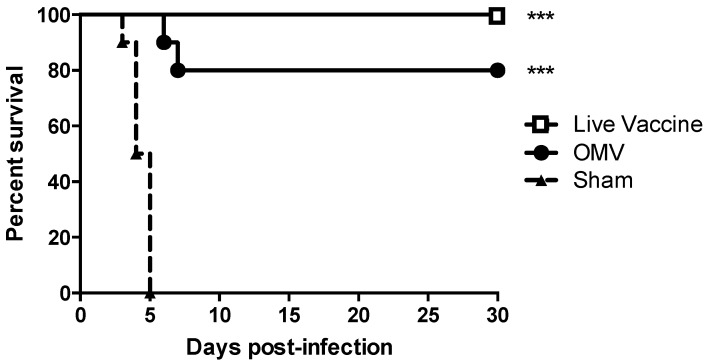
Figure 1
Figure 1
Immunization with B. pseudomallei outer membrane vesicles (OMVs) protects mice against pneumonic glanders. Mice (n = 10 per group) were challenged with 1246 cfu of B. mallei by small particle aerosol. Survival was monitored for up to 30 days. Mice immunized with OMV or live vaccine were significantly protected (*** p < 0.001 as determined by Log Rank Mantel–Cox test).
Figure 2
Figure 2
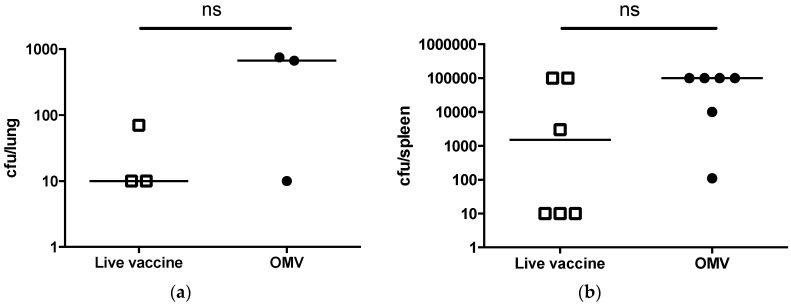
Immunized C57Bl/6 mice are persistently colonized with B. mallei. B. mallei bacterial burdens in the (a) lungs (n = 3 per group) or (b) spleen (n = 6 per group) of surviving mice immunized with OMV or live vaccine (ns = not significant; lungs, p = 0.13 and spleens, p = 0.09 by t-test).
Figure 3
Figure 3
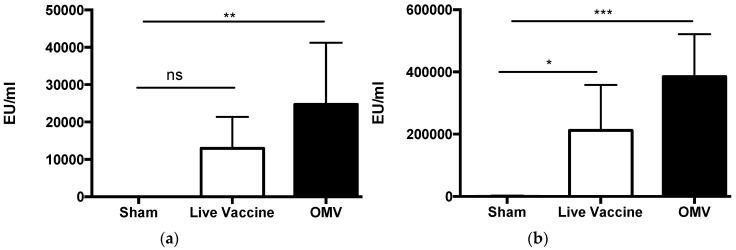
OMV immunization induces B. mallei-specific antibody in mice. (a) B. mallei-specific and (b) OMV-specific IgG was measured in the sera of mice (n = 5 per group) immunized with sham, live Bp82, or Bp82 OMVs by ELISA (* p < 0.05 ** p < 0.01 *** p < 0.001 by one way ANOVA, ns = not significant).
Figure 4
Figure 4
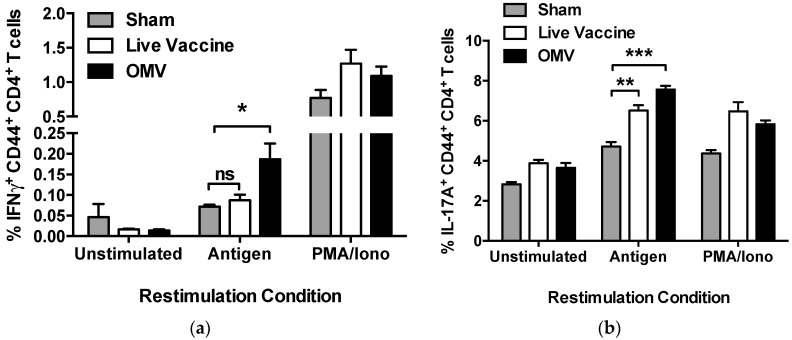
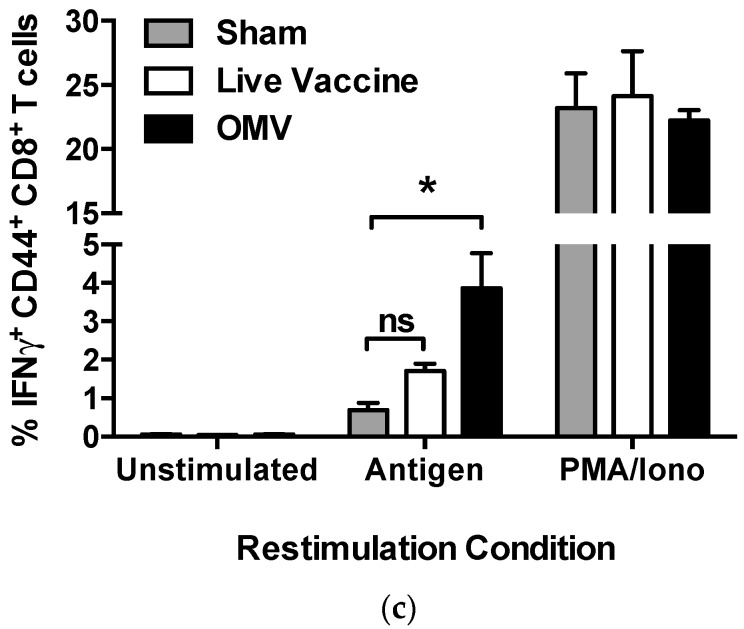
OMV immunization induces antigen-specific mixed Th1/Th17 CD4 T cells and CD8 T cells in mice. Antigen-specific CD4 and CD8 T cell responses were measured in the spleens of mice (n = 3 per group) immunized with sham, live vaccine, or OMV by flow cytometry (* p < 0.05 ** p < 0.01 *** p < 0.001 by one way ANOVA, ns = not significant). Cells were gated using granularity to include lymphocytes, then size to include only single cells. Cells were assessed for viability, then expression of CD3 and exclusion of B220, CD11b, CD11c, CD19, F4/80, and NK1.1 on the surface. The CD3+ T cell population was then gated to include CD4+ or CD8+ T cells. CD4+ were then gated to include those antigen-experienced (CD44+) cells producing the cytokines (a) IFN-γ or (b) IL-17A and (c) CD8+ were then gated to include those antigen-experienced (CD44+) cells producing the cytokine IFN-γ.
Figure 4
Figure 4
OMV immunization induces antigen-specific mixed Th1/Th17 CD4 T cells and CD8 T cells in mice. Antigen-specific CD4 and CD8 T cell responses were measured in the spleens of mice (n = 3 per group) immunized with sham, live vaccine, or OMV by flow cytometry (* p < 0.05 ** p < 0.01 *** p < 0.001 by one way ANOVA, ns = not significant). Cells were gated using granularity to include lymphocytes, then size to include only single cells. Cells were assessed for viability, then expression of CD3 and exclusion of B220, CD11b, CD11c, CD19, F4/80, and NK1.1 on the surface. The CD3+ T cell population was then gated to include CD4+ or CD8+ T cells. CD4+ were then gated to include those antigen-experienced (CD44+) cells producing the cytokines (a) IFN-γ or (b) IL-17A and (c) CD8+ were then gated to include those antigen-experienced (CD44+) cells producing the cytokine IFN-γ.
Figure 5
Figure 5
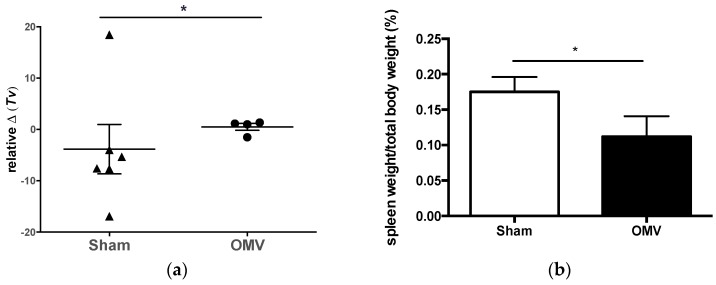
Immunization with B. pseudomallei OMVs provides protection against glanders disease in nonhuman primates. Pulmonary function of rhesus macaques vaccinated with OMV or saline (sham-vaccinated). (a) Relative change (Δ) in tidal volume (mL/breath) prior to challenge when compared to measurement +7 days after B. mallei aerosol challenge. Group comparison by Kolmogorov-Smirnov test, significance at * p < 0.05; (b) Spleen weight over total body weight was calculated as a percentage to quantify degree of splenomegaly (* p < 0.05).
Figure 6
Figure 6
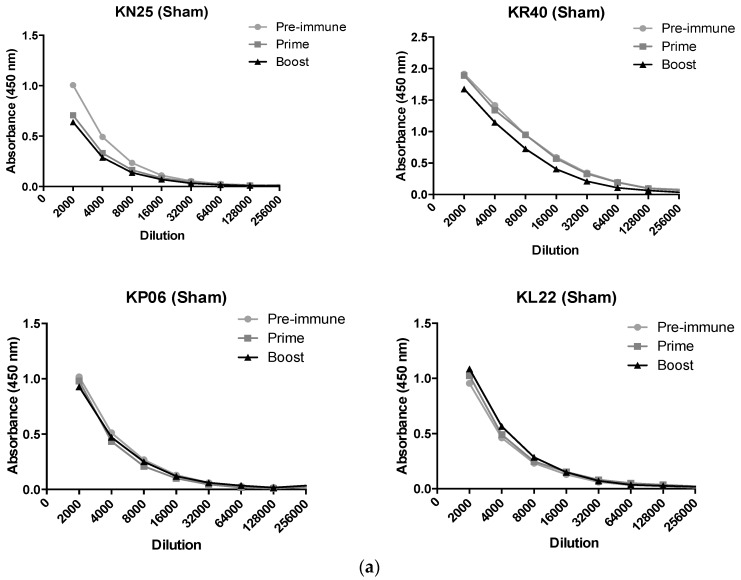
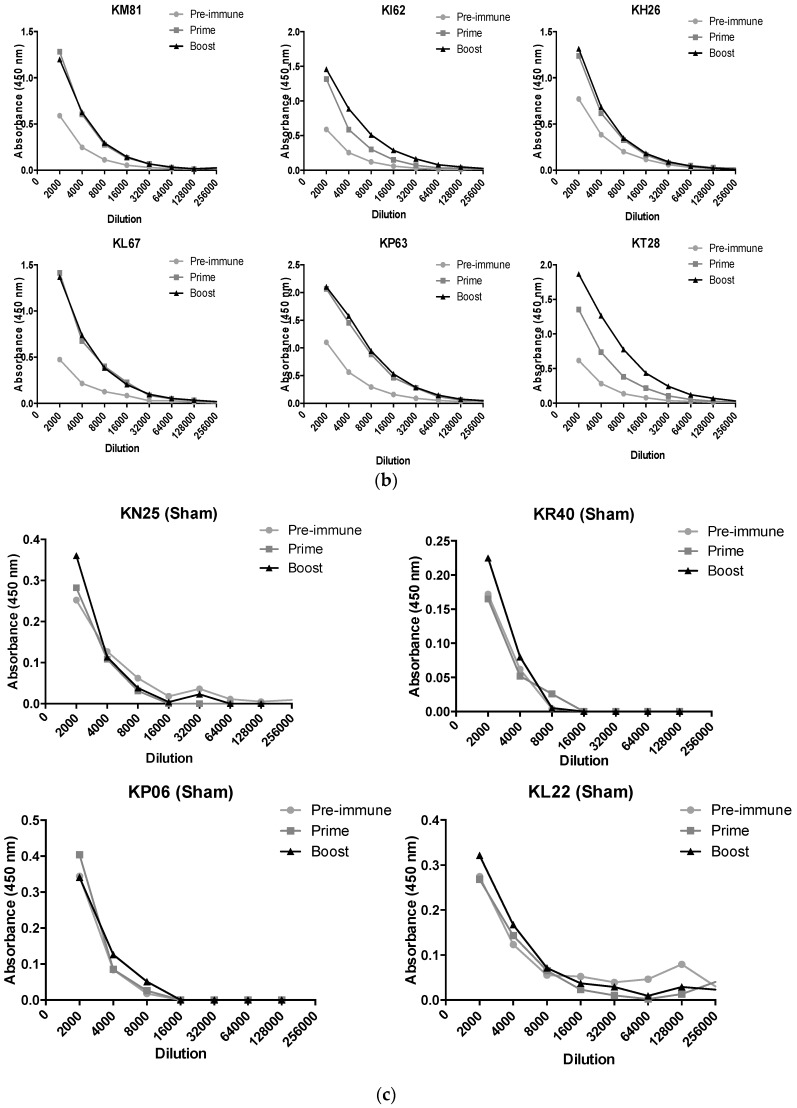
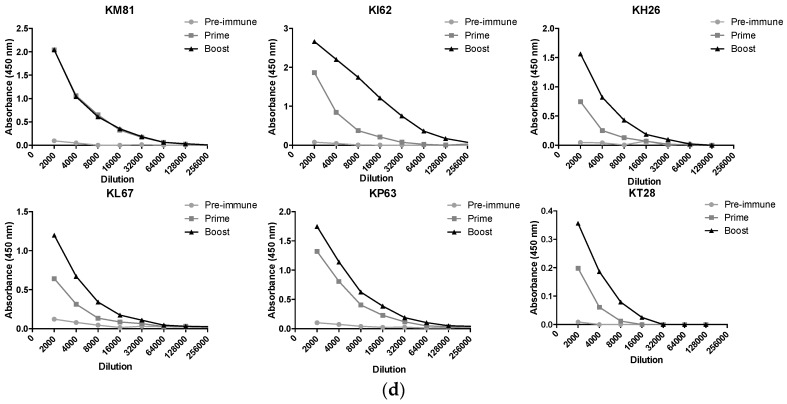
OMV immunization induces B. mallei-specific antibody responses in nonhuman primates. (a) B. mallei-specific and (c) OMV-specific IgG were measured in the sera of sham-immunized and (b,d) OMV-immunized rhesus macaques by ELISA prior to immunization (pre-immune), one month after the first dose (prime), and two weeks after the second dose (boost). Reciprocal titers are plotted against absorbance for each individual macaque.
Figure 6
Figure 6
OMV immunization induces B. mallei-specific antibody responses in nonhuman primates. (a) B. mallei-specific and (c) OMV-specific IgG were measured in the sera of sham-immunized and (b,d) OMV-immunized rhesus macaques by ELISA prior to immunization (pre-immune), one month after the first dose (prime), and two weeks after the second dose (boost). Reciprocal titers are plotted against absorbance for each individual macaque.
Figure 6
Figure 6
OMV immunization induces B. mallei-specific antibody responses in nonhuman primates. (a) B. mallei-specific and (c) OMV-specific IgG were measured in the sera of sham-immunized and (b,d) OMV-immunized rhesus macaques by ELISA prior to immunization (pre-immune), one month after the first dose (prime), and two weeks after the second dose (boost). Reciprocal titers are plotted against absorbance for each individual macaque.

References

    1. Struck Preliminary report of the studies of the imperial institute which led to the discovery of the bacillus of Glanders. Deutsch. Med. Wochenschr. 1882;8:707–708.
    1. Dvorak G.D., Spickler A.R. Glanders. J. Am. Vet. Med. Assoc. 2008;233:570–577. doi: 10.2460/javma.233.4.570. - DOI - PubMed
    1. Van Zandt K.E., Greer M.T., Gelhaus H. Glanders: An overview of infection in humans. Orphanet J. Rare Dis. 2013;8:131. doi: 10.1186/1750-1172-8-131. - DOI - PMC - PubMed
    1. Lipsitz R., Garges S., Aurigemma R., Baccam P., Blaney D.D., Cheng A.C., Currie B.J., Dance D., Gee J.E., Larsen J., et al. Workshop on treatment of and postexposure prophylaxis for Burkholderia pseudomallei and B. mallei Infection, 2010. Emerg. Infect. Dis. 2012;18 doi: 10.3201/eid1812.120638. - DOI - PMC - PubMed
    1. Moore R.A., Reckseidler-Zenteno S., Kim H., Nierman W., Yu Y., Tuanyok A., Warawa J., DeShazer D., Woods D.E. Contribution of gene loss to the pathogenic evolution of Burkholderia pseudomallei and Burkholderia mallei. Infect. Immun. 2004;72:4172–4187. doi: 10.1128/IAI.72.7.4172-4187.2004. - DOI - PMC - PubMed