. 2017 Dec 11;18(12):2651.
doi: 10.3390/ijms18122651.

Synergistic Effects of Bacillus amyloliquefaciens (GB03) and Water Retaining Agent on Drought Tolerance of Perennial Ryegrass

Affiliations

Synergistic Effects of Bacillus amyloliquefaciens (GB03) and Water Retaining Agent on Drought Tolerance of Perennial Ryegrass

An-Yu Su et al. Int J Mol Sci. .

Abstract

Water retaining agent (WRA) is widely used for soil erosion control and agricultural water saving. Here, we evaluated the effects of the combination of beneficial soil bacterium Bacillus amyloliquefaciens strain GB03 and WRA (the compound is super absorbent hydrogels) on drought tolerance of perennial ryegrass (Lolium perenne L.). Seedlings were subjected to natural drought for maximum 20 days by stopping watering and then rewatered for seven days. Plant survival rate, biomass, photosynthesis, water status and leaf cell membrane integrity were measured. The results showed that under severe drought stress (20-day natural drought), compared to control, GB03, WRA and GB03+WRA all significantly improved shoot fresh weight, dry weight, relative water content (RWC) and chlorophyll content and decreased leaf relative electric conductivity (REC) and leaf malondialdehyde (MDA) content; GB03+WRA significantly enhanced chlorophyll content compared to control and other two treatments. Seven days after rewatering, GB03, WRA and GB03+WRA all significantly enhanced plant survival rate, biomass, RWC and maintained chlorophyll content compared to control; GB03+WRA significantly enhanced plant survival rate, biomass and chlorophyll content compared to control and other two treatments. The results established that GB03 together with water retaining agent promotes ryegrass growth under drought conditions by improving survival rate and maintaining chlorophyll content.

Keywords: Bacillus amyloliquefaciens; drought tolerance; perennial ryegrass; synergistic effects; water retaining agent.


Conflict of interest statement

The authors declare no conflict of interest.

Figures
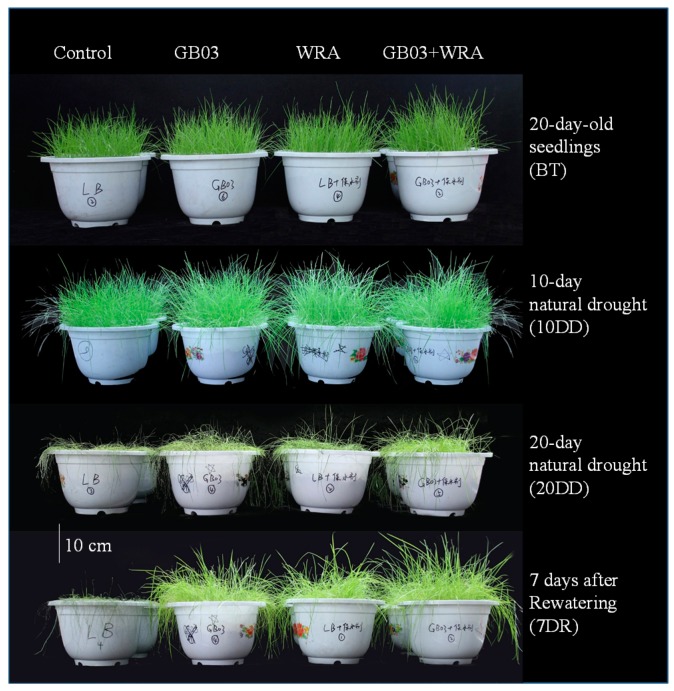
Figure 1
Figure 1
Ryegrass growth status of different treatments in four vegetation phases. From left to right: control, GB03, WRA and GB03+WRA treatments; from top to bottom: 20-day-old seedlings (before treatment, BT), 10-day natural drought (10DD), 20-day natural drought (20DD) and 7 days after rewatering (7DR).
Figure 2
Figure 2
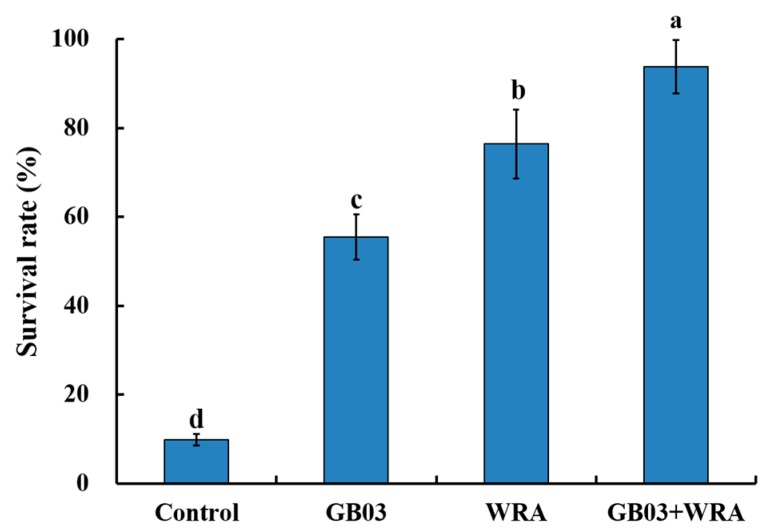
The survival rate of ryegrass seedlings with 20 days natural drought and then seven days after rewatering. Values are means and bars indicate standard errors (SEs) (n = 12). Columns with different letters indicate significant differences among treatments at p < 0.05 (ANOVA and Duncan’s post-hoc multiple comparison test).
Figure 3
Figure 3
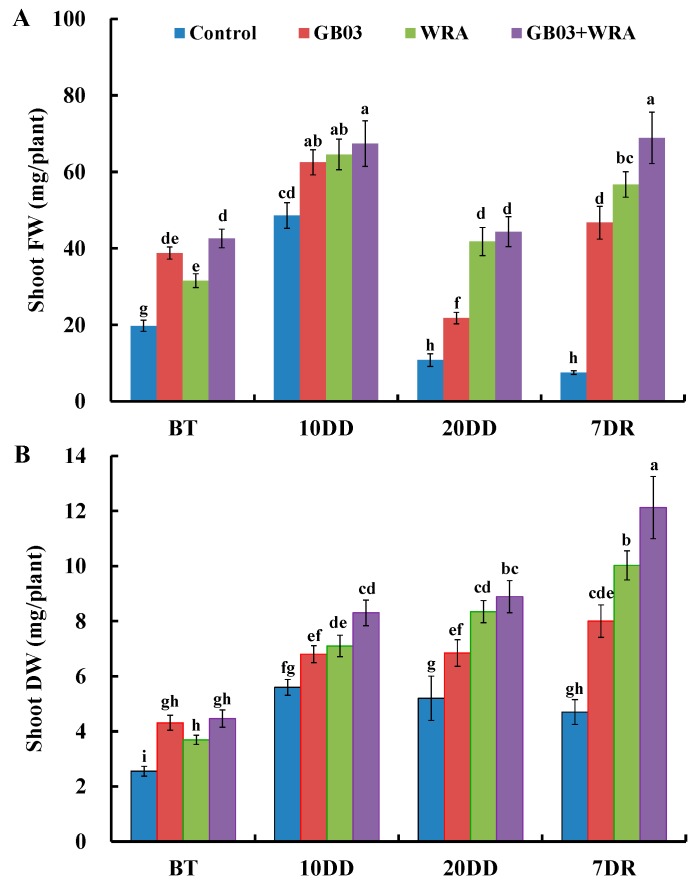
Effects of GB03, water retaining agent (WRA), or the combination of GB03+WRA on shoot fresh weight (FW) (A) and dry weight (DW) (B) of ryegrass. BT, before treatment (20-day-old seedling); 10DD, 10-day natural drought; 20DD, 20-day natural drought; 7DR, 7 days after rewatering. Values are means and bars indicate SEs (n = 12). Columns with different letters indicate significant differences among treatments at p < 0.05 (ANOVA and Duncan’s post-hoc multiple comparison test).
Figure 4
Figure 4
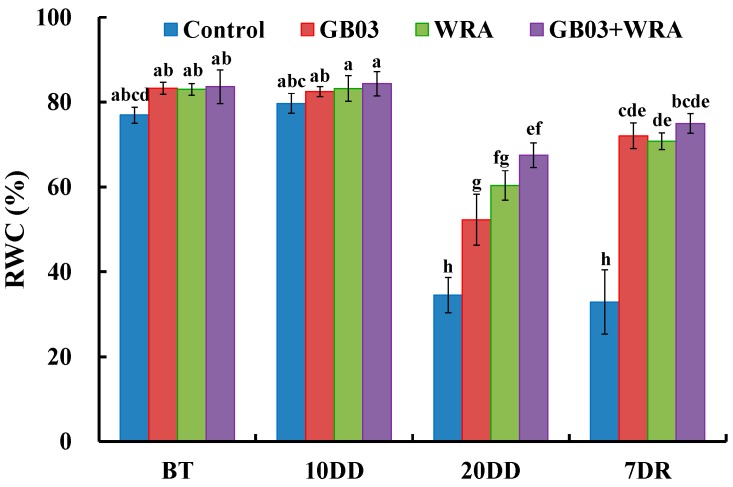
Effects of GB03, water retaining agent (WRA), or the combination of GB03+WRA on leaf relative water content (RWC) of ryegrass. BT, before treatment (20-day-old seedling); 10DD, 10-day natural drought; 20DD, 20-day natural drought; 7DR, 7 days after rewatering. Values are means and bars indicate SEs (n = 12). Columns with different letters indicate significant differences among treatments at p < 0.05 (ANOVA and Duncan’s post-hoc multiple comparison test).
Figure 5
Figure 5
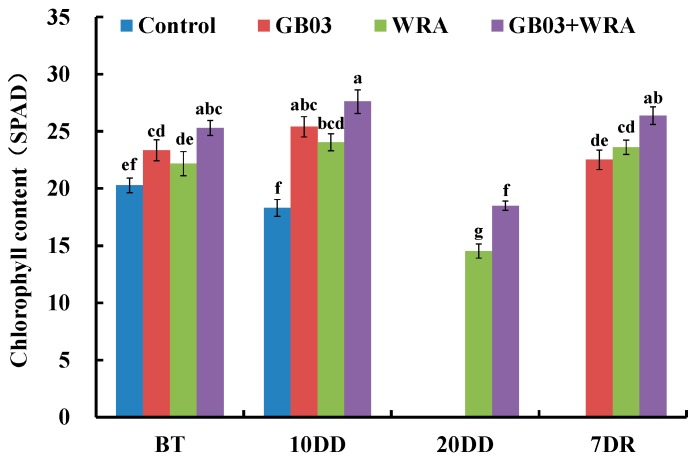
Effects of GB03, water retaining agent (WRA), or the combination of GB03+WRA on leaf chlorophyll content of ryegrass. BT, before treatment (20-day-old seedling); 10DD, 10-day natural drought; 20DD, 20-day natural drought; 7DR, 7 days after rewatering. Values are means and bars indicate SEs (n = 12). Columns with different letters indicate significant differences among treatments at p < 0.05 (ANOVA and Duncan’s post-hoc multiple comparison test).
Figure 6
Figure 6
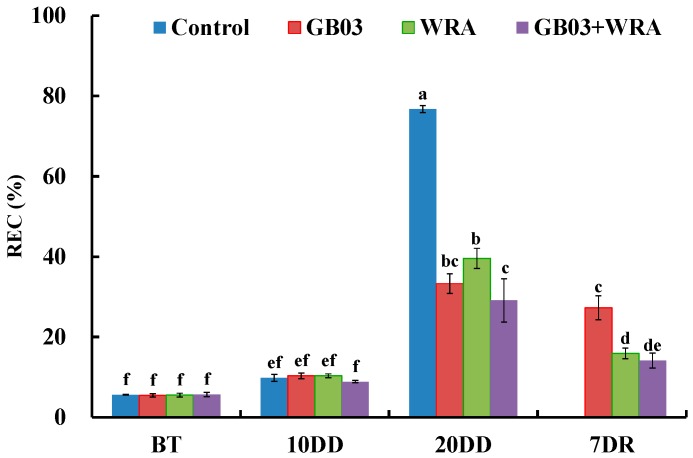
Effects of GB03, water retaining agent (WRA), or the combination of GB03+WRA on relative electric conductivity (REC) of ryegrass. BT, before treatment (20-day-old seedling); 10DD, 10-day natural drought; 20DD, 20-day natural drought; 7DR, 7 days after rewatering Values are means and bars indicate SEs (n = 12). Columns with different letters indicate significant differences among treatments at p < 0.05 (ANOVA and Duncan’s post-hoc multiple comparison test).
Figure 7
Figure 7
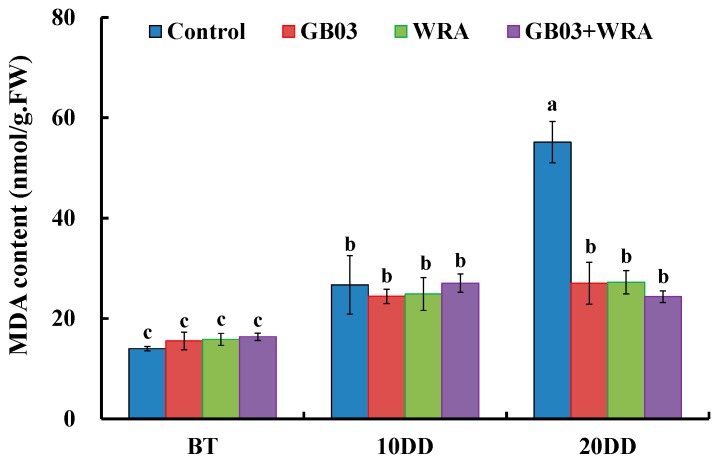
Effects of GB03, water retaining agent (WRA), or the combination of GB03+WRA on leaf malondialdehyde (MDA) content of ryegrass. BT, before treatment (20-day-old seedling); 10DD, 10-day natural drought; 20DD, 20-day natural drought; 7DR, 7 days after rewatering. Values are means and bars indicate SEs (n = 12). Columns with different letters indicate significant differences among treatments at p < 0.05 (ANOVA and Duncan’s post-hoc multiple comparison test).

References

    1. Kramer P.J., Boyer J.S. Water Relations of Plants and Soils. Academic Press; Cambridge, MA, USA: 1995.
    1. Hassine A.B., Bouzid S., Lutts S. Does habitat of Atriplex halimus L. affect plant strategy for osmotic adjustment? Acta Physiol. Plant. 2010;32:325–331. doi: 10.1007/s11738-009-0410-4. - DOI
    1. Wu G.Q., Xi J.J., Wang Q., Bao A.K., Ma Q., Zhang J.L., Wang S.M. The ZxNHX gene encoding tonoplast Na+/H+ antiporter from the xerophyte Zygophyllum xanthoxylum plays important roles in response to salt and drought. J. Plant Physiol. 2011;168:758–767. doi: 10.1016/j.jplph.2010.10.015. - DOI - PubMed
    1. Martínez J.P., Kinet J.M., Bajji M., Lutts S. NaCl alleviates polyethylene glycol-induced water stress in the halophyte species Atriplex halimus L. J. Exp. Bot. 2005;56:2421–2431. doi: 10.1093/jxb/eri235. - DOI - PubMed
    1. Slama I., Ghnaya T., Messedi D., Hessini K., Labidi N., Savoure A., Abdelly C. Effect of sodium chloride on the response of the halophyte species Sesuvium portulacastrum grown in mannitol-induced water stress. J. Plant Res. 2007;120:291–299. doi: 10.1007/s10265-006-0056-x. - DOI - PubMed

LinkOut - more resources