


Genetic diversity and distribution of Mycobacterium tuberculosis genotypes in Limpopo, South Africa
- PMID: 29233106
- PMCID: PMC5727936
- DOI: 10.1186/s12879-017-2881-z
Genetic diversity and distribution of Mycobacterium tuberculosis genotypes in Limpopo, South Africa
Abstract
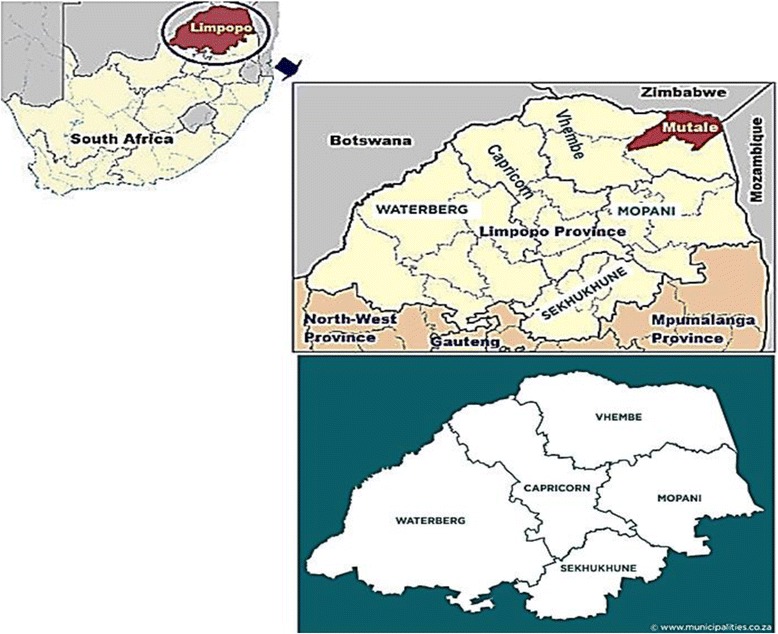
Background: Tuberculosis remains a major health problem and knowledge of the diversity of Mycobacterium tuberculosis strains in specific geographical regions can contribute to the control of the disease. This study describes the genetic profile of M. tuberculosis in five districts of Limpopo Province.
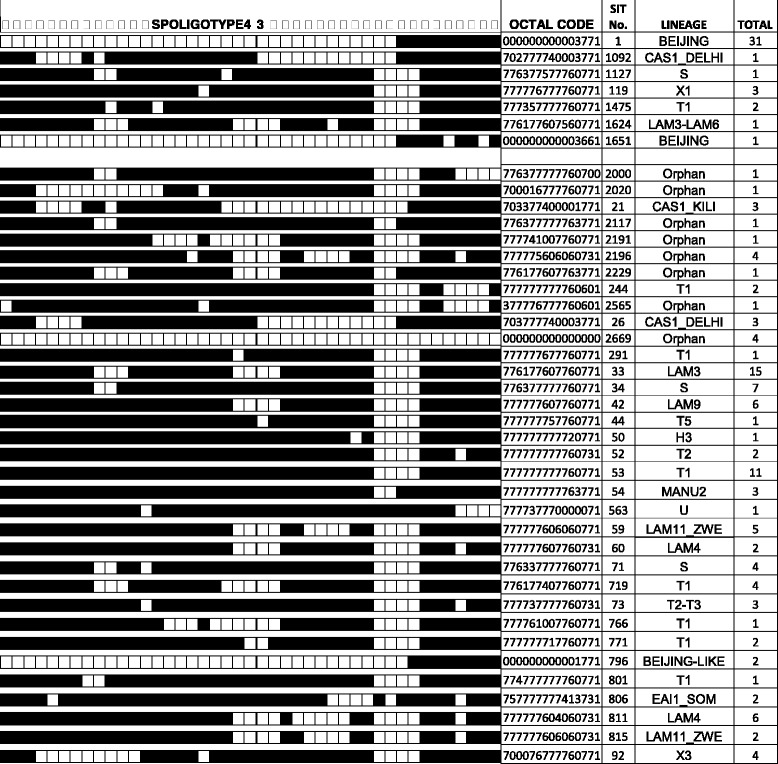
Methods: A total 487 isolates were collected from the National Health Laboratory Services from all regions/districts of Limpopo Province. Only 215 isolates were confirmed to be M. tuberculosis by Bactec Mycobacterium Growth Indicator Tube 960® and Rhodamine-Auramine staining. Isolates were subcultured on Löwenstein-Jensen medium agar slants to validate purity. They were spoligotyped and data analysed using the international spoligotyping database 4 (SpolDB4).
Results: Of the 215 isolates, 134 (62.3%) were genotyped into 21 genotype families while 81 (37.7%) were orphans. The 81 orphans were further subjected to resolution employing SpolDB3/RIM. Overall, the study revealed a high diversity of strains of 32 predominantly the non-Beijing lineages: the LAM- LAM3 (9.8%), LAM9 (4.7%) and LAM11- ZWE (3.3%), the T-T1(15.0%), T2 (0.9%), T2-T3 (1.4%), the CAS-CAS1-Delhi 5 (1.9%) and CAS1-KILI (1.4%) the MANU2 (1.4%), U (0.5%), X-X1(1.4%), X3 (1.9%), S (9.8%), CAS (1.4%), LAM7(0.9%), T3(0.5%), LAM8(4.7%), T4(1.4%), X2(0.4%), AI5(1.9%), LAM1(0.5%), FAMILY33 (1.9%), EAI4(1.4%), M. microti (1.9%). The Beijing and Beijing-like families were (14.9%) and (0.9%), respectively. A total of 28(13%) clusters and 77(36%) unique cases were identified. Beijing strain (SIT 1) formed the biggest cluster constituting 14%, followed by LAM3 (SIT 33), T1 (SIT 53) and LAM4 (SIT 811) with 7%, 5.1% and 2.8%, respectively. The Beijing family was the only genotype found in all the five districts and was predominant in Mopani (18.8%), Sekhukhune (23.7%) and Vhembe (23.3%). Dominant genotypes in Capricorn and Waterberg were LAM3 (11.9%) and T1 (13.3%), respectively.
Conclusion: A wide diversity of lineages was demonstrated at district level. A high number of clusters per district provided evidence of on-going transmission in this Province.
Keywords: Genetic diversity; Mycobacterium tuberculosis; Spoligotyping.
Conflict of interest statement
Authors’ information
Optional.
Ethics approval and consent to participate
The Medunsa Research and Ethics Committee (MREC) approved this study (MREC/HS/399/2014: IR). Permission to conduct research in the Province was obtained from Department of Health and National Health Laboratory Services (NHLS), respectively after ensuring patient’s confidentiality in the research tool used.
Consent for publication
Not Applicable.
Competing interests
The authors declare that they have no competing interests.
Publisher’s Note
Springer Nature remains neutral with regard to jurisdictional claims in published maps and institutional affiliations.
Figures

References
-
- World Health Organization . Global tuberculosis control: surveillance, planning, financing: the world health report 2008. Geneva: WHO; 2008.
-
- Statistics SA, 2013. From http://beta2.statssa.gov.za/publications/P03022013.pdf (Accessed 28 Jan 2016).
-
- Supply P, Allix C, Lesjean S, Cardoso-Oelemann M, Rüsch-Gerdes S, Willery E, et al. Proposal for standardization of optimized mycobacterial interspersed repetitive unit-variable-number tandem repeat typing of mycobacterium tuberculosis. J Clin Microbiol. 2006;44(22):4498–4510. doi: 10.1128/JCM.01392-06. - DOI - PMC - PubMed
MeSH terms
Substances
Grants and funding
LinkOut - more resources
Full Text Sources
Other Literature Sources
Medical
