


Timing of food intake impacts daily rhythms of human salivary microbiota: a randomized, crossover study
- PMID: 29233857
- PMCID: PMC5893176
- DOI: 10.1096/fj.201700697RR
Timing of food intake impacts daily rhythms of human salivary microbiota: a randomized, crossover study
Abstract
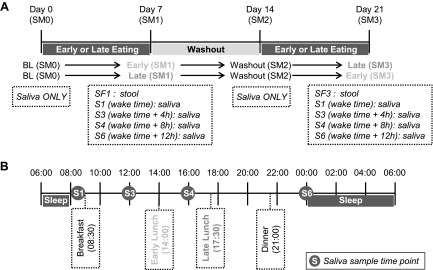
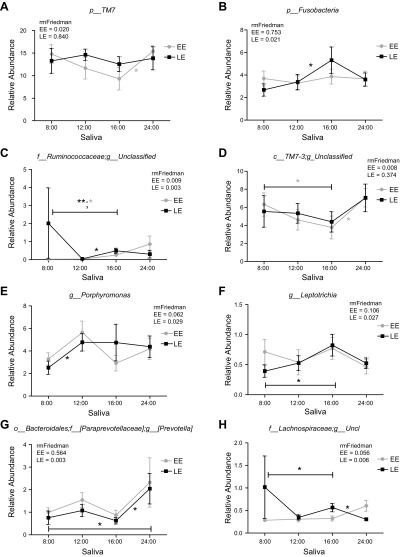
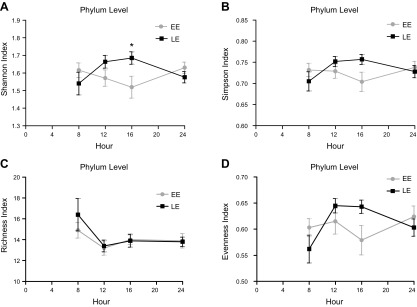
The composition of the diet (what we eat) has been widely related to the microbiota profile. However, whether the timing of food consumption (when we eat) influences microbiota in humans is unknown. A randomized, crossover study was performed in 10 healthy normal-weight young women to test the effect of the timing of food intake on the human microbiota in the saliva and fecal samples. More specifically, to determine whether eating late alters daily rhythms of human salivary microbiota, we interrogated salivary microbiota in samples obtained at 4 specific time points over 24 h, to achieve a better understanding of the relationship between food timing and metabolic alterations in humans. Results revealed significant diurnal rhythms in salivary diversity and bacterial relative abundance ( i.e., TM7 and Fusobacteria) across both early and late eating conditions. More importantly, meal timing affected diurnal rhythms in diversity of salivary microbiota toward an inverted rhythm between the eating conditions, and eating late increased the number of putative proinflammatory taxa, showing a diurnal rhythm in the saliva. In a randomized, crossover study, we showed for the first time the impact of the timing of food intake on human salivary microbiota. Eating the main meal late inverts the daily rhythm of salivary microbiota diversity which may have a deleterious effect on the metabolism of the host.-Collado, M. C., Engen, P. A., Bandín, C., Cabrera-Rubio, R., Voigt, R. M., Green, S. J., Naqib, A., Keshavarzian, A., Scheer, F. A. J. L., Garaulet, M. Timing of food intake impacts daily rhythms of human salivary microbiota: a randomized, crossover study.
Keywords: alpha diversity; beta diversity; diurnal rhythm; eating time; feces.
Conflict of interest statement
This work was supported by Spanish Government of Economy and Competitiveness (MINECO) Grants AGL2015-707487-P (to M.C.C.) and SAF2014-52480R; the European Regional Development Fund (ERDF); U.S. National Institutes of Health (NIH) National Institute of Diabetes and Digestive and Kidney Diseases Grants R01DK102696 and DK1-R01DK_105072-01A1 (to M.G.), and R01 DK099512 and R01DK105072 (to F.A.J.L.S.); and NIH National, Heart, Lung, and Blood Institute Grants R01 HL094806, R01 HL140574 and R01 HL118601 (to F.A.J.L.S.). F.A.J.L.S. has received speaker fees from Bayer Healthcare, Sentara Healthcare, Philips, and Kellogg Company. The remaining authors declare no conflicts of interest.
Figures
References
-
- Garaulet M., Vera B., Bonnet-Rubio G., Gómez-Abellán P., Lee Y. C., Ordovás J. M. (2016) Lunch eating predicts weight-loss effectiveness in carriers of the common allele at PERILIPIN1: the ONTIME (obesity, nutrigenetics, timing, mediterranean) study. Am. J. Clin. Nutr. 104, 1160–1166 10.3945/ajcn.116.134528 - DOI - PubMed
Publication types
MeSH terms
Grants and funding
LinkOut - more resources
Full Text Sources
Other Literature Sources
