. 2017 Nov 28:8:2264.
doi: 10.3389/fmicb.2017.02264. eCollection 2017.

Rokubacteria: Genomic Giants among the Uncultured Bacterial Phyla

Affiliations

Rokubacteria: Genomic Giants among the Uncultured Bacterial Phyla

Eric D Becraft et al. Front Microbiol. .

Abstract

Recent advances in single-cell genomic and metagenomic techniques have facilitated the discovery of numerous previously unknown, deep branches of the tree of life that lack cultured representatives. Many of these candidate phyla are composed of microorganisms with minimalistic, streamlined genomes lacking some core metabolic pathways, which may contribute to their resistance to growth in pure culture. Here we analyzed single-cell genomes and metagenome bins to show that the "Candidate phylum Rokubacteria," formerly known as SPAM, represents an interesting exception, by having large genomes (6-8 Mbps), high GC content (66-71%), and the potential for a versatile, mixotrophic metabolism. We also observed an unusually high genomic heterogeneity among individual Rokubacteria cells in the studied samples. These features may have contributed to the limited recovery of sequences of this candidate phylum in prior cultivation and metagenomic studies. Our analyses suggest that Rokubacteria are distributed globally in diverse terrestrial ecosystems, including soils, the rhizosphere, volcanic mud, oil wells, aquifers, and the deep subsurface, with no reports from marine environments to date.

Keywords: microbial dark matter; microbial ecology; microbial evolution; microbial genomics; uncultivated bacteria.


Figures
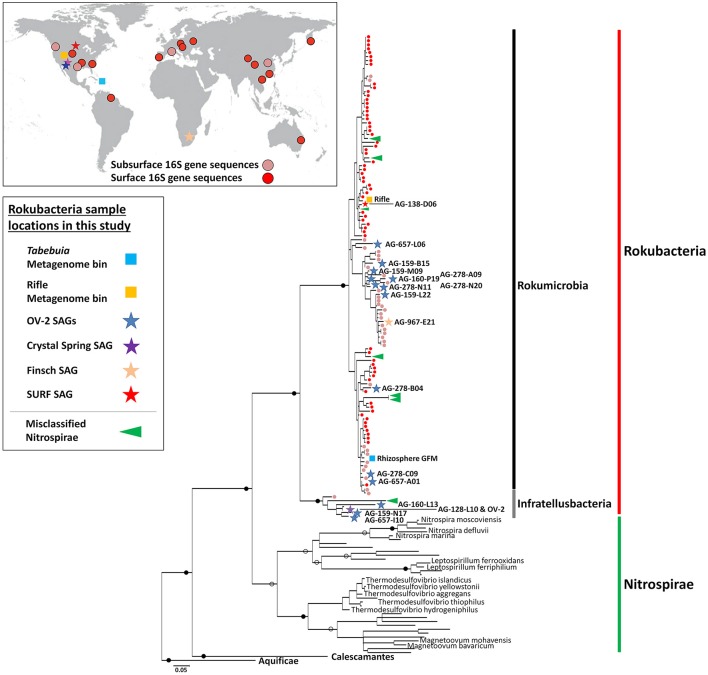
Figure 1
Figure 1
Maximum-likelihood phylogeny of the Rokubacteria (red line), based on partial 16S rRNA gene sequences (~600 bps in length). Included are NCBI sequences with ≥85% nucleotide identity to Rokubacteria SAGs. The Rokumicrobia are demarcated by a black line, and the Infratellusbacteria are demarcated by a grey line. Nitrospirae genome 16S rRNA gene sequences representing classified genera and sequences misclassified as Nitrospirae are demarcated by a green vertical bar and green arrows, respectively. 16S rRNA gene sequence from previous surface (red circles), and subsurface (tan circles) studies are also indicated at the terminal branch of each sequence. Map insert (upper left) shows geographic distribution of reported Rokubacteria 16S rRNA gene sequences from past surface (red circles), and subsurface (tan circles) studies. Sequence identifiers are reported in Supplemental Figure 3. Previously sampled subsurface sites from Puerto Rico and Nevada where Rokubacteria 16S rRNA genes sequences were identified are not shown in Figure 1 insert due to space constants. Stars indicate Rokubacteria SAGs (blue = OV-2, purple = Crystal Spring; tan = Finsch mine; and red = SURF) and squares indicate metagenome bins (light blue = Tabebuia; orange = Rifle site), and color corresponds to site SAGs were isolated from (left; also see Supplemental Figure 2). All SAGs and metagenome bins that contained a 16S rRNA gene are included in the phylogeny. Full circles indicate bootstrap values >90%; open circles indicate boot-strap values >70%. Scale bar represents 0.05 nucleotide substitutions per site.
Figure 2
Figure 2
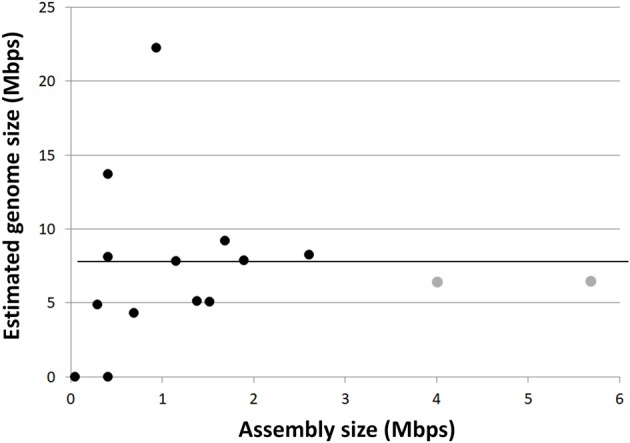
Single-cell genome (black circles) and metagenome bin (gray circles) assembly sizes compared to CheckM estimated genome sizes. Horizontal line indicates average estimated genome size (~6.8 Mbps).
Figure 3
Figure 3
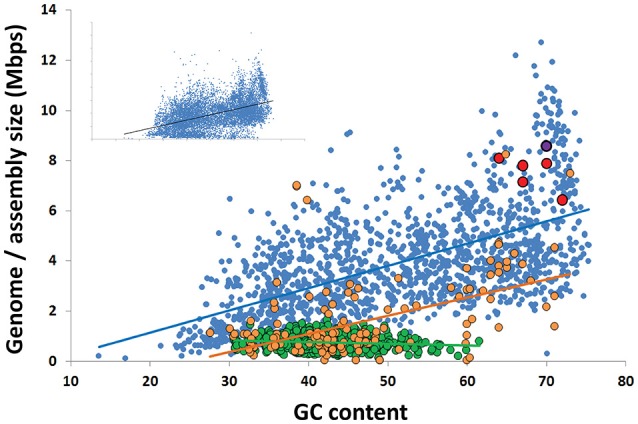
Correlation between the G+C content and genome size among all finished bacterial genomes in IMG (blue; R2 = 0.35), the 4 most complete Rokubacteria SAGs from OV-2 (red), metagenome bins from OV-2 bin 8 and Puerto Rican Tabebuia rhizosphere that contain a 16S rRNA gene (purple), and the Rifle metagenome bin that contains a 16S rRNA gene (black) (also see Supplemental Table 3). Also displayed are the estimated genome sizes for Candidate Phyla Radiation (CPR) genomes (green; R2 = 0.02) and candidate phyla genomes not a part of the CPR lineage (orange; R2 = 0.25). The insert contains all genomes in IMG, including all partial SAGs and metagenome bins from all bacterial phyla (R2 = 0.35).
Figure 4
Figure 4
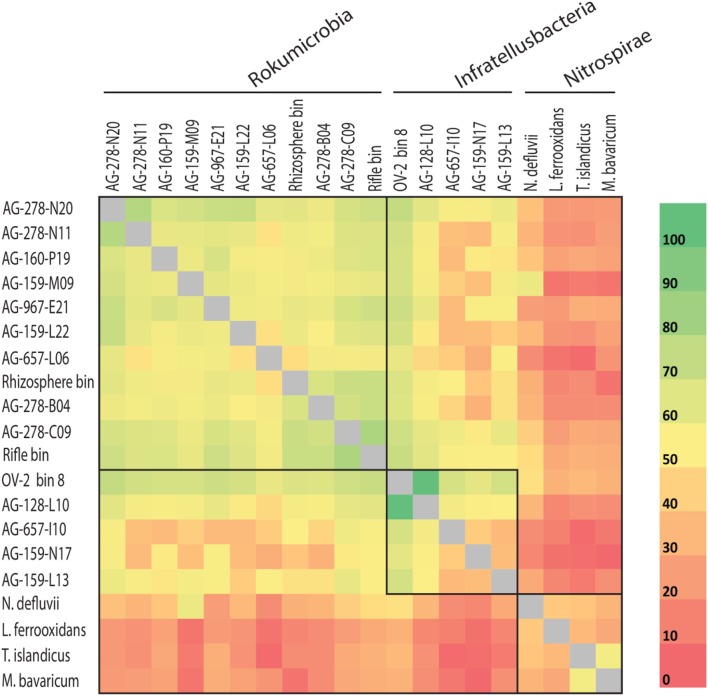
Average amino acid identity (AAI) for shared proteins among more complete Rokubacteria single amplified genomes (SAGs) (>0.5 Mbps) and Rokubacteria metagenome bin 8 and rhizosphere bin (indicated by asterisks in Table 1), and select genomes from the Nitrospirae phylum. Boxes indicate phylogenetically defined class-level lineages (also see Figure 1 and Supplemental Table 2).
Figure 5
Figure 5
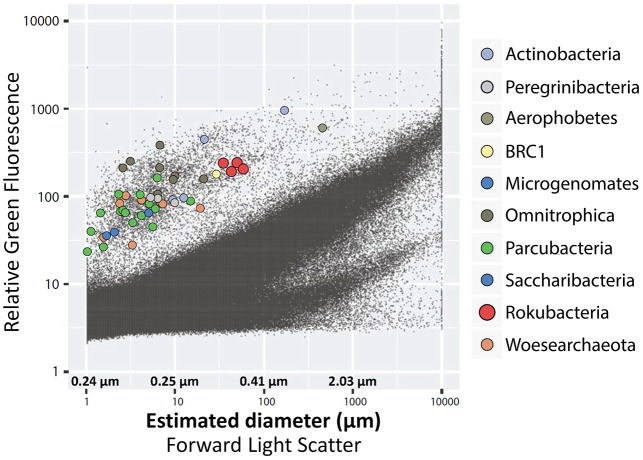
Optical properties and estimated diameters of cells sorted from the OV-2 sample that contained the largest number of cells identified as Rokubacteria. Colored dots indicate cells that were successfully identified by their 16S rRNA gene. Black dots indicate all particles detected by the fluorescence-activated cell sorter.
Figure 6
Figure 6
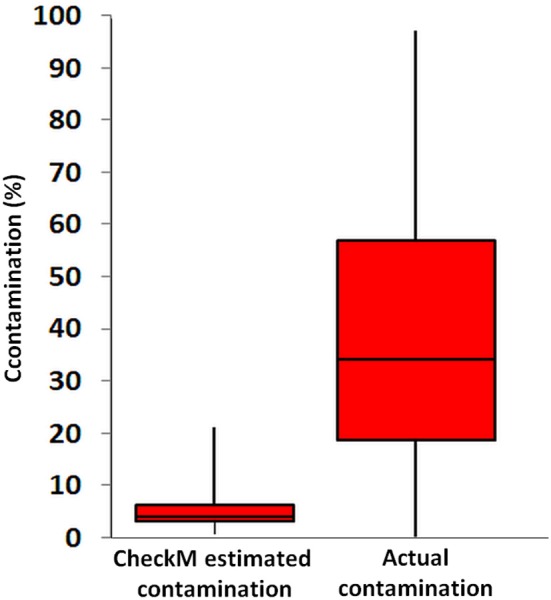
Contamination predicted by CheckM software from all pairwise SAG combinations across the class-level lineages Rokumicrobia and Infratellusbacteria (15 Rokumicrobia and 4 Infratellusbacteria SAGs; 60 combinations total), compared to actual contamination calculated from all artificially combined SAGs. Two-sample t-test assuming equal variances was significant (p = <000.1).

References

    1. Altschul S. F., Gish W., Miller W., Myers E. W., Lipman D. J. (1990). Basic local alignment search tool. J. Mol. Biol. 215, 403–410. 10.1016/S0022-2836(05)80360-2 - DOI - PubMed
    1. Anantharaman K., Brown C. T., Hug L. A., Sharon I., Castelle C. J., Probst A. J., et al. . (2016). Thousands of microbial genomes shed light on interconnected biogeochemical processes in an aquifer system. Nat. Commun. 7:13219. 10.1038/ncomms13219 - DOI - PMC - PubMed
    1. Aziz R. K., Bartels D., Best A. A., DeJongh M., Disz T., Edwards R. A., et al. . (2008). The RAST server: rapid annotations using subsystems technology. BMC Genomics 9:75. 10.1186/1471-2164-9-75 - DOI - PMC - PubMed
    1. Bankevich A., Nurk S., Antipov D., Gurevich A. A., Dvorkin M., Kulikov A. S., et al. . (2012). SPAdes: a new genome assembly algorithm and its applications to single-cell sequencing. J. Comput. Biol. 19, 455–477. 10.1089/cmb.2012.0021 - DOI - PMC - PubMed
    1. Becraft E. D., Dodsworth J. A., Murugapiran S. K., Ohlsson J. I., Briggs B. R., Kanbar J., et al. . (2015). Single-cell-genomics-facilitated read binning of candidate phylum EM19 genomes from geothermal spring metagenomes. Appl. Environ. Microbiol. 82, 992–1003. 10.1128/AEM.03140-15 - DOI - PMC - PubMed