


Trends of intervention for paediatric stone disease over the last two decades (2000-2015): A systematic review of literature
- PMID: 29234533
- PMCID: PMC5717467
- DOI: 10.1016/j.aju.2017.10.006
Trends of intervention for paediatric stone disease over the last two decades (2000-2015): A systematic review of literature
Abstract
Objective: To ascertain the publication trends of interventions for paediatric kidney stone disease (KSD) we conducted a systematic review of literature over the last 16 years.
Patients and methods: With a rise of paediatric KSD and related interventions, a systematic review using PubMed was done over the last 16 years for all published papers on 'Paediatric stone disease intervention - ureteroscopy (URS), shockwave lithotripsy (SWL), percutaneous nephrolithotomy (PCNL), open stone surgery, and laparoscopic stone surgery'. The search was limited to English language articles with a published abstract, whilst case reports, animal and laboratory studies, were excluded. We also analysed the data in two time periods, period-1 (2000-2007) and period-2 (2008-2015).
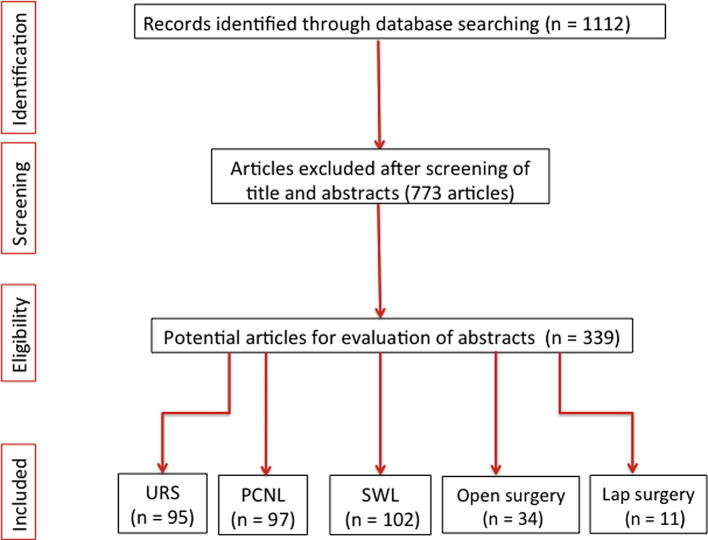
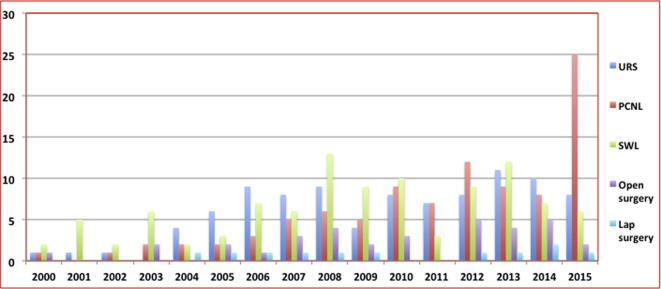
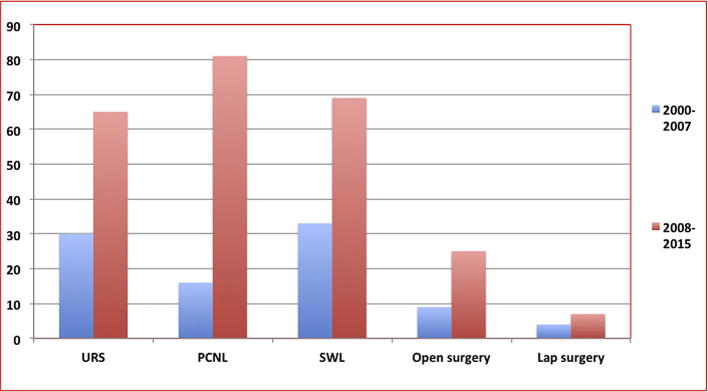
Results: During the last 16-years, 339 papers were published on paediatric stone disease intervention on PubMed. This included papers on URS (95), PCNL (97), SWL (102), open stone surgery (34) and laparoscopic stone surgery (11). During period-1 and period-2 there were 30 and 65 papers on URS, 16 and 81 papers on PCNL, 33 and 60 papers on SWL, nine and 25 papers on open surgery, respectively. When comparing the two periods, there were 92 published papers for all interventions in period-1 and this had risen almost threefold to 247 papers in period-2.
Conclusions: Our systematic review shows that intervention for KSD in the paediatric age group has risen over the last 8 years. Whilst URS, SWL, open surgery and laparoscopic surgery have all doubled, PCNL has risen fivefold reflecting an increase in the new minimally invasive PCNL techniques.
Keywords: KSD, kidney stone disease; MIST, minimally invasive surgical techniques; PCNL, percutaneous nephrolithotomy; PRISMA, Preferred Reporting Items for Systematic Reviews and Meta-Analyses; Paediatrics; Publication trends; SWL, shockwave lithotripsy; Stone; URS, ureteroscopy; Ureteroscopy; Urolithiasis.
Figures
References
-
- Hernandez J.D., Ellison J.S., Lendvay T.S. Current trends, evaluation, and management of pediatric nephrolithiasis. JAMA Pediatr. 2015;169:964–970. - PubMed
-
- Sas D.J. An update on the changing epidemiology and metabolic risk factors in pediatric kidney stone disease. Clin J Am Soc Nephrol. 2011;6:2062–2068. - PubMed
-
- Rizvi S.A., Sultan S., Zafar M.N., Ahmed B., Aba Umer S., Naqvi S.A. Paediatric urolithiasis in emerging economies. Int J Surg. 2016;36:705–712. - PubMed
-
- Sirin A., Emre S., Alpay H., Nayir A., Bilge I., Tanman F. Etiology of chronic renal failure in Turkish children. Paediatr Nephrol. 1995;9:549–552. - PubMed
Publication types
LinkOut - more resources
Full Text Sources
Other Literature Sources
