Review
. 2017 Oct 24:8:1-13.
doi: 10.1016/j.omto.2017.10.002. eCollection 2018 Mar 30.

The Dual Role of Bone Morphogenetic Proteins in Cancer

Affiliations
Review

The Dual Role of Bone Morphogenetic Proteins in Cancer

Duc-Hiep Bach et al. Mol Ther Oncolytics. .

Abstract

Bone morphogenetic proteins (BMPs) are a diverse class of molecules with over 20 growth factor proteins that belong to the transforming growth factor-β (TGF-β) family and are highly associated with bone formation and disease development. Aberrant expression of various BMPs has been reported in several cancer tissues. Biological function studies have elicited the dual role of BMPs in both cancer development and suppression. Furthermore, a variety of BMP antagonists, ligands, and receptors have been shown to reduce or enhance tumorigenesis and metastasis. Knockout mouse models of BMP signaling components have also revealed that the suppression of BMP signaling impairs cancer metastasis. Herein, we highlight the basic clinical background and involvement of BMPs in modulating cancer progression and their dynamic interactions (e.g., with microRNAs) in the tumor microenvironment in addition to their mutations and roles in chemoprevention. We also suggest that BMPs should be considered a powerful putative therapeutic target in tumorigenesis and bone metastasis.

Keywords: biomarkers; bone morphogenetic proteins; drug treatment; metastasis; miRNAs; mutations; tumors.


Figures

Figure 1
Figure 1
BMP-Mediated Signaling Pathways The type II receptor trans-phosphorylates the type I receptor, which, in turn, stimulates transcriptional regulators called SMADs, which transduce the signal to the nucleus to modify gene expression.
Figure 2
Figure 2
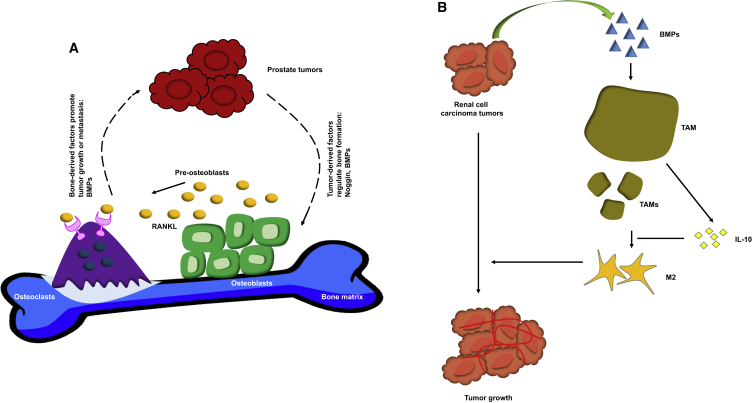
The Role of BMPs in Tumorigenesis (A) Prostate tumors produce tumor-derived factors, including BMPs, for the regulation of bone formation, which promote the process from osteoblast to osteoclast via RANKL. Subsequently, osteoclasts make bone-derived factors including BMPs, which promote tumorigenesis. (B) BMPs from tumor tissues activate TAMs and stimulate the type II cytokine, IL-10. IL-10 promotes the M2 polarization of TAMs and leads to tumor development by suppressing the local antitumor immune response.
Figure 3
Figure 3
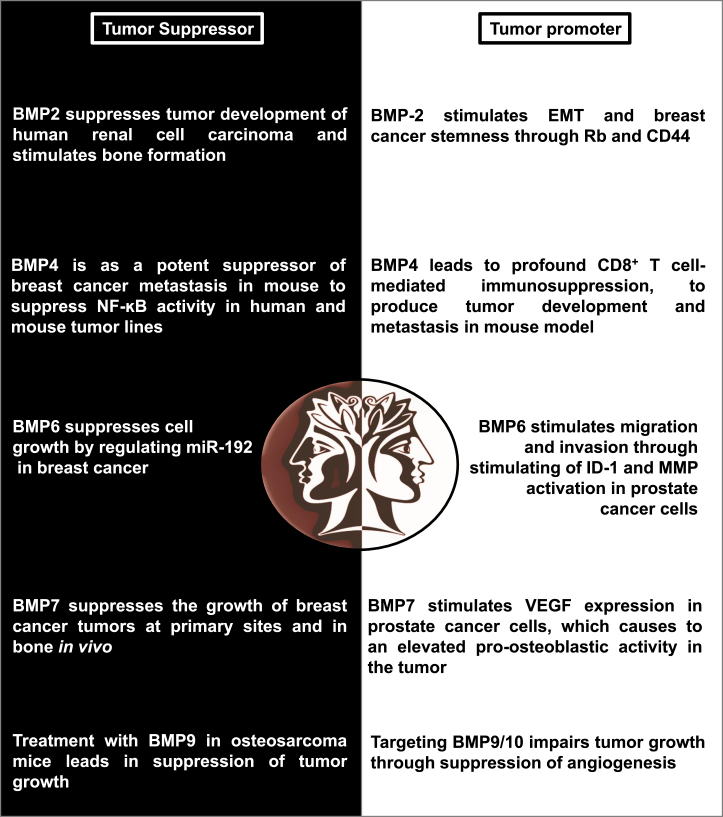
The Dual Function of BMPs in Cancer Cells BMPs can suppress tumor growth and metastasis, acting as tumor suppressors. Paradoxically, BMPs also accelerate tumorigenesis as tumor promoters through various mechanisms, such as activation of oncogenes, and stimulation metastasis in tumor microenvironment. The bifrontal figure displays the Janus face of BMPs in tumor progression.

References

    1. Urist M.R. Bone: formation by autoinduction. Science. 1965;150:893–899. - PubMed
    1. Guo X., Wang X.F. Signaling cross-talk between TGF-beta/BMP and other pathways. Cell Res. 2009;19:71–88. - PMC - PubMed
    1. Hardwick J.C., Kodach L.L., Offerhaus G.J., van den Brink G.R. Bone morphogenetic protein signalling in colorectal cancer. Nat. Rev. Cancer. 2008;8:806–812. - PubMed
    1. Rahman M.S., Akhtar N., Jamil H.M., Banik R.S., Asaduzzaman S.M. TGF-β/BMP signaling and other molecular events: regulation of osteoblastogenesis and bone formation. Bone Res. 2015;3:15005. - PMC - PubMed
    1. Wang R.N., Green J., Wang Z., Deng Y., Qiao M., Peabody M., Zhang Q., Ye J., Yan Z., Denduluri S. Bone morphogenetic protein (BMP) signaling in development and human diseases. Genes Dis. 2014;1:87–105. - PMC - PubMed