


Exercise and heart failure: an update
- PMID: 29235244
- PMCID: PMC5880674
- DOI: 10.1002/ehf2.12225
Exercise and heart failure: an update
Abstract
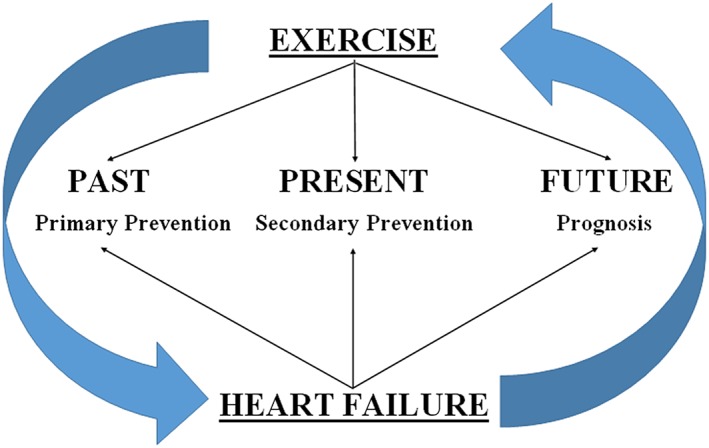
The present update is dedicated to the evolution of the interaction between heart failure (HF) and exercise and how the scientific community has handled it. Indeed, on the one hand, HF is a leading cause of morbidity and mortality with a stable prevalence from 1998 onward varying between 6.3% and 13.3%. On the other hand, exercise is seen as a diagnostic and prognostic tool as well as a therapeutic intervention in chronic HF. More precisely, the knowledge, the clinical application, and the research interest on the mutual interactions between exercise and HF have different phases in disease progression: Before HF onset (past): exercise provides protective benefit in preventing HF (primary prevention). With HF present: exercise improvement with training provides benefits in HF (secondary prevention). The prediction of future in HF patients: exercise impairment, as a leading characteristic of HF, is used as a prognostic factor.
Keywords: Exercise; Heart failure; Prevention; Prognosis; Training.
© 2017 The Authors. ESC Heart Failure published by John Wiley & Sons Ltd on behalf of the European Society of Cardiology.
Figures
References
-
- Van Riet EES, Hoes AW, Wagenaar KP, Limburg A, Landman MA, Rutten FH. Epidemiology of heart failure: the prevalence of heart failure and ventricular dysfunction in older adults over time. A systematic review. Eur J Heart Fail 2016; 18: 242–252. - PubMed
-
- Go AS, Mozaffarian D, Roger VL, Benjamin EJ, Berry JD, Blaha MJ, Dai S, Ford ES, Fox CS, Franco S, Fullerton HJ, Gillespie C, Hailpern SM, Heit JA, Howard VJ, Huffman MD, Judd SE, Kissela BM, Kittner SJ, Lackland DT, Lichtman JH, Lisabeth LD, Mackey RH, Magid DJ, Marcus GM, Marelli A, Matchar DB, McGuire DK, Mohler ER 3rd, Moy CS, Mussolino ME, Neumar RW, Nichol G, Pandey DK, Paynter NP, Reeves MJ, Sorlie PD, Stein J, Towfighi A, Turan TN, Virani SS, Wong ND, Woo D, Turner MB; American Heart Association Statistics Committee and Stroke Statistics Subcommittee . Executive summary: heart disease and stroke statistics—2014 update: a report from the American Heart Association. Circulation 2014; 129: 399–410. - PubMed
-
- Laukkanen KS, Salonen R, Rauramaa R, Salonen JT. The predictive value of cardiorespiratory fitness for cardiovascular events in men with various risk profiles: a prospective population‐based cohort study. Eur Heart J 2004; 25: 1428–1437. - PubMed
-
- Ekelung LG, Haskell WL, Johnson JL, Whaley FS, Criqui MH, Sheps DS. Physical fitness as a predictor of cardiovascular mortality in asymptomatic North American men. The Lipid Research Clinics Mortality Follow‐up Study. N Engl J Med 1988; 319: 1379–1384. - PubMed
-
- Marijon E, Tafflet M, Antero‐Jacquemin J, El Helou N, Berthelot G, Celermajer DS, Bougouin W, Combes N, Hermine O, Empana JP, Rey G, Toussaint JF, Jouven X. Mortality of French participants in the Tour de France (1947–2012). Eur Heart J 2013; 343: 3145–3150. - PubMed
Publication types
MeSH terms
LinkOut - more resources
Full Text Sources
Other Literature Sources
Medical
Research Materials
Miscellaneous
