


Reduced Educational Outcomes Persist into Adolescence Following Mild Iodine Deficiency in Utero, Despite Adequacy in Childhood: 15-Year Follow-Up of the Gestational Iodine Cohort Investigating Auditory Processing Speed and Working Memory
- PMID: 29236073
- PMCID: PMC5748804
- DOI: 10.3390/nu9121354
Reduced Educational Outcomes Persist into Adolescence Following Mild Iodine Deficiency in Utero, Despite Adequacy in Childhood: 15-Year Follow-Up of the Gestational Iodine Cohort Investigating Auditory Processing Speed and Working Memory
Erratum in
-
Correction: Hynes et al. "Reduced Educational Outcomes Persist into Adolescence Following Mild Iodine Deficiency in Utero, Despite Adequacy in Childhood: 15-Year Follow-Up of the Gestational Iodine Cohort Investigating Auditory Processing Speed and Working Memory" Nutrients 2017, 9 (12), 1354.Nutrients. 2019 Jun 5;11(6):1272. doi: 10.3390/nu11061272. Nutrients. 2019. PMID: 31195606 Free PMC article.
Abstract
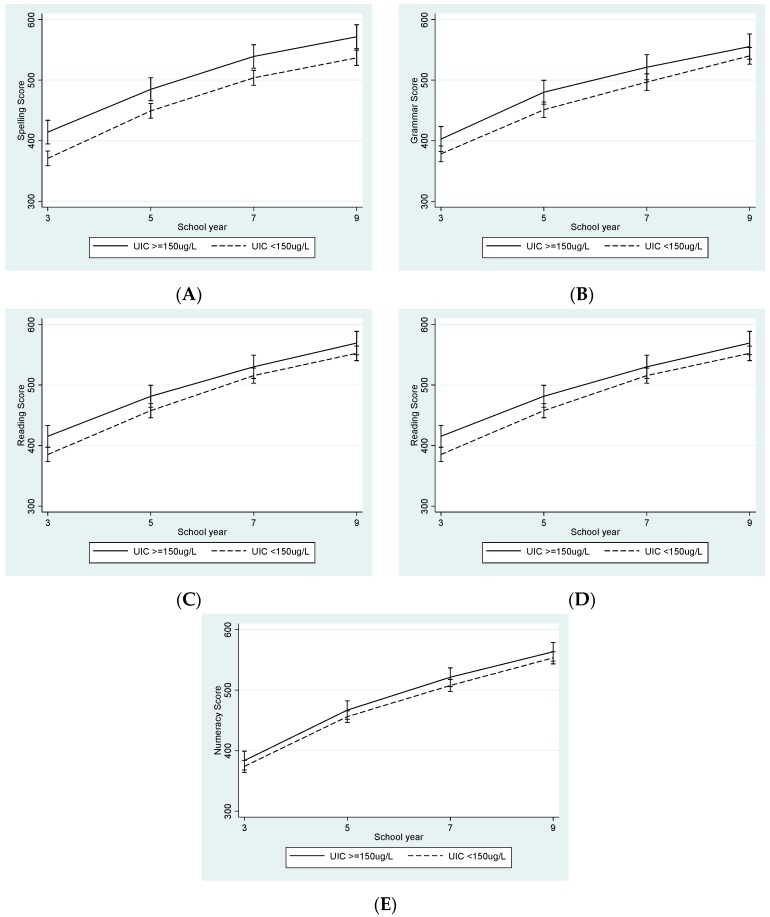
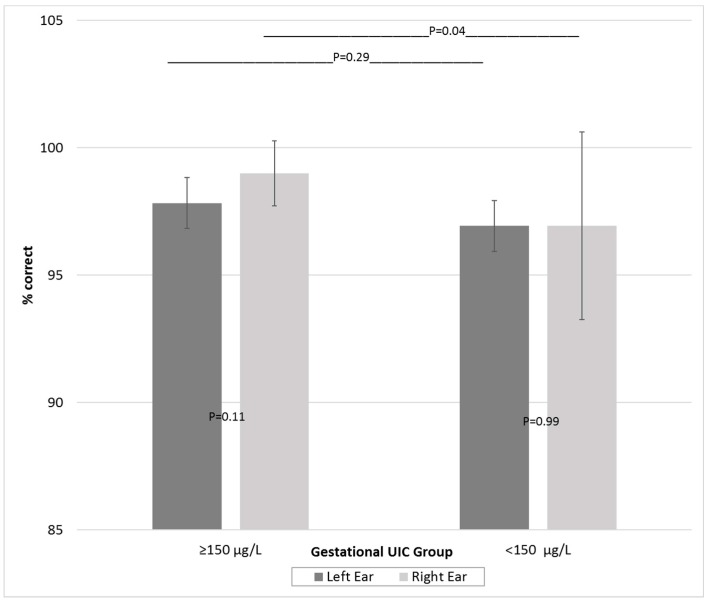
There is increasing evidence that even mild gestational iodine deficiency (GID) results in adverse neurocognitive impacts on offspring. It's unclear, however, if these persist long-term and whether they can be ameliorated by iodine sufficiency in childhood. We followed a unique cohort (Gestational Iodine Cohort, n = 266) where gestation occurred during a period of mild population iodine deficiency, with children subsequently growing-up in an iodine replete environment. We investigated whether associations between mild GID and reductions in literacy outcomes, observed at age 9-years, persisted into adolescence. Comparisons were made between offspring of mothers with gestational urinary iodine concentrations (UICs) ≥ 150 μg/L and < 150 μg/L. Educational outcomes were measured using Australian National Assessment Program-Literacy and Numeracy (NAPLAN) tests. Children whose mothers had UICs < 150 μg/L exhibited persistent reductions in spelling from Year 3 (10%, -41.4 points (95% Confidence Interval -65.1 to -17.6, p = 0.001)) to Year 9 (5.6%, -31.6 (-57.0 to -6.2, p = 0.015)) compared to children whose mothers had UICs ≥ 150 μg/L. Associations remained after adjustment for biological factors, socioeconomic status and adolescent UIC. Results support the hypothesis that mild GID may impact working memory and auditory processing speed. The findings have important public health implications for management of iodine nutrition in pregnancy.
Keywords: adolescence; auditory processing speed; children; educational outcomes; gestation; iodine deficiency; iodine nutrition; literacy; working memory.
Conflict of interest statement
The authors declare no conflict of interest.
Figures
References
-
- World Health Organization (WHO) UNICEF. International Council for Control of Iodine Deficiency Disorders (ICCIDD) Assessment of Iodine Deficiency Disorders and Monitoring Their Elimination. 3rd ed. World Health Organization; Geneva, Switzerland: 2007.
-
- Bath S.C., Steer C.D., Golding J., Emmett P., Rayman M.P. Effect of inadequate iodine status in UK pregnant women on cognitive outcomes in their children: Results from the Avon Longitudinal Study of Parents and Children (ALSPAC) Lancet. 2013;382:331–337. doi: 10.1016/S0140-6736(13)60436-5. - DOI - PubMed
MeSH terms
Substances
LinkOut - more resources
Full Text Sources
Other Literature Sources
Medical
