. 2017 Dec 13;13(12):e1007114.
doi: 10.1371/journal.pgen.1007114. eCollection 2017 Dec.

ciRS-7 exonic sequence is embedded in a long non-coding RNA locus

Affiliations

ciRS-7 exonic sequence is embedded in a long non-coding RNA locus

Steven P Barrett et al. PLoS Genet. .

Abstract

ciRS-7 is an intensely studied, highly expressed and conserved circRNA. Essentially nothing is known about its biogenesis, including the location of its promoter. A prevailing assumption has been that ciRS-7 is an exceptional circRNA because it is transcribed from a locus lacking any mature linear RNA transcripts of the same sense. To study the biogenesis of ciRS-7, we developed an algorithm to define its promoter and predicted that the human ciRS-7 promoter coincides with that of the long non-coding RNA, LINC00632. We validated this prediction using multiple orthogonal experimental assays. We also used computational approaches and experimental validation to establish that ciRS-7 exonic sequence is embedded in linear transcripts that are flanked by cryptic exons in both human and mouse. Together, this experimental and computational evidence generates a new model for regulation of this locus: (a) ciRS-7 is like other circRNAs, as it is spliced into linear transcripts; (b) expression of ciRS-7 is primarily determined by the chromatin state of LINC00632 promoters; (c) transcription and splicing factors sufficient for ciRS-7 biogenesis are expressed in cells that lack detectable ciRS-7 expression. These findings have significant implications for the study of the regulation and function of ciRS-7, and the analytic framework we developed to jointly analyze RNA-seq and ChIP-seq data reveal the potential for genome-wide discovery of important biological regulation missed in current reference annotations.


Conflict of interest statement

The authors have declared that no competing interests exist.

Figures
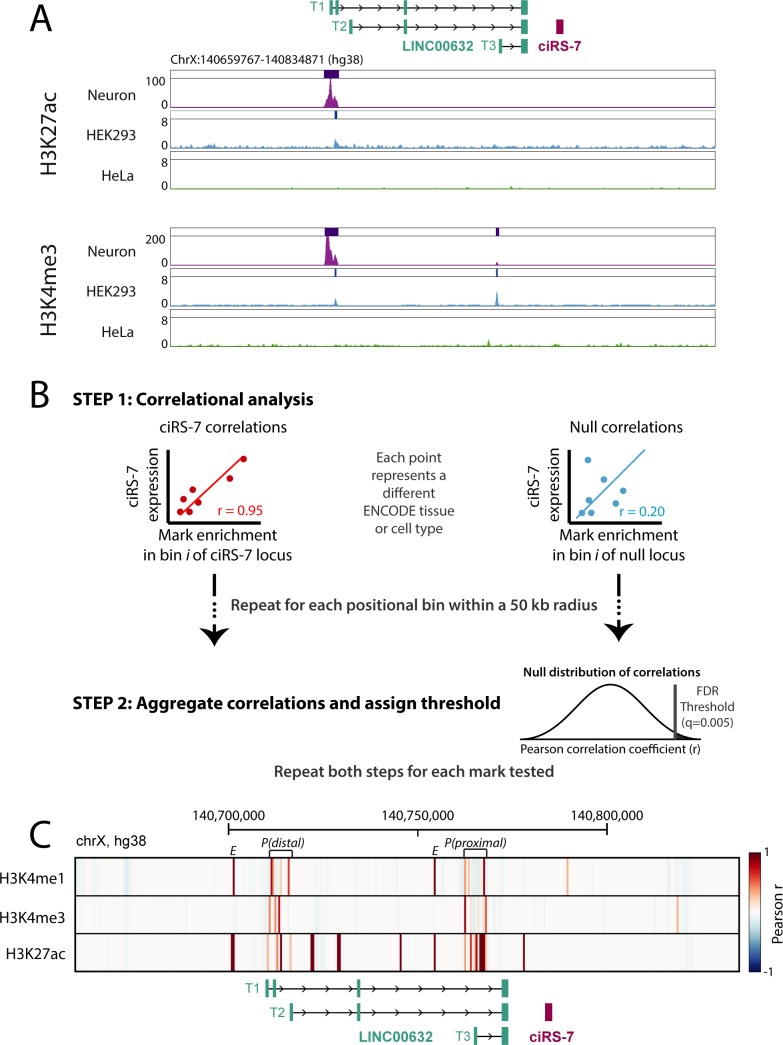
Fig 1
Fig 1. Computational and statistical analysis predict ciRS-7 shares a promoter with annotated LINC isoforms.
(A) H3K27ac and H3K4me3 peaks across the ciRS-7 locus and nearby genomic region in in vitro-differentiated neurons, HEK293, and HeLa cells. (B) Schematic depicting analysis correlating chromatin mark enrichment near the ciRS-7 locus with ciRS-7 expression in RNA seq data. To estimate a false discovery rate, null correlations are computed using ChIP-seq enrichment at disparate regions of the genome with no relationship to ciRS-7 (ACTB, FOXO4, and HOTAIR). Then, using these null correlations, a null distribution is created from which a false discovery rate can be estimated. (C) Heatmap correlation (Pearson r) between strand-specific ciRS-7 expression and enrichment of histone marks across the ciRS-7 locus and surrounding genomic region (spanning from 50 kb upstream of LINC00632 and 50 kb downstream of ciRS-7). Correlations are plotted in 500 nucleotide bins, and a depiction of annotated genes is shown below. Our FDR threshold (q<0.005) is satisfied for correlations greater than 0.35 for H3K4me1 (top 6 correlated bins), 0.45 for H3K4me3 (top 4 correlated bins), and 0.75 for H3K27ac (top 14 correlated bins) (See S5 File). Putative promoters regions are annotated with brackets and the letter ‘P’. Putative enhancers are marked with the letter ‘E’.
Fig 2
Fig 2. Experimental approaches confirm the identity of the ciRS-7 promoter.
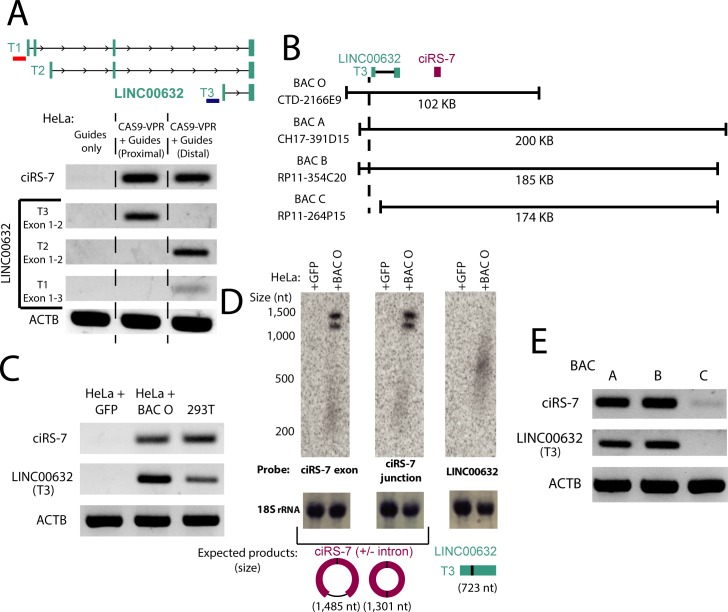
(A) RT-PCR for ciRS-7 and LINC00632 transcripts in HeLa cells (+/- Cas9-VPR activation) with guide RNAs targeting distal and proximal promoters identified in Fig 1C. The approximate targeted locations of the proximal and distal guide RNAs are shown with a blue and red bar, respectively, in the diagram shown above the gel. (B) Schematic of BAC inserts with respect to the ciRS-7 and LINC00632 genes. (C) RT-PCR and (D) Northern blot for ciRS-7 and LINC00632 transcripts generated after BAC O transfection. The appearance of two bands in the ciRS-7 Northern blots is due to alternative splicing of an intron contained within the ciRS-7 exonic sequence. (E) RT-PCR for ciRS-7 and LINC00632 transcripts from HeLa cells transfected with BACs A-C.
Fig 3
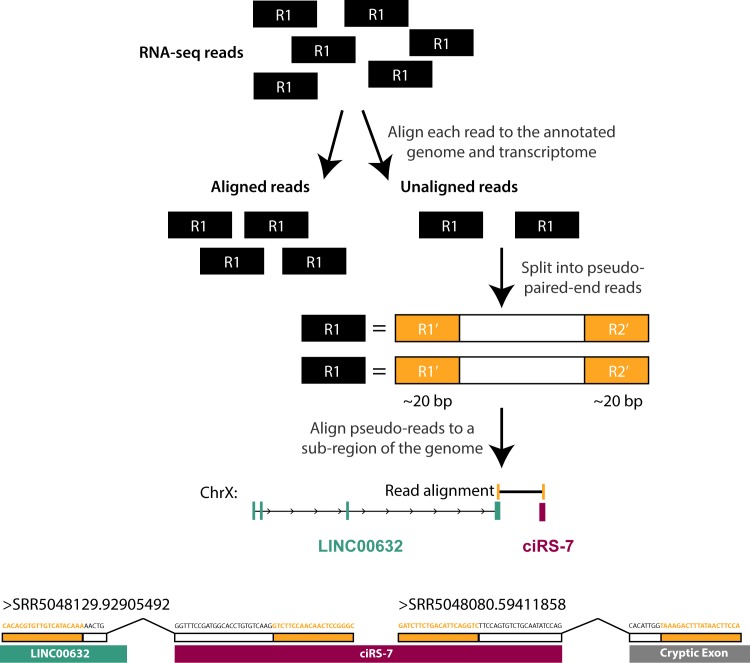
Fig 3. (Upper) Schematic outlining RNA-seq split read mapping approach.
(Lower) Unannotated linear splicing is predicted up- and downstream of the ciRS-7 exon. Reads supporting these junctions are shown above the locus. Note, features are not drawn to scale.
Fig 4
Fig 4. ciRS-7 exonic sequence is included in linear transcripts.
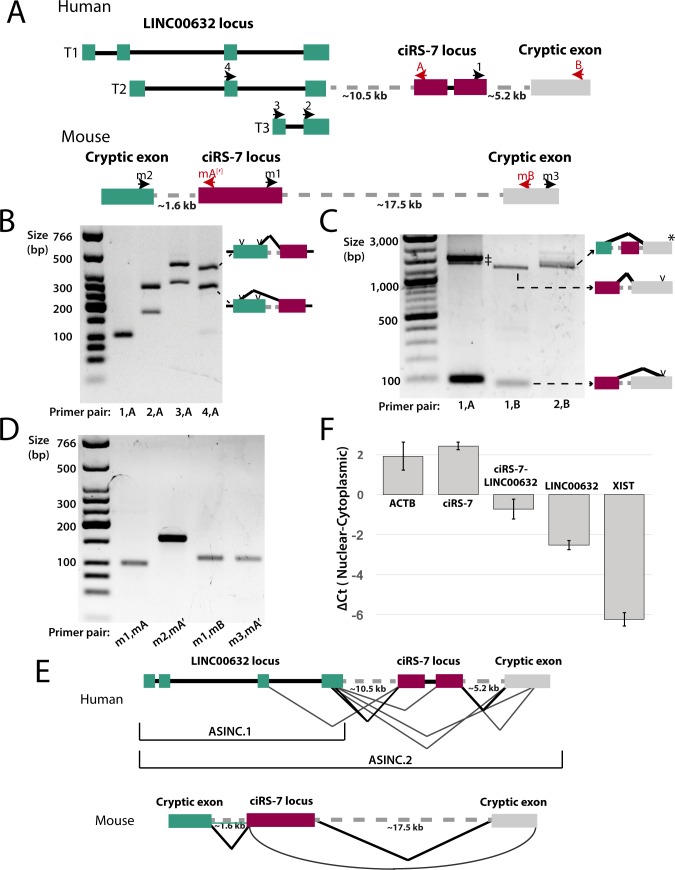
(A) Schematic of the locus including PCR primers used in this study. Dotted lines indicate approximate positions of newly discovered introns. Figure is not drawn to scale. (B) RT-PCR of circular and linear ciRS-7 splice products from HEK293T. (1,A): control PCR for ciRS-7; other lanes: LINC00632 exons spliced to the ciRS-7 exonic sequence: the two bands in each of these lanes represent the products formed when the two possible splice sites in the final exon of LINC00632 are used (see diagram on the right of gel). (C) PCR of spliced products that include cryptic exons downstream of ciRS-7. (‡) represents rolling circle ciRS-7 PCR products with and without intron retention. (*) Other products were also identified (see S7 Fig). (D) RT-PCR of circular and linear ciRS-7 splice products from mouse brain RNA. mA and mA’ bind to approximately the same region but have slightly different sequence (see S1 File). (E) Examples of novel splicing observed in the human and mouse ASINC loci. Curved line in mouse indicates a backsplice. (F) qPCR quantification of nuclear-cytoplasmic fractionated RNA from HEK293T. Error bars represent the standard deviation of biological replicates.
Fig 5
Fig 5. Up- and downstream transcripts are upregulated in ciRS-7 KO mouse.
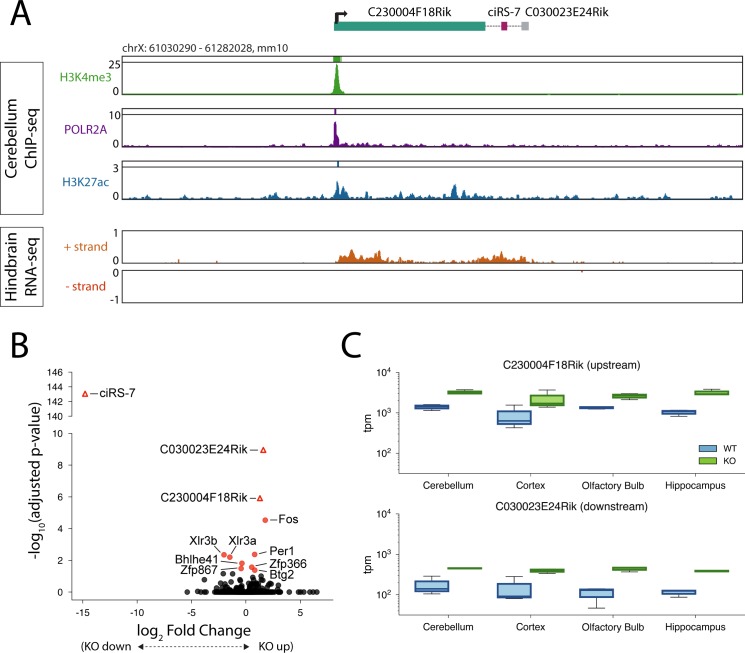
(A) ChIP-seq and RNA-seq tracks for mouse cerebellum and hindbrain in the genomic region surrounding the ciRS-7 locus. (B) Volcano plots of log fold-change ciRS-7 KO vs WT collapsed across four brain regions. (C) Box plots depicting tpm of C230004F18Rik (top) and C030023E24Rik (bottom) in WT and ciRS-7 KO mice across four brain regions.

References

    1. Salzman J, Gawad C, Wang PL, Lacayo N, Brown PO (2012) Circular RNAs are the predominant transcript isoform from hundreds of human genes in diverse cell types. PLoS ONE 7: e30733 doi: 10.1371/journal.pone.0030733 - DOI - PMC - PubMed
    1. Capel B, Swain A, Nicolis S, Hacker A, Walter M, et al. (1993) Circular transcripts of the testis-determining gene Sry in adult mouse testis. Cell 73: 1019–1030. doi: 10.1016/0092-8674(93)90279-Y - DOI - PubMed
    1. Jeck WR, Sorrentino JA, Wang K, Slevin MK, Burd CE, et al. (2013) Circular RNAs are abundant, conserved, and associated with ALU repeats. RNA 19: 141–157. doi: 10.1261/rna.035667.112 - DOI - PMC - PubMed
    1. Nigro JM, Cho KR, Fearon ER, Kern SE, Ruppert JM, et al. (1991) Scrambled exons. Cell 64: 607–613. doi: 10.1016/0092-8674(91)90244-S - DOI - PubMed
    1. Wang PL, Bao Y, Yee M-C, Barrett SP, Hogan GJ, et al. (2014) Circular RNA is expressed across the eukaryotic tree of life. PLoS ONE 9: e90859 doi: 10.1371/journal.pone.0090859 - DOI - PMC - PubMed

Publication types

LinkOut - more resources