


Does a decision aid improve informed choice in mammography screening? Results from a randomised controlled trial
- PMID: 29236722
- PMCID: PMC5728514
- DOI: 10.1371/journal.pone.0189148
Does a decision aid improve informed choice in mammography screening? Results from a randomised controlled trial
Abstract
Background: Decision aids can support informed choice in mammography screening, but for the German mammography screening programme no systematically evaluated decision aid exists to date. We developed a decision aid for women invited to this programme for the first time based on the criteria of the International Patient Decision Aids Standards Collaboration.
Objective: To determine whether a decision aid increases informed choice about mammography screening programme participation.
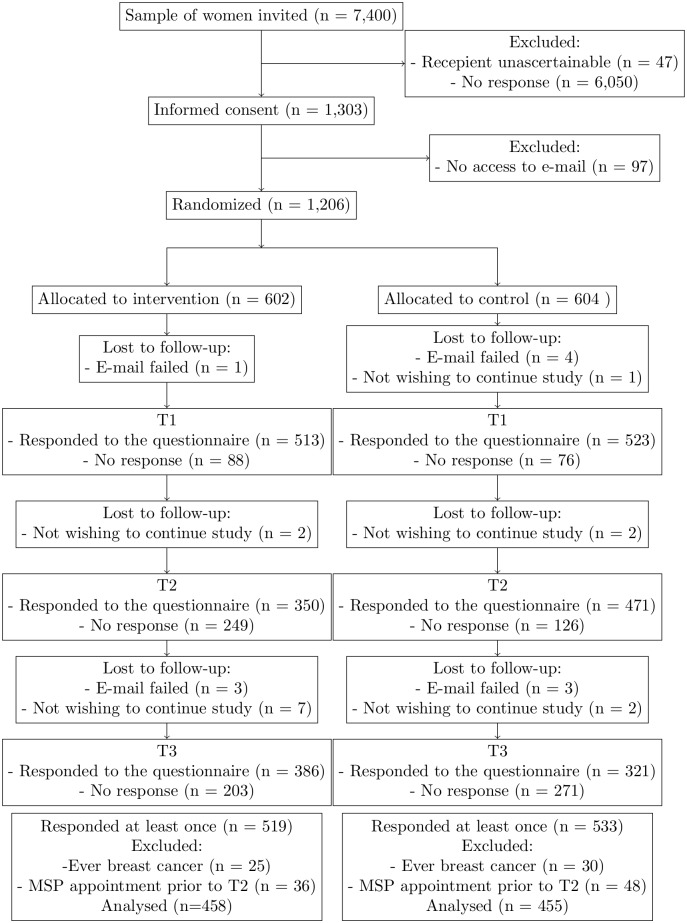
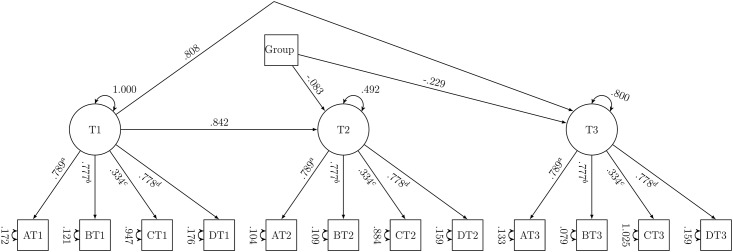
Methods: A representative sample of 7,400 women aged 50 was drawn from registration offices in Westphalia-Lippe, Germany. Women were randomised to receive usual care (i.e., the standard information brochure sent with the programme's invitation letter) or the decision aid. Data were collected online at baseline, post-intervention, and 3 months follow-up. The primary outcome was informed choice. Secondary outcomes were the constituents of informed choice (knowledge, attitude, intention/uptake), decisional conflict, decision regret, and decision stage. Outcomes were analysed using latent structural equation models and χ2-tests.
Results: 1,206 women participated (response rate of 16.3%). The decision aid increased informed choice. Women in the control group had lower odds to make an informed choice at post-intervention (OR 0.26, 95% CI 0.18-0.37) and at follow-up (OR 0.66, 95% CI 0.46-0.94); informed choices remained constant at 30%. This was also reflected in lower knowledge and more decisional conflict. Post-intervention, the uptake intention was higher in the control group, whereas the uptake rate at follow-up was similar. Women in the control group had a more positive attitude at follow-up than women receiving the decision aid. Decision regret and decision stage were not influenced by the intervention.
Conclusion: This paper describes the first systematic evaluation of a newly developed decision aid for the German mammography screening programme in a randomised controlled trial. Our decision aid proved to be an effective tool to enhance the rate of informed choice and was made accessible to the public.
Trial registration: German Clinical Trials Register DRKS00005176.
Conflict of interest statement
Figures
References
-
- Berens EM, Reder M, Razum O, Kolip P, Spallek J. Informed Choice in the German Mammography Screening Program by Education and Migrant Status: Survey among First-Time Invitees. PLoS One. 2015;10(11):e0142316 doi: 10.1371/journal.pone.0142316 - DOI - PMC - PubMed
-
- Stefanek ME. Uninformed compliance or informed choice? A needed shift in our approach to cancer screening. Journal of the National Cancer Institute. 2011;103(24):1821–1826. doi: 10.1093/jnci/djr474 - DOI - PubMed
-
- Gigerenzer G, Mata J, Frank R. Public Knowledge of Benefits of Breast and Prostate Cancer Screening in Europe. Journal of the National Cancer Institute. 2009;101(17):1216–1220. doi: 10.1093/jnci/djp237 - DOI - PMC - PubMed
-
- Marteau TM, Dormandy E, Michie S. A measure of informed choice. Health Expectations. 2001;4(2):99–108. doi: 10.1046/j.1369-6513.2001.00140.x - DOI - PMC - PubMed
Publication types
MeSH terms
LinkOut - more resources
Full Text Sources
Other Literature Sources
Medical
