


The combined fatigue effects of sequential exposure to seated whole body vibration and physical, mental, or concurrent work demands
- PMID: 29236752
- PMCID: PMC5728521
- DOI: 10.1371/journal.pone.0188468
The combined fatigue effects of sequential exposure to seated whole body vibration and physical, mental, or concurrent work demands
Abstract
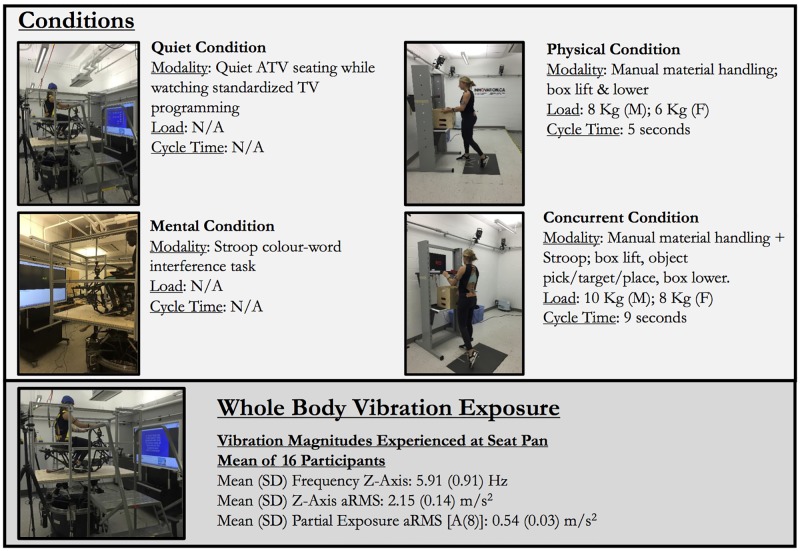
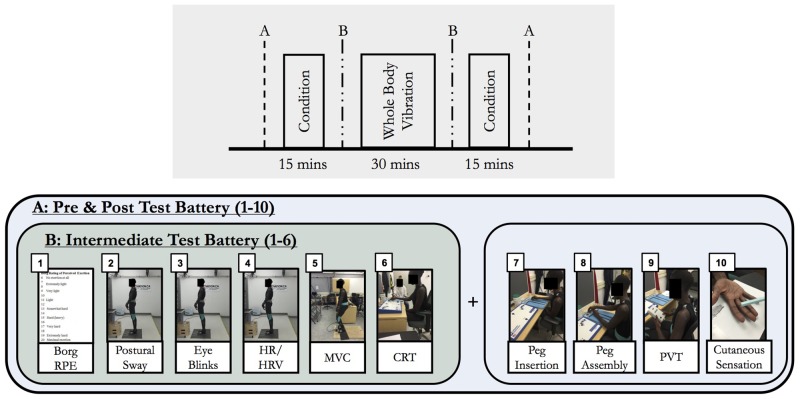
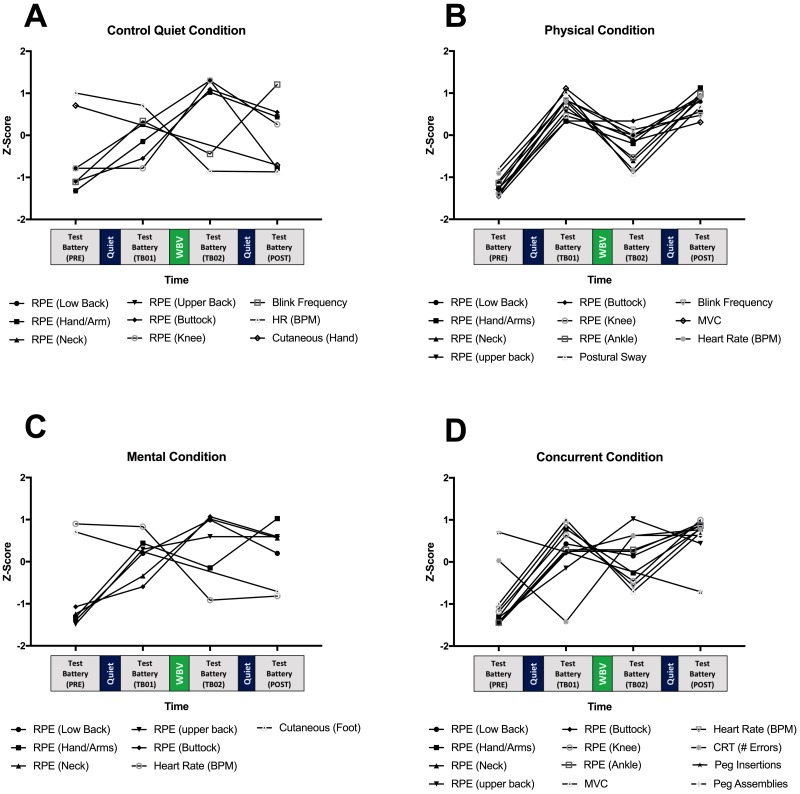
Many occupations in agriculture, construction, transportation, and forestry are non-routine, involving non-cyclical tasks, both discretionary and non-discretionary work breaks, and a mix of work activities. Workers in these industries are exposed to seated whole body vibration (WBV) and tasks consisting of physical, mental, or a combination of demands. Risk assessment tools for non-routinized jobs have emerged but there remains a need to understand the combined effects of different work demands to improve risk assessment methods and ultimately inform ergonomists and workers on optimum work arrangement and scheduling strategies. The objective of this study was to investigate fatigue-related human responses of WBV sequentially combined with physical, mental, or concurrent physical and mental demands. Sixteen healthy participants performed four conditions on four separate days: (1) physically demanding work, (2) mentally demanding work, (3) concurrent work, and (4) control quiet sitting. For each condition, participants performed two 15-minute bouts of the experimental task, separated by 30-minutes of simulated WBV based on realistic all-terrain vehicle (ATV) riding data. A test battery of fatigue measures consisting of biomechanical, physiological, cognitive, and sensorimotor measurements were collected at four interval periods: pre-session, after the first bout of the experimental task and before WBV, after WBV and before the second bout of the experimental task, and post-session. Nine measures demonstrated statistically significant time effects during the control condition; 11, 7, and 12 measures were significant in the physical, mental, and concurrent conditions, respectively. Overall, the effects of seated WBV in combination with different tasks are not additive but possibly synergistic or antagonistic. There appears to be a beneficial effect of seated ATV operation as a means of increasing task variation; but since excessive WBV may independently pose a health risk in the longer-term, these beneficial results may not be sensible as a long-term solution.
Conflict of interest statement
Figures
References
-
- Mathiassen SE, Christmansson M. Variation and autonomy In: Delleman NJ, Haslegrave CM, Chaffin DB, editors. Working postures and movements: Tools for evaluation and engineering. Boca Raton: CRC Press; 2004. p. 330–355.
-
- Gold JE, Park J-S, Punnett L. Work routinization and implications for ergonomic exposure assessment. Ergonomics. 2006; 49(1): 12–27. doi: 10.1080/00140130500356643 - DOI - PubMed
-
- Yung M, Bigelow PL, Hastings DM, Wells RP. Detecting within- and between-day manifestations of neuromuscular fatigue at work: An exploratory study. Ergonomics, 2014; 57(10): 1562–1573. doi: 10.1080/00140139.2014.934299 - DOI - PubMed
-
- Jahncke H, Hygge S, Mathiassen SE, Hallman D, Mixter S, Lyskov E. Variation at work: Alterations between physically and mentally demanding tasks in blue-collar occupations. Ergonomics, 2017. - PubMed
-
- Davis KG, Kotowski MS. Understanding the ergonomic risk for musculoskeletal disorders in the United States agricultural sector. American Journal of Industrial Medicine. 2007; 50(7): 501–511. doi: 10.1002/ajim.20479 - DOI - PubMed
MeSH terms
LinkOut - more resources
Full Text Sources
Other Literature Sources
Medical
Research Materials
