


Aflatoxin and viral hepatitis exposures in Guatemala: Molecular biomarkers reveal a unique profile of risk factors in a region of high liver cancer incidence
- PMID: 29236788
- PMCID: PMC5728519
- DOI: 10.1371/journal.pone.0189255
Aflatoxin and viral hepatitis exposures in Guatemala: Molecular biomarkers reveal a unique profile of risk factors in a region of high liver cancer incidence
Abstract
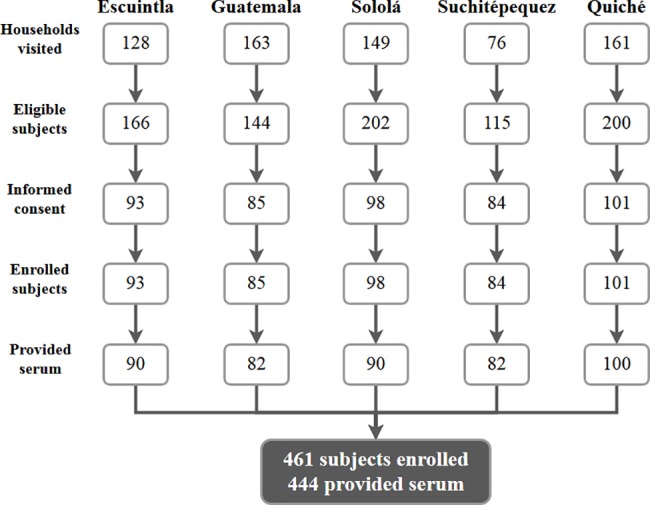
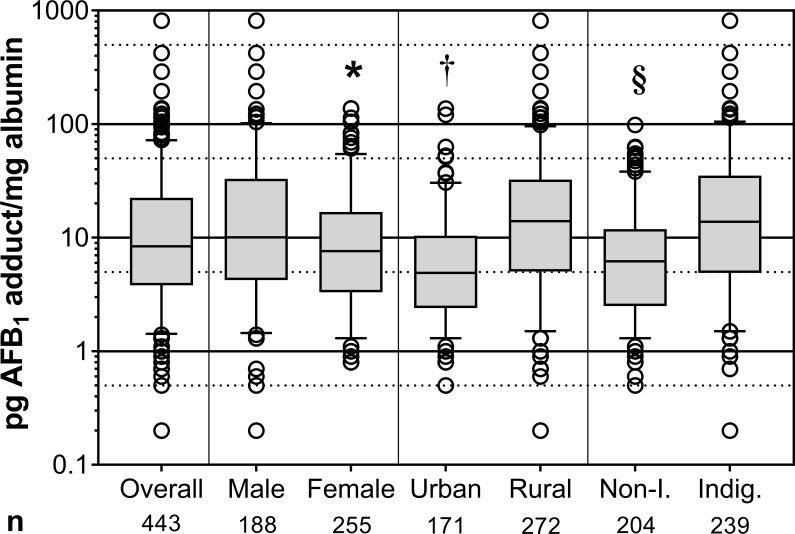
Liver cancer is an emerging global health issue, with rising incidence in both the United States and the economically developing world. Although Guatemala experiences the highest rates of this disease in the Western hemisphere and a unique 1:1 distribution in men and women, few studies have focused on this population. Thus, we determined the prevalence and correlates of aflatoxin B1 (AFB1) exposure and hepatitis virus infection in Guatemalan adults. Healthy men and women aged ≥40 years (n = 461), residing in five departments of Guatemala, were enrolled in a cross-sectional study from May-October of 2016. Serum AFB1-albumin adducts were quantified using isotope dilution mass spectrometry. Multivariate linear regression was used to assess relationships between AFB1-albumin adduct levels and demographic factors. Biomarkers of hepatitis B virus and hepatitis C virus infection were assessed by immunoassay and analyzed by Fisher's exact test. AFB1-albumin adducts were detected in 100% of participants, with a median of 8.4 pg/mg albumin (range, 0.2-814.8). Exposure was significantly higher (p<0.05) in male, rural, low-income, and less-educated participants than in female, urban, and higher socioeconomic status participants. Hepatitis B and C seropositivity was low (0.9% and 0.5%, respectively). Substantial AFB1 exposure exists in Guatemalan adults, concurrent with low prevalence of hepatitis virus seropositivity. Quantitatively, AFB1 exposures are similar to those previously found to increase risk for liver cancer in Asia and Africa. Mitigation of AFB1 exposure may reduce liver cancer incidence and mortality in Guatemala, warranting further investigation.
Conflict of interest statement
Figures
References
-
- Wild CP, Bucher JR, De Jong BWD, Dillner J, Von Gertten C, Groopman JD, et al. Translational Cancer Research: Balancing Prevention and Treatment to Combat Cancer Globally. J Natl Cancer Inst. 2015;107 doi: 10.1093/jnci/dju353 - DOI - PMC - PubMed
-
- International Agency for Research on Cancer WHO. World Cancer Report 2014. 2014. 9283204298
-
- Bray F, Jemal A, Grey N, Ferlay J, Forman D. Global cancer transitions according to the Human Development Index (2008–2030): A population-based study. Lancet Oncol. Elsevier Ltd; 2012;13: 790–801. doi: 10.1016/S1470-2045(12)70211-5 - DOI - PubMed
-
- Ferlay J, Soerjomataram I, Dikshit R, Eser S, Mathers C, Rebelo M, et al. Cancer incidence and mortality worldwide: Sources, methods and major patterns in GLOBOCAN 2012. Int J Cancer. 2015;136: E359–E386. doi: 10.1002/ijc.29210 - DOI - PubMed
-
- Torre LA, Bray F, Siegel RL, Ferlay J, Lortet-Tieulent J, Jemal A. Global Cancer Statistics, 2012. CA Cancer J Clin. 2015;65: 87–108. doi: 10.3322/caac.21262 - DOI - PubMed
MeSH terms
Substances
Grants and funding
LinkOut - more resources
Full Text Sources
Other Literature Sources
Medical
