. 2018 Nov 3;122(5):747-756.
doi: 10.1093/aob/mcx155.

Anaesthetics stop diverse plant organ movements, affect endocytic vesicle recycling and ROS homeostasis, and block action potentials in Venus flytraps

Affiliations

Anaesthetics stop diverse plant organ movements, affect endocytic vesicle recycling and ROS homeostasis, and block action potentials in Venus flytraps

K Yokawa et al. Ann Bot. .

Abstract

Background and aims: Anaesthesia for medical purposes was introduced in the 19th century. However, the physiological mode of anaesthetic drug actions on the nervous system remains unclear. One of the remaining questions is how these different compounds, with no structural similarities and even chemically inert elements such as the noble gas xenon, act as anaesthetic agents inducing loss of consciousness. The main goal here was to determine if anaesthetics affect the same or similar processes in plants as in animals and humans.

Methods: A single-lens reflex camera was used to follow organ movements in plants before, during and after recovery from exposure to diverse anaesthetics. Confocal microscopy was used to analyse endocytic vesicle trafficking. Electrical signals were recorded using a surface AgCl electrode.

Key results: Mimosa leaves, pea tendrils, Venus flytraps and sundew traps all lost both their autonomous and touch-induced movements after exposure to anaesthetics. In Venus flytrap, this was shown to be due to the loss of action potentials under diethyl ether anaesthesia. The same concentration of diethyl ether immobilized pea tendrils. Anaesthetics also impeded seed germination and chlorophyll accumulation in cress seedlings. Endocytic vesicle recycling and reactive oxygen species (ROS) balance, as observed in intact Arabidopsis root apex cells, were also affected by all anaesthetics tested.

Conclusions: Plants are sensitive to several anaesthetics that have no structural similarities. As in animals and humans, anaesthetics used at appropriate concentrations block action potentials and immobilize organs via effects on action potentials, endocytic vesicle recycling and ROS homeostasis. Plants emerge as ideal model objects to study general questions related to anaesthesia, as well as to serve as a suitable test system for human anaesthesia.


Figures
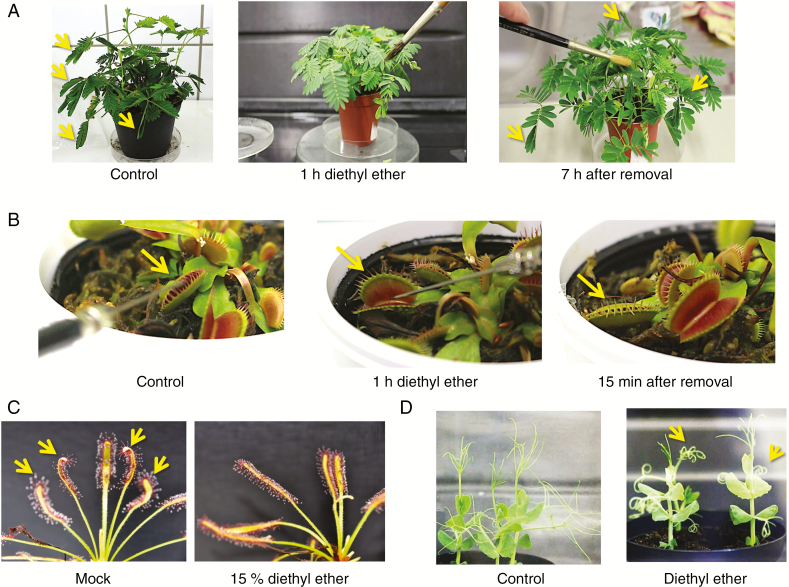
Fig. 1.
Fig. 1.
Effects of a volatile anaesthetic agent, diethyl ether, on plant movements. (A) The leaf-closing movement of Mimosa pudica under 15 % diethyl ether. After 1 h of treatment, leaves completely lost the response to touch stimuli. All leaves gradually recovered closure movement after 7 h following the removal of diethyl ether. Arrows indicate closed leaves. (B) The rapid trap movement of Dionaea muscipula disappeared after 1 h of 15 % diethyl ether treatment. The arrow indicates the leaf stimulated. (C) Sundew plant (Drosera capensis) showed no prey reaction under 15 % diethyl ether atmosphere. Arrows show normal trap bending reaction. (D) The movement of tendrils disappears with 15 % diethyl ether. The relevant movies are available as Supplementary Data.
Fig. 2.
Fig. 2.
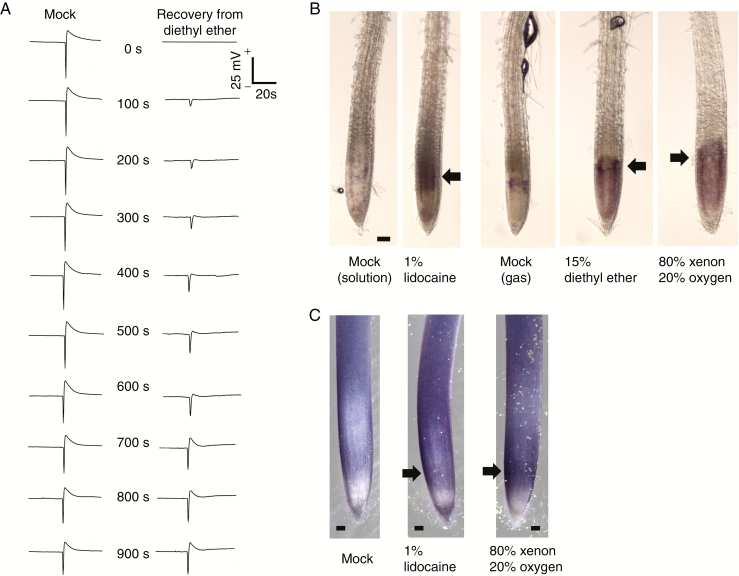
Disappearance and recovery of action potentials in Dionaea muscipula, and the production of reactive oxygen species in Arabidopsis roots under anaesthesia. (A) Recovery of diethyl ether inhibition of action potential on leaves of Venus flytrap in response to trigger hair stimulation recorded every 100 s after removal of diethyl ether. (B) NBT histochemical staining to detect superoxide production in Arabidopsis root apex. The treatment with anaesthetics promoted the generation of superoxide between the meristem and transition zones. (C) NBT staining in maize roots under lidocaine and xenon treatment. The purple–blue colour represents the area of superoxide generation. The black arrows indicate the position of strong NBT staining pattern. Representative images are shown from 7–9 stained samples.
Fig. 3.
Fig. 3.
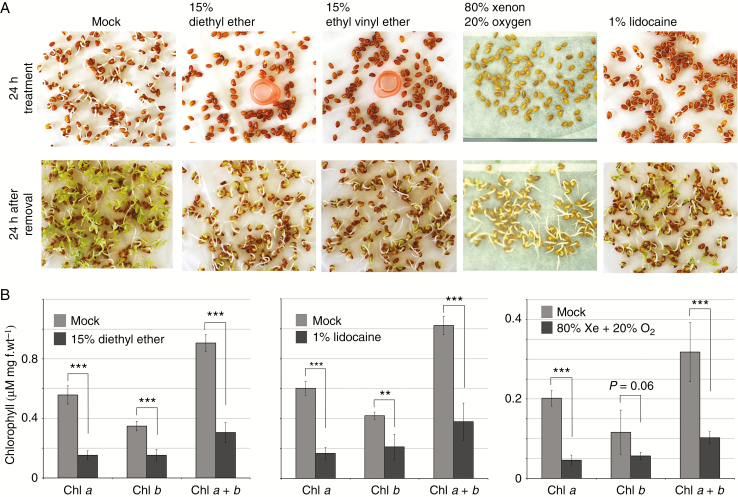
Inhibition of dormancy breaking and chlorophyll accumulation under anaesthetics. (A) Inhibition of cress seed germination under anaesthetic treatment. After 24 h, all anaesthetics inhibited germination. Seed germination recovered completely 24 h after removal of anaesthetics. (B) Anaesthetic treatment attenuates chlorophyll accumulation. Chlorophyll was extracted from the leaves of cress seedlings germinated after 24 h of anaesthetic treatment. The values are averaged from five independent treatments. The error bars represent the standard deviation (***P < 0.001; **P < 0.01)
Fig. 4.
Fig. 4.
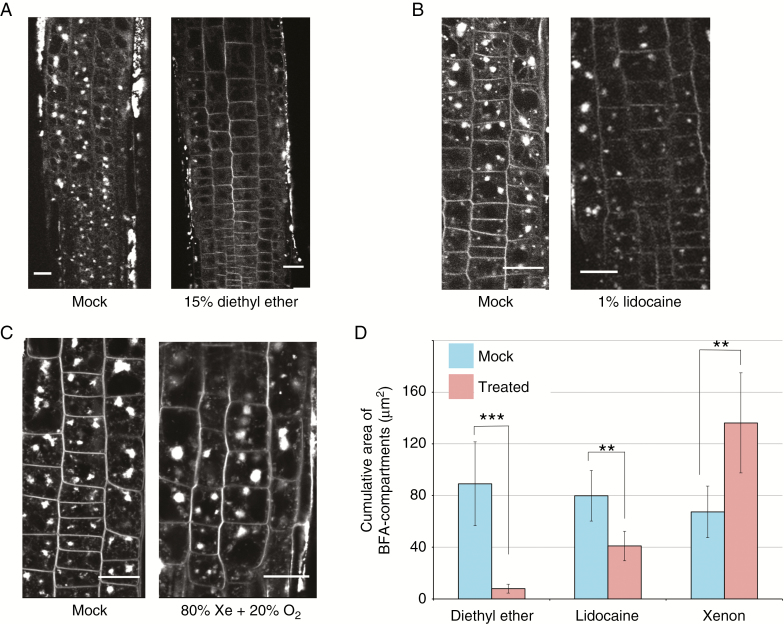
Anaesthetics modify vesicle recycling in Arabidopsis root epidermal cells. (A) Treatment with 15 % diethyl ether for 30 min; (B) 1 % lidocaine for 30 min; (C) 80 % xenon mixed with 20 % oxygen for 90 min. (D) A comparison of the size of BFA-induced compartments between mock and treated cells. The total area of BFA-induced compartments located inside a square of 50 μm2 was calculated and averaged from 7–9 independent roots. Error bars represent the standard deviation (***P < 0.001; **P < 0.01).

References

    1. Andersen OS, Koeppe RE 2nd. 2007. Bilayer thickness and membrane protein function: an energetic perspective. Annual Review of Biophysics and Biomolecular Structure 36:107–130. - PubMed
    1. Baluška F, Levin M. 2016. On having no head: cognition throughout biological systems. Frontiers in Psychology 7:902. - PMC - PubMed
    1. Baluška F, Mancuso S. 2013. Root apex transition zone as oscillatory zone. Frontiers in Plant Science 4:354. - PMC - PubMed
    1. Baluška F, Hlavacka A, Samaj J et al. 2002. F-actin-dependent endocytosis of cell wall pectins in meristematic root cells: insights from brefeldin A-induced compartments. Plant Physiology 130:422–431. - PMC - PubMed
    1. Baluška F, Yokawa K, Mancuso S, Baverstock K. 2016. Understanding of anesthesia – why consciousness is essential for life and not based on genes. Communications and Integrative Biology 9:e1238118. - PMC - PubMed

Publication types

MeSH terms