


Six-monthly appointment spacing for clinical visits as a model for retention in HIV Care in Conakry-Guinea: a cohort study
- PMID: 29237401
- PMCID: PMC5729484
- DOI: 10.1186/s12879-017-2826-6
Six-monthly appointment spacing for clinical visits as a model for retention in HIV Care in Conakry-Guinea: a cohort study
Abstract
Background: The outbreak of the Ebola virus disease (EVD) in 2014 led to massive dropouts in HIV care in Guinea. Meanwhile, Médecins Sans Frontières (MSF) was implementing a six-monthly appointment spacing approach adapted locally as Rendez-vous de Six Mois (R6M) with an objective to improve retention in care. We sought to evaluate this innovative model of ART delivery in circumstances where access to healthcare is restricted.
Methods: A retrospective cohort study in 2014 of the outcome of a group of stable patients (viral load ≤1000 copies/μl) enrolled voluntarily in R6M compared with a group of stable patients continuing standard one to three monthly visits in Conakry. Log-rank test and Cox proportional hazards model were used to compare rates of attrition (deaths and defaulters) from care between the two groups. A linear regression analysis was used to describe the trend or pattern in the number of clinical visits over time.
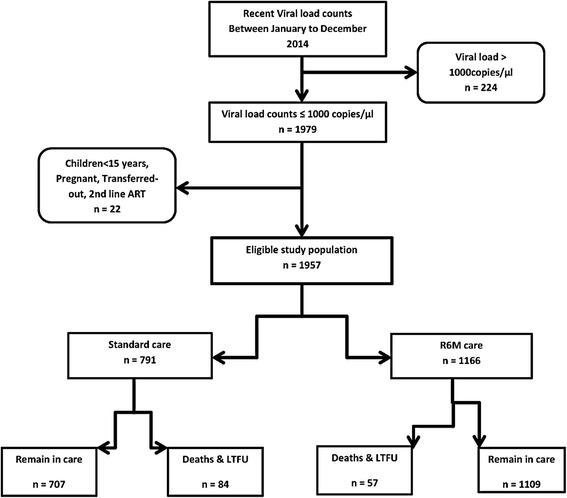
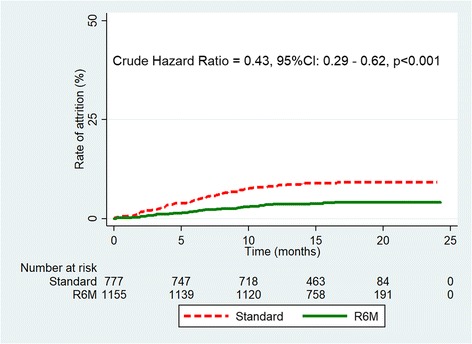
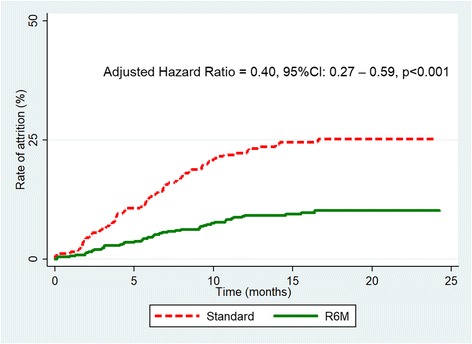
Results: Included were 1957 adults of 15 years old and above of whom 1166 (59.6%) were enrolled in the R6M group and 791 (40.4%) in the standard care group. The proportion remaining in care at 18 months and beyond was 90% in the R6M group; significantly higher than the 75% observed in the control group (p < 0.0001). After adjusting for duration on ART and tuberculosis co-infection as covariates, the R6M strategy was associated with a 60% reduction in the rate of attrition from care compared with standard care (adjusted Hazard Ratio = 0.40, 95%CI: 0.27-0.59, p < 0.001). There was a negative secular trend in the number of monthly clinical visits for 24 months as the predicted caseload reduced on average by just below 50 visits per month (β = -48.6, R2 = 0.82, p < 0.0001).
Conclusion: R6M was likely to reduce staff workload and to mitigate attrition from ART care for stable patients in Conakry despite restricted access to healthcare caused by the devastating EVD on the health system in Guinea. R6M could be rolled out as the model of care for stable patients where and when feasible as a strategy likely to improve retention in HIV care.
Keywords: ART delivery; Ebola epidemic; Guinea; Retention in HIV care.
Conflict of interest statement
Ethics approval and consent to participate
The study was approved by the MSF Ethical Review Board. Individual consent was not necessary because the study used existing clinical data. All patient information was anonymised and de-identified prior to analysis.
Consent for publication
Not applicable
Competing interests
The authors declare that they have no competing interests.
Publisher’s Note
Springer Nature remains neutral with regard to jurisdictional claims in published maps and institutional affiliations.
Figures


References
-
- WHO . Consolidated guidelines on the use of antiretroviral drugs for treating and preventing HIV infection: recommendations for a public health approach. Geneva: World Health Organization; 2013. - PubMed
-
- HIV/AIDS Fact sheet N°360 [http://www.who.int/mediacentre/factsheets/fs360/en/].
-
- WHO . March 2014 supplement to the 2013 consolidated guidelines on the use of antiretroviral drugs for treating and preventing HIV infection recommendations for a public health approach. Geneva: World Health Organization; 2014. - PubMed
-
- Joint United Nations Programme on HIV/AIDS (UNAIDS). 90–90–90 - An ambitious treatment target to help end the AIDS epidemic. In. Geneva; 2014.
-
- WHO . Consolidated guidelines on the use of antiretroviral drugs for treating and preventing HIV infection: recommendations for a public health approach. Geneva: World Health Organization; 2016. - PubMed
MeSH terms
Substances
LinkOut - more resources
Full Text Sources
Other Literature Sources
Medical
Miscellaneous
