


Trend of caesarean deliveries in Egypt and its associated factors: evidence from national surveys, 2005-2014
- PMID: 29237410
- PMCID: PMC5729511
- DOI: 10.1186/s12884-017-1591-2
Trend of caesarean deliveries in Egypt and its associated factors: evidence from national surveys, 2005-2014
Abstract
Background: The continued rise in caesarean section (c-section) deliveries raises a major public health concern worldwide. This study assessed the trend of c-section deliveries and examined factors associated with a rise in c-section deliveries among the Egyptian mothers, from 2005 to 2014, by place of delivery.
Methods: This study utilized the 2005, 2008, and 2014 Egypt Demographic and Health Surveys (EDHS). The EDHS reported on the mode of delivery for the last birth occurred within five years preceding each survey including place of delivery and sociodemographic information for a total sample of over 29,000 mothers in the three surveys. To document trend of c-section, the EDHS-2005 was set as a reference in two binary logistic regression models; among all mothers together and for mothers stratified by place of delivery (public or private). P-value for the trend was assessed by entering the year of the survey as a continuous variable. The study followed STROBE statement in reporting observational studies.
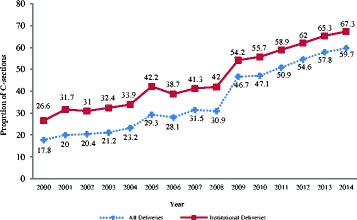
Results: Institutional-based c-sections increased by 40.7 points from EDHS-2005 to EDHS-2014 (aOR, 3.46, 95%CI: 3.15-3.80, P trend < 0.001). Compared to mothers with low socioeconomic status (SES), mothers with high SES had higher odds (aOR, 1.78, 95%CI: 1.25-2.54, P = 0.001) for c-section, but only in EDHS-2005. The adjusted trend of c-sections was found to be 4.19-time (95%CI: 3.73-4.70, P < 0.001) higher in private sector while that in public sector it was 2.67-time (95%CI: 2.27-3.13, P = 0.001) higher, in EDHS-2014 relative to EDHS-2005. This increase in the private sector is explained by significant increases among mothers who are potentially at low risk for c-sections; mothers aged 19-24 years vs. ≥35 years (aOR: 0.31, 95%CI: 0.21-0.45, in EDHS-2005 vs. 0.43, 95%CI: 0.33-0.56, in EDHS-2014, P < 0.001); primigravida mothers vs. mothers with ≥4 children (aOR: 1.62, 95%CI: 1.12-2.34, in EDHS-2005 vs. 3.76, 95%CI: 2.94-4.80 in EDHS-2014); and among normal compared to high risk birth weight babies (aOR: 0.79, 95%CI: 0.62-0.99 in EDHS-2005 P < 0.05 vs. 0.83, 95%CI: 0.65-1.04 in EDHS-2014, P > 0.05).
Conclusions: Results showed a steady rise in c-sections in Egypt that has reached an alarming level in recent years. This increase appears to be associated with a shift towards delivery in private health care facilities. More vigilance of c-section deliveries, particularly in the private sector, is warranted.
Keywords: Caesarean section delivery; Egypt; Maternal delivery; Maternal health.
Conflict of interest statement
Ethics approval and consent to participate
This study is based solely on a retrospective analysis of secondary existing anonymous survey data published by the DHS program. EDHS is approved by the government of Egypt. Data collection team obtained voluntary consent from sampled women to participate in the survey, study protocol and consent procedure are described elsewhere [16]. For this analysis, there was no need for permission from the institutional review board.
Consent for publication
Not applicable.
Competing interests
The author declares that he has no competing interests.
Publisher’s Note
Springer Nature remains neutral with regard to jurisdictional claims in published maps and institutional affiliations.
Figures
References
-
- World Health Organization. Statement on Caesarean Section Rates. (http://apps.who.int/iris/bitstream/10665/161442/1/WHO_RHR_15.02_eng.pdf) Accessed 12 Apr 2016.
-
- World Health Organization. Cesarean section without medical indication increases risk of short-term adverse outcomes for mothers. Geneva: WHO. Available from: http://whqlibdoc.who.int/hq/2010/WHO_RHR_HRP_10.20_eng.pdf. Accessed 21 Mar 2015.
-
- Souza JP, Gulmezoglu A, Lumbiganon P, Laopaiboon M, Carroli G, Fawole B, et al. Caesarean section without medical indications is associated with an increased risk of adverse short-term maternal outcomes: the 2004-2008 WHO global survey on maternal and Perinatal health. BMC Med. 2010;8:71. doi: 10.1186/1741-7015-8-71. PubMed PMID: 21067593; PubMed Central PMCID: PMCPMC2993644. - PMC - PubMed
-
- Villar J, Carroli G, Zavaleta N, Donner A, Wojdyla D, Faundes A, et al. Maternal and neonatal individual risks and benefits associated with caesarean delivery: multicentre prospective study. BMJ. 2007;335(7628):1025. doi: 10.1136/bmj.39363.706956.55. PubMed PMID: 17977819; PubMed Central PMCID: PMCPMC2078636. - PMC - PubMed
-
- Kennare R, Tucker G, Heard A, Chan A. Risks of adverse outcomes in the next birth after a first cesarean delivery. Obstet Gynecol 2007;109(2 Pt 1):270-276. doi: 10.1097/01.AOG.0000250469.23047.73. PubMed PMID: 17267823. - PubMed
MeSH terms
LinkOut - more resources
Full Text Sources
Other Literature Sources
Medical
