


Toward Genetics-Driven Early Intervention in Dilated Cardiomyopathy: Design and Implementation of the DCM Precision Medicine Study
- PMID: 29237686
- PMCID: PMC5842914
- DOI: 10.1161/CIRCGENETICS.117.001826
Toward Genetics-Driven Early Intervention in Dilated Cardiomyopathy: Design and Implementation of the DCM Precision Medicine Study
Abstract
Background: The cause of idiopathic dilated cardiomyopathy (DCM) is unknown by definition, but its familial subtype is considered to have a genetic component. We hypothesize that most idiopathic DCM, whether familial or nonfamilial, has a genetic basis, in which case a genetics-driven approach to identifying at-risk family members for clinical screening and early intervention could reduce morbidity and mortality.
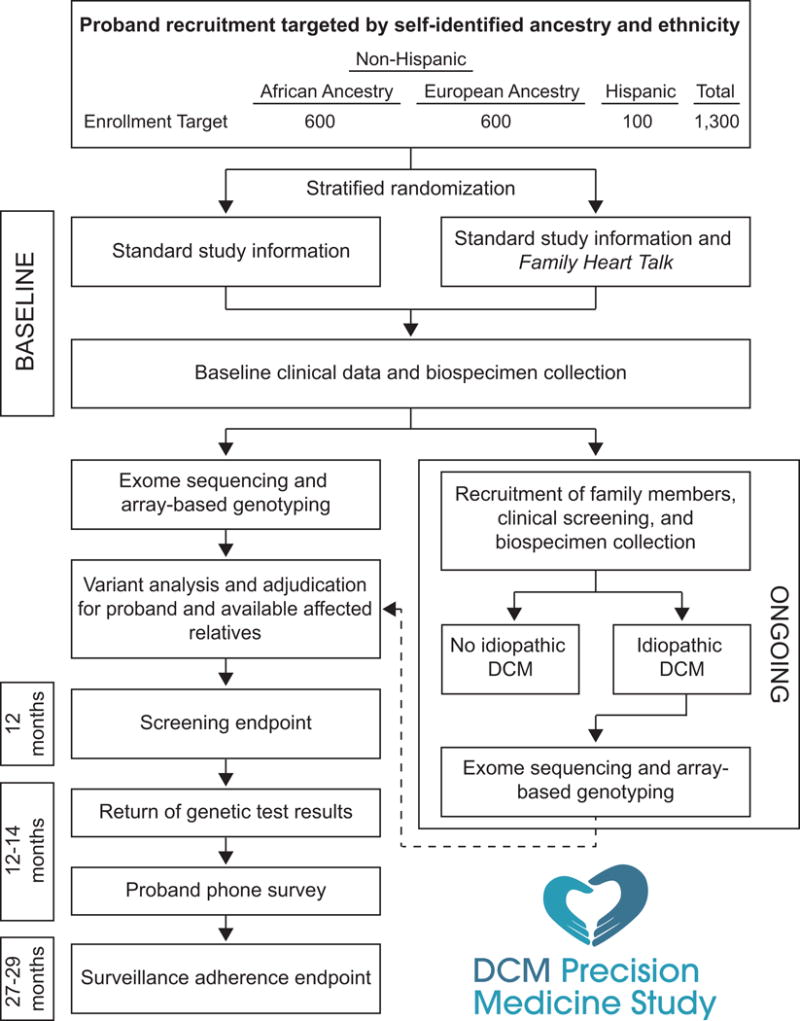
Methods: On the basis of this hypothesis, we have launched the National Heart, Lung, and Blood Institute- and National Human Genome Research Institute-funded DCM Precision Medicine Study, which aims to enroll 1300 individuals (600 non-Hispanic African ancestry, 600 non-Hispanic European ancestry, and 100 Hispanic) who meet rigorous clinical criteria for idiopathic DCM along with 2600 of their relatives. Enrolled relatives will undergo clinical cardiovascular screening to identify asymptomatic disease, and all individuals with idiopathic DCM will undergo exome sequencing to identify relevant variants in genes previously implicated in DCM. Results will be returned by genetic counselors 12 to 14 months after enrollment. The data obtained will be used to describe the prevalence of familial DCM among idiopathic DCM cases and the genetic architecture of idiopathic DCM in multiple ethnicity-ancestry groups. We will also conduct a randomized controlled trial to test the effectiveness of Family Heart Talk, an intervention to aid family communication, for improving uptake of preventive screening and surveillance in at-risk first-degree relatives.
Conclusions: We anticipate that this study will demonstrate that idiopathic DCM has a genetic basis and guide best practices for a genetics-driven approach to early intervention in at-risk relatives.
Clinical trial registration: URL: http://www.clinicaltrials.gov. Unique identifier: NCT03037632.
Keywords: communication; exome; genetics; morbidity; prevalence.
© 2017 American Heart Association, Inc.
Figures
References
-
- Yancy CW, Jessup M, Bozkurt B, Butler J, Casey DE, Drazner MH, et al. 2013 ACCF/AHA guideline for the management of heart failure. Circulation. 2013;128:e240–e327. - PubMed
-
- Japp AG, Gulati A, Cook SA, Cowie MR, Prasad SK. The diagnosis and evaluation of dilated cardiomyopathy. J Am Coll Cardiol. 2016;67:2996–3010. - PubMed
-
- Mahon NG, Murphy RT, MacRae CA, Caforio ALP, Elliott PM, McKenna WJ. Echocardiographic evaluation in asymptomatic relatives of patients with dilated cardiomyopathy reveals preclinical disease. Ann Intern Med. 2005;143:108–115. - PubMed
-
- Mozaffarian D, Benjamin EJ, Go AS, Arnett DK, Blaha MJ, Cushman M, et al. Heart disease and stroke statistics—2016 update. Circulation. 2016;133:e38–360. - PubMed
Publication types
MeSH terms
Supplementary concepts
Associated data
Grants and funding
LinkOut - more resources
Full Text Sources
Other Literature Sources
Medical
Molecular Biology Databases
