


Genome Assembly and Annotation of the Medicinal Plant Calotropis gigantea, a Producer of Anticancer and Antimalarial Cardenolides
- PMID: 29237703
- PMCID: PMC5919723
- DOI: 10.1534/g3.117.300331
Genome Assembly and Annotation of the Medicinal Plant Calotropis gigantea, a Producer of Anticancer and Antimalarial Cardenolides
Abstract
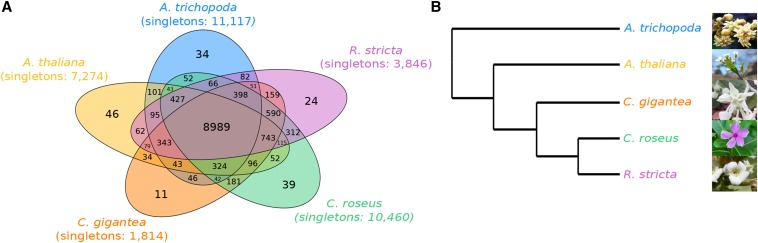
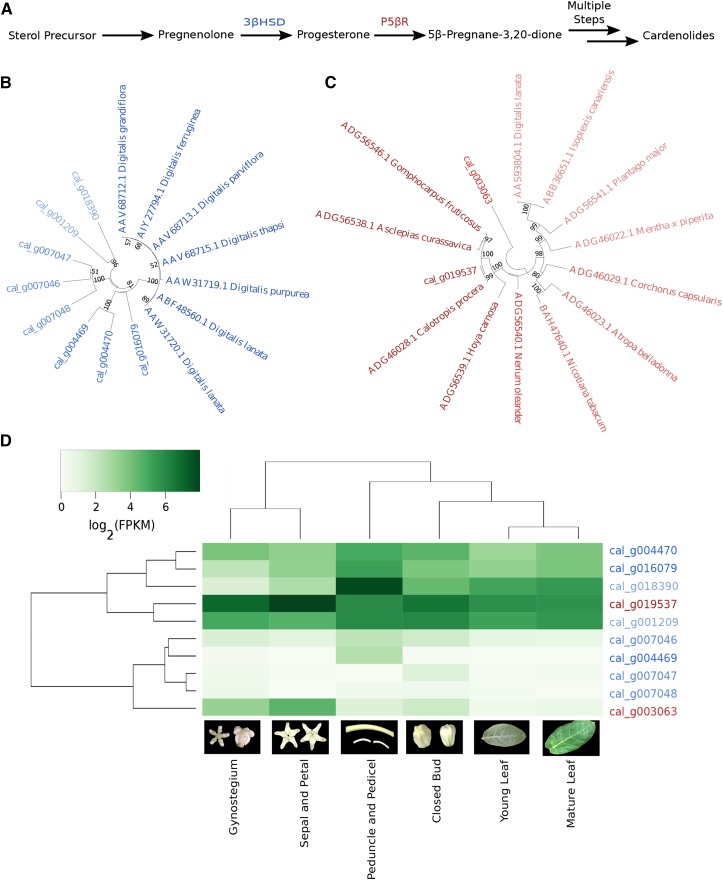
Calotropis gigantea produces specialized secondary metabolites known as cardenolides, which have anticancer and antimalarial properties. Although transcriptomic studies have been conducted in other cardenolide-producing species, no nuclear genome assembly for an Asterid cardenolide-producing species has been reported to date. A high-quality de novo assembly was generated for C. gigantea, representing 157,284,427 bp with an N50 scaffold size of 805,959 bp, for which quality assessments indicated a near complete representation of the genic space. Transcriptome data in the form of RNA-sequencing libraries from a developmental tissue series was generated to aid the annotation and construction of a gene expression atlas. Using an ab initio and evidence-driven gene annotation pipeline, 18,197 high-confidence genes were annotated. Homologous and syntenic relationships between C. gigantea and other species within the Apocynaceae family confirmed previously identified evolutionary relationships, and suggest the emergence or loss of the specialized cardenolide metabolites after the divergence of the Apocynaceae subfamilies. The C. gigantea genome assembly, annotation, and RNA-sequencing data provide a novel resource to study the cardenolide biosynthesis pathway, especially for understanding the evolutionary origin of cardenolides and the engineering of cardenolide production in heterologous organisms for existing and novel pharmaceutical applications.
Keywords: Apocynaceae family; Calotropis gigantea; Genome Report; cardenolide; genome assembly; pharmaceutical.
Copyright © 2018 Hoopes et al.
Figures
References
-
- Agrawal A. A., Petschenka G., Bingham R. A., Weber M. G., Rasmann S., 2012. Toxic cardenolides: chemical ecology and coevolution of specialized plant-herbivore interactions. New Phytol. 194: 28–45. - PubMed
-
- Amborella Genome Project , 2013. The Amborella genome and the evolution of flowering plants. Science. 342: 1241089. - PubMed
-
- Andrews, S., 2010 FastQC: a quality control tool for high throughput sequence data. Available at: http://www.bioinformatics.babraham.ac.uk/projects/fastqc.
-
- Bauer P., Munkert J., Brydziun M., Burda E., Müller-Uri F., et al. , 2010. Highly conserved progesterone 5β-reductase genes (P5βR) from 5β-cardenolide-free and 5β-cardenolide-producing angiosperms. Phytochemistry 71: 1495–1505. - PubMed
Publication types
MeSH terms
Substances
LinkOut - more resources
Full Text Sources
Other Literature Sources