. 2018 Apr;29(4):1097-1107.
doi: 10.1681/ASN.2017090962. Epub 2017 Dec 13.

Ascending Vasa Recta Are Angiopoietin/Tie2-Dependent Lymphatic-Like Vessels

Affiliations

Ascending Vasa Recta Are Angiopoietin/Tie2-Dependent Lymphatic-Like Vessels

Yael Kenig-Kozlovsky et al. J Am Soc Nephrol. 2018 Apr.

Abstract

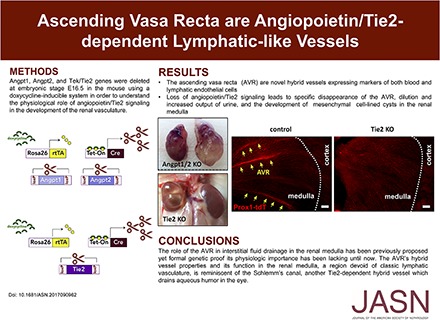
Urinary concentrating ability is central to mammalian water balance and depends on a medullary osmotic gradient generated by a countercurrent multiplication mechanism. Medullary hyperosmolarity is protected from washout by countercurrent exchange and efficient removal of interstitial fluid resorbed from the loop of Henle and collecting ducts. In most tissues, lymphatic vessels drain excess interstitial fluid back to the venous circulation. However, the renal medulla is devoid of classic lymphatics. Studies have suggested that the fenestrated ascending vasa recta (AVRs) drain the interstitial fluid in this location, but this function has not been conclusively shown. We report that late gestational deletion of the angiopoietin receptor endothelial tyrosine kinase 2 (Tie2) or both angiopoietin-1 and angiopoietin-2 prevents AVR formation in mice. The absence of AVR associated with rapid accumulation of fluid and cysts in the medullary interstitium, loss of medullary vascular bundles, and decreased urine concentrating ability. In transgenic reporter mice with normal angiopoietin-Tie2 signaling, medullary AVR exhibited an unusual hybrid endothelial phenotype, expressing lymphatic markers (prospero homeobox protein 1 and vascular endothelial growth factor receptor 3) as well as blood endothelial markers (CD34, endomucin, platelet endothelial cell adhesion molecule 1, and plasmalemmal vesicle-associated protein). Taken together, our data redefine the AVRs as Tie2 signaling-dependent specialized hybrid vessels and provide genetic evidence of the critical role of AVR in the countercurrent exchange mechanism and the structural integrity of the renal medulla.

Keywords: Tie2; angiopoietin; ascending vasa recta; countercurrent exchange; fluid homeostasis; lymphatic.


Figures

None
Graphical abstract
Figure 1.
Figure 1.
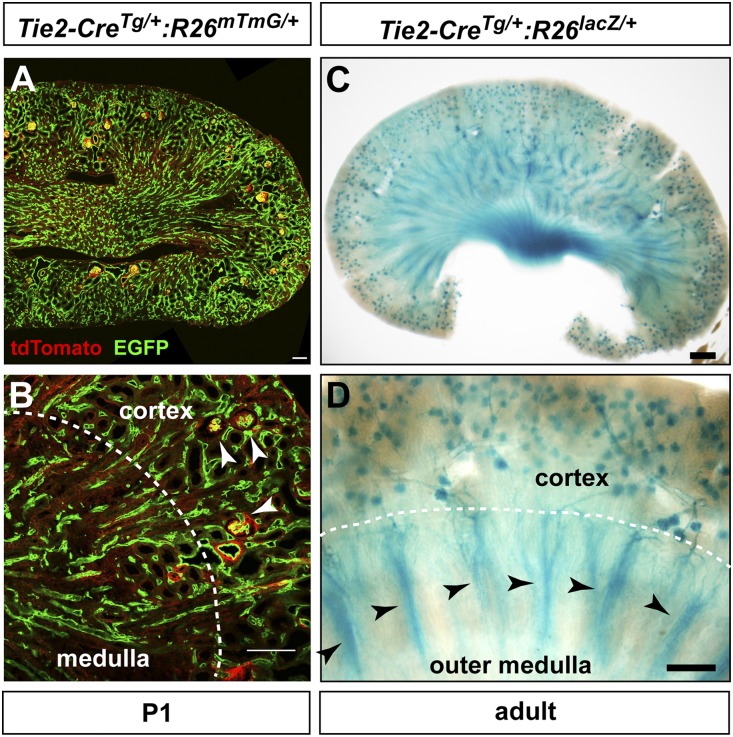
Lineage-tracing analysis reveals Tie2 expression pattern in the renal microvasculature. (A) Cells with prior or current Tie2 promoter activity observed as EGFP fluorescence in a P1 animal doubly hemizygous for the transgenes Tie2-Cre and Rosa26mTmG (R26mTmG). (B) Higher magnification pattern of Tie2 promoter activity in a P1 kidney showing EGFP expression in glomeruli (white arrowheads) and peritubular capillaries within the cortex and medulla. (C) LacZ histochemical staining of a vibratome-sectioned adult kidney from a mouse hemizygous for both Tie2-Cre and Rosa26lacZ (R26lacZ) transgenes showing Tie2 promoter activity consistent with the renal vascular network. (D) Cortical and outer medullary lacZ staining pattern in an adult kidney showing prior or current Tie2-Cre activity in glomeruli, cortical peritubular capillaries, medullary capillary plexus, and medullary vascular bundles (black arrowheads). Scale bars, 100 μm.
Figure 2.
Figure 2.
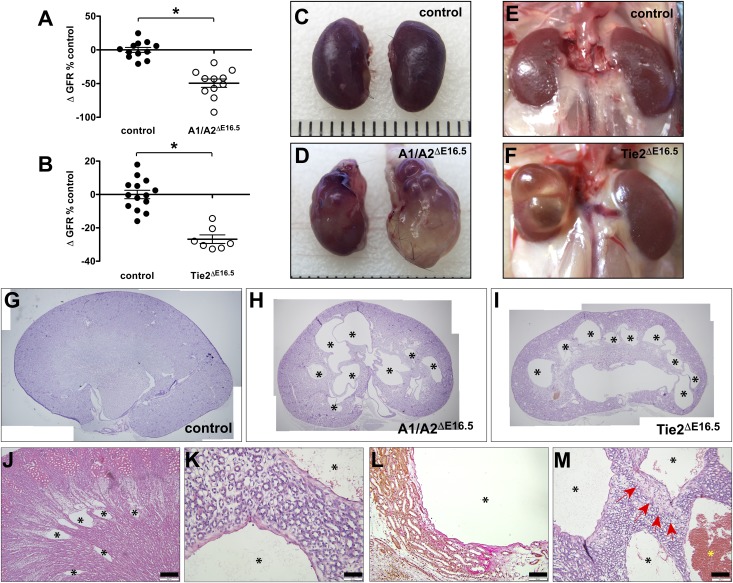
Renal cysts develop in the absence of Angpt1/2-Tie2 signaling. (A) Reduced GFR in A1/A2ΔE16.5 mutants. (B) Reduced GFR in Tie2ΔE16.5 mutants. Asterisks in A and B denote statistical significance at P<0.05. Gross kidney appearances in adult mice showing renal cysts in (D and F) compound Angpt1/2 (A1/A2ΔE16.5) and Tie2 (Tie2ΔE16.5) knockout mutants in comparison with (C and E) their control littermates, respectively. (G–I) Stitched images of hematoxylin and eosin histology of adult kidneys showing multiple cysts (asterisks) in A1/A2ΔE16.5 and Tie2ΔE16.5 mutants. (J) Medullary microcyst (asterisks) development in a P10 Tie2ΔE16.5 kidney. (K) Higher magnification image showing squamous cells lining renal cysts. (L) Van Gieson staining reveals collagen matrix accumulation around cysts (shown from a representative A1/A2ΔE16.5 kidney). (M) Occasional hemorrhage in renal cysts (yellow asterisk) shown from a representative of hematoxylin and eosin–stained A1/A2ΔE16.5 kidney. Specimen ages: 10 weeks in A, B, and E–I; 20 weeks in C, D, and K–M; and P10 in J. Scale bars, 100 μm in J–M.
Figure 3.
Figure 3.
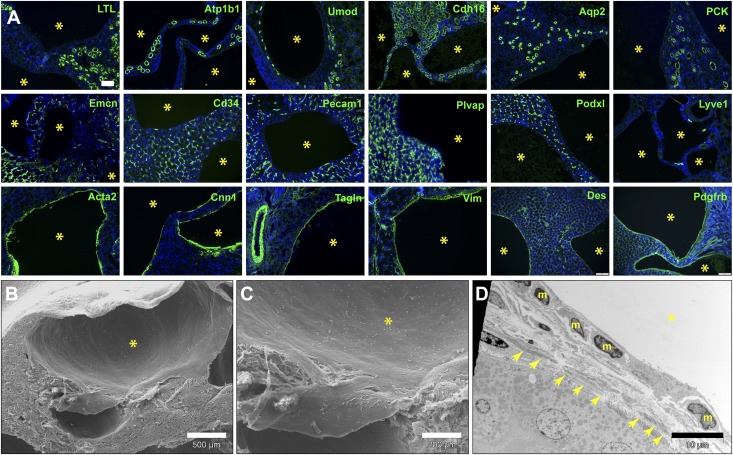
Renal cysts arising from loss of Angpt1/2-Tie signaling uniformly express myofibroblast markers. (A) Representative immunofluorescence analysis of renal cysts (yellow asterisks) found adult A1/A2ΔE16.5mutants showing lack of expression of epithelial tubule–specific (L. tetraglobulus lectin [LTL], Na+/K+-ATPase [Atp1b1], uromodulin [Umod], Ksp-cadherin [Cdh16], aquaporin-2 [Aqp2], and pancytokeratin [PCK]) and endothelial (Emcn, Cd34, Pecam1, Plvap, Podxl, and Lyve1) markers but strong expression of myofibroblast markers (Acta2, Cnn1, Tagln, Vim, desmin [Des], and PDGFRβ receptor [Pdgfrb]). (B and C) Scanning electron and (D) transmission electron micrographs of renal cysts (yellow asterisks) in an adult Tie2ΔE16.5 kidney showing the squamous mesenchymal morphology of cells lining cysts (nuclei labeled m). Fibrillar deposits are also visible underneath the cyst linings (arrows). Scale bars, 100 μm in A; 500μm in B; 200 μm in C; 10 μm in D.
Figure 4.
Figure 4.
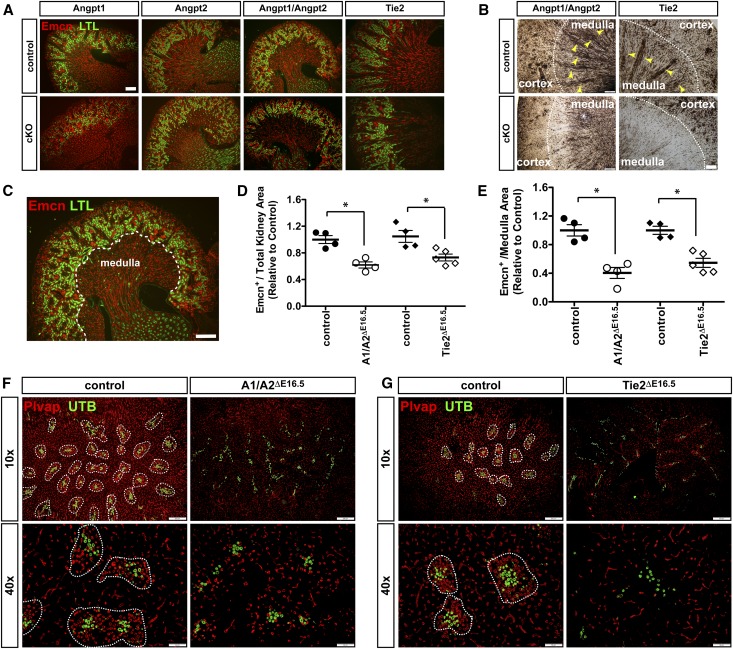
AVRs are lost and renal vascular density is reduced upon attenuation of Angpt1/2-Tie2 signaling. (A) Sagittal sections of P5 kidneys doubly stained for Emcn and L. tetraglobulus lectin (LTL) showing attenuated vascular density in the absence of both Angpt1 and Angpt2 together and Tie2 but not in singular loss of Angpt1 or Angpt2. (B) Immunohistochemical staining for Emcn in adult kidneys showing persistence of renal vascular density reduction in A1/A2ΔE16.5 and Tie2ΔE16.5 mutants and notable loss of medullary vascular bundles (yellow arrowheads). cKO, homozygous conditional knockout mutant. (C) Representative sagittal section of a P5 kidney indicating the demarcation (white dotted line) of cortical and medullary regions on the basis of LTL-stained proximal tubules for quantification of Emcn staining density. (D) Emcn staining area normalized to total tissue area in fully sectioned kidneys showing reduced total renal vascular densities in A1/A2ΔE16.5 and TieΔE16.5 mutant compared with control littermates. (E) Emcn staining density indicating significant medullary vascular reduction in A1/A2ΔE16.5 and TieΔE16.5 mutants relative to controls. (F) Plvap and UTB coimmunostaining of transverse kidney sections at the level of the outer medulla showing diminished Plvap-stained microvasculature in a representative kidney from an A1/A2ΔE16.5 mutant. AVR clusters but not the DVRs are lost in A1/A2ΔE16.5 mutants. (G) Diminished Plvap-stained microvasculature in the outer medulla in representative kidney from a TieΔE16.5 mutant. Similar to A1/A2ΔE16.5 mutants, TieΔE16.5 mutants have distinctive loss of AVRs but not the DVRs. (F and G) Vascular bundles formed by Plvap+ve AVR and UTB+ve DVR are encircled. Scale bars: 200 μm in A–C, F, upper panel, and G, upper panel; 50 μm in F, lower panel, and G, lower panel. Statistically significant means (P<0.05) are denoted by asterisks in D and E.
Figure 5.
Figure 5.
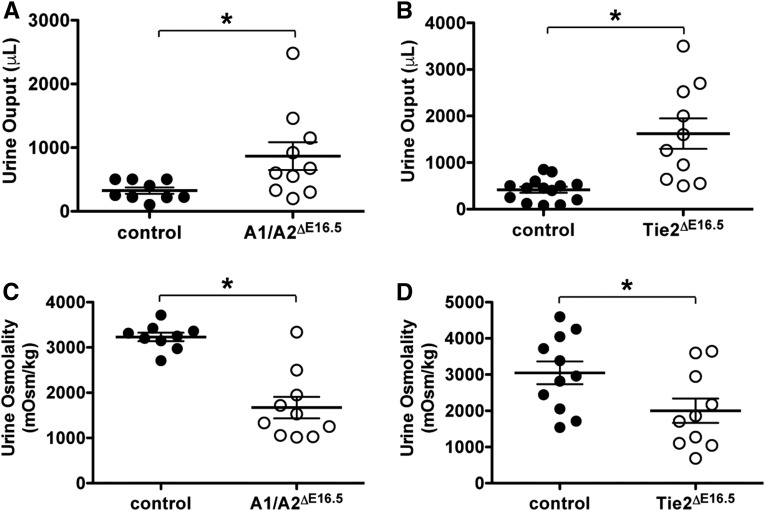
A1/A2ΔE16.5 and Tie2ΔE16.5 mutants have urine concentration defects. Total urine collected within a 24-hour period showing increased urine output from (A) A1/A2ΔE16.5 and (B) Tie2ΔE16.5 mutants. Osmolality measurements on urine samples showing dilute urine production from (C) A1/A2ΔE16.5 and (D) Tie2ΔE16.5 mutants. Statistically significant means (P<0.05) are denoted by asterisks.
Figure 6.
Figure 6.
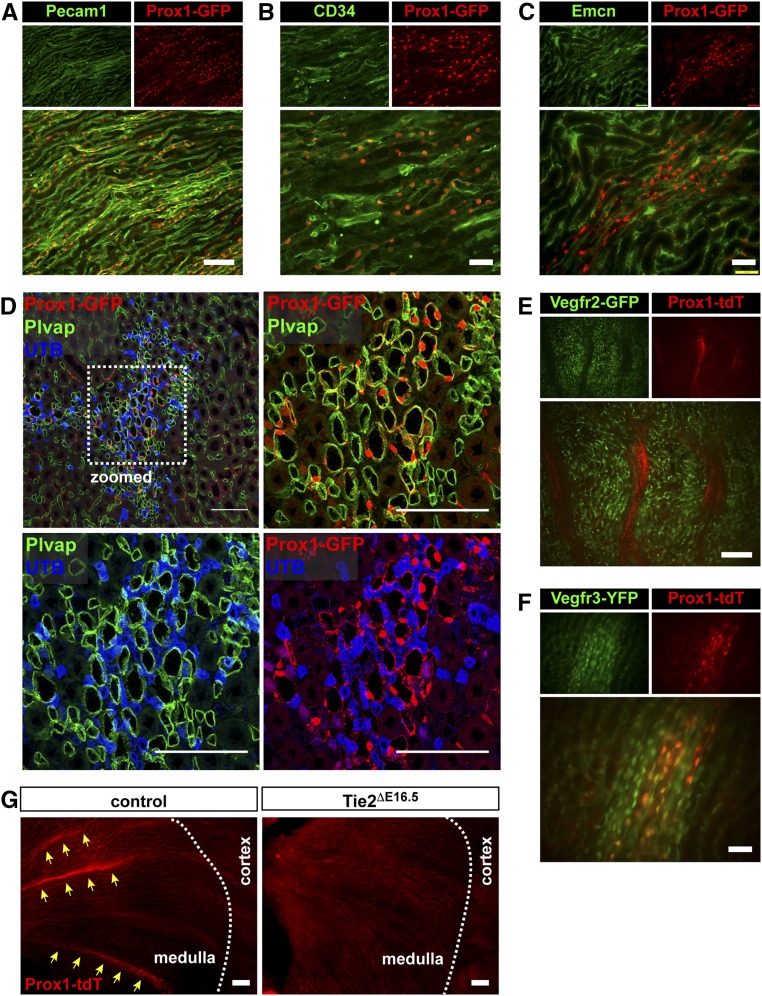
The AVR bundles lost on inactivation of Angpt1/2 signaling express Prox1 and Vegfr3. In Prox1-GFP reporter mice, vessels within medullary vascular bundles coexpress GFP with (A) Pecam1, (B) CD34, (C) Emcn, and (D) Plvap but not UTB. (E) TdTomato and GFP expressions in Prox1-tdTomato (Prox1-tdT)/Vegfr2-GFP double-reporter mice do not overlap. Prox1-tdT+ve medullary vessels do not express GFP. (F) In Prox1-tdT/Vegfr3-YFP double-reporter mice, YFP expression overlaps with tdTomato in medullary vascular bundles. (G) Prox1+ve AVR vessels are lost in kidneys from Tie2ΔE16.5 mutants. Scale bars: 100μm in A, D, F, and G; 50 μm in B, C, and E.
Figure 7.
Figure 7.
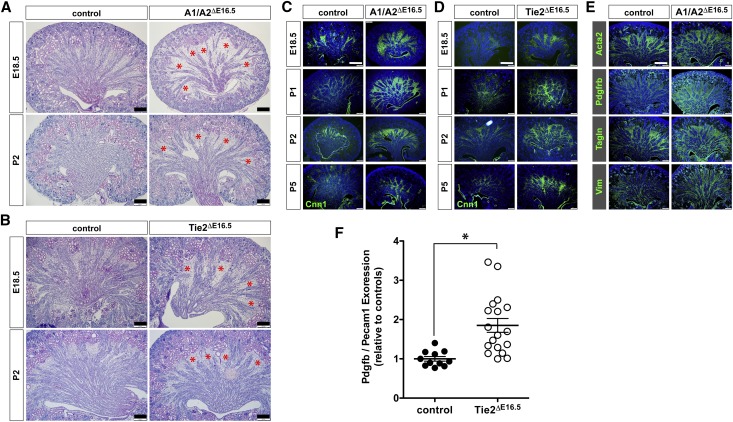
A1/A2ΔE16.5 and Tie2ΔE16.5 mutants have abnormal expansion of the renal interstitium. (A and B) Periodic acid–Schiff histology of E18.5 and P2 kidney sections showing similar expansion of medullary interstitium (red asterisks) in A1/A2ΔE16.5 and Tie2ΔE16.5 mutants. (C and D) Immunofluorescence staining for the interstitial marker Cnn1 showing expansion of the interstitium at E18.5, P1, P2, and P5 in A1/A2ΔE16.5 and Tie2ΔE16.5 mutants. (E) Immunofluorescence staining for other myofibroblast markers (Acta2, PDGFRβ receptor [Pdgfrb], Tagln, and Vim) notably expressed in the medullary interstitium as seen in P1 kidneys showing increased expression of these markers in the kidneys of A1/A2ΔE16.5 mutants. (F) Renal expression of Pdgfb is increased in the absence of Tie2 signaling on the basis of quantitative RT-PCR analysis. Pdgfb relative to Pecam1 gene expression as normalized to controls from P1 kidneys. Statistically significant means (P<0.05) are denoted by an asterisk. Scale bars: 200 μm in A and B; 400 μm in C–E.

Comment in

References

    1. Munger KA, Maddox DA, Brenner BM, Kost CK: The renal circulations and glomerular ultrafiltration. In: Brenner & Rector’s the Kidney, 10th Ed., edited by Skorecki K, Chertow GM, Marsden PA, Taal MW, Yu ASL, Philadelphia, Elsevier, 2016, pp 83–111
    1. Pallone TL, Chunhua C: Renal cortical and medullary microcirculations: Structure and function. In: Seldin and Giebisch’s the Kidney, 5th Ed., edited by Alpern RJ, Moe OW, Caplan MJ, London, Academic Press, 2013, pp 803–857
    1. Kriz W, Kaissling B: Structural organization of the mammalian kidney. In: Seldin and Giebisch’s the Kidney, 5th Ed., edited by Alpern RJ, Moe OW, Caplan MJ, Amsterdam, Elsevier, 2013, pp 595–691
    1. Schwartz MM, Karnovsky MJ, Vehkatachalam MA: Ultrastructural differences between rat inner medullary descending and ascending vasa recta. Lab Invest 35: 161–170, 1976 - PubMed
    1. Pallone TL, Turner MR, Edwards A, Jamison RL: Countercurrent exchange in the renal medulla. Am J Physiol Regul Integr Comp Physiol 284: R1153–R1175, 2003 - PubMed

Publication types

MeSH terms