. 2017 Dec 13;9(420):eaao4163.
doi: 10.1126/scitranslmed.aao4163.

Durability and correlates of vaccine protection against Zika virus in rhesus monkeys

Affiliations

Durability and correlates of vaccine protection against Zika virus in rhesus monkeys

Peter Abbink et al. Sci Transl Med. .

Abstract

An effective Zika virus (ZIKV) vaccine will require long-term durable protection. Several ZIKV vaccine candidates have demonstrated protective efficacy in nonhuman primates, but these studies have typically involved ZIKV challenge shortly after vaccination at peak immunity. We show that a single immunization with an adenovirus vector-based vaccine, as well as two immunizations with a purified inactivated virus vaccine, afforded robust protection against ZIKV challenge in rhesus monkeys at 1 year after vaccination. In contrast, two immunizations with an optimized DNA vaccine, which provided complete protection at peak immunity, resulted in reduced protective efficacy at 1 year that was associated with declining neutralizing antibody titers to subprotective levels. These data define a microneutralization log titer of 2.0 to 2.1 as the threshold required for durable protection against ZIKV challenge in this model. Moreover, our findings demonstrate that protection against ZIKV challenge in rhesus monkeys is possible for at least 1 year with a single-shot vaccine.


Figures

Figure 1
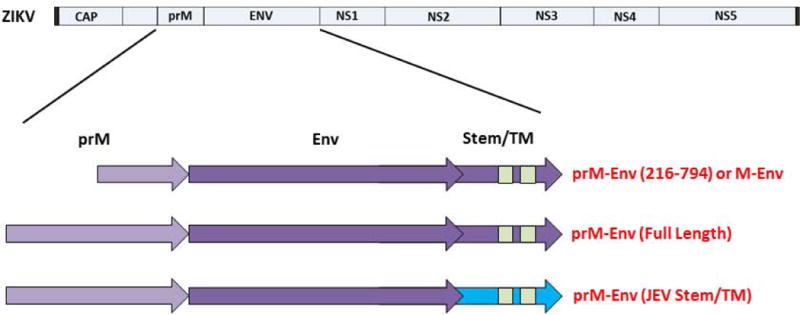
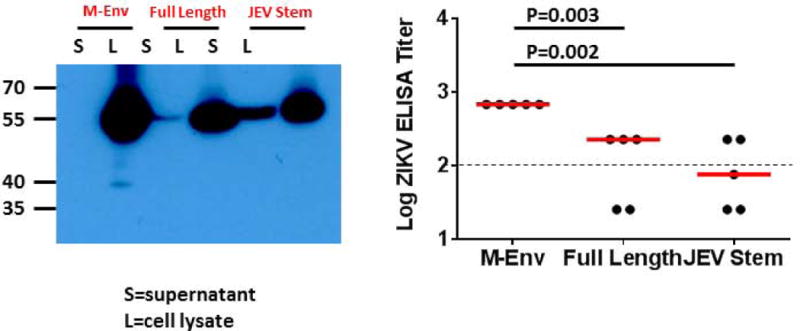
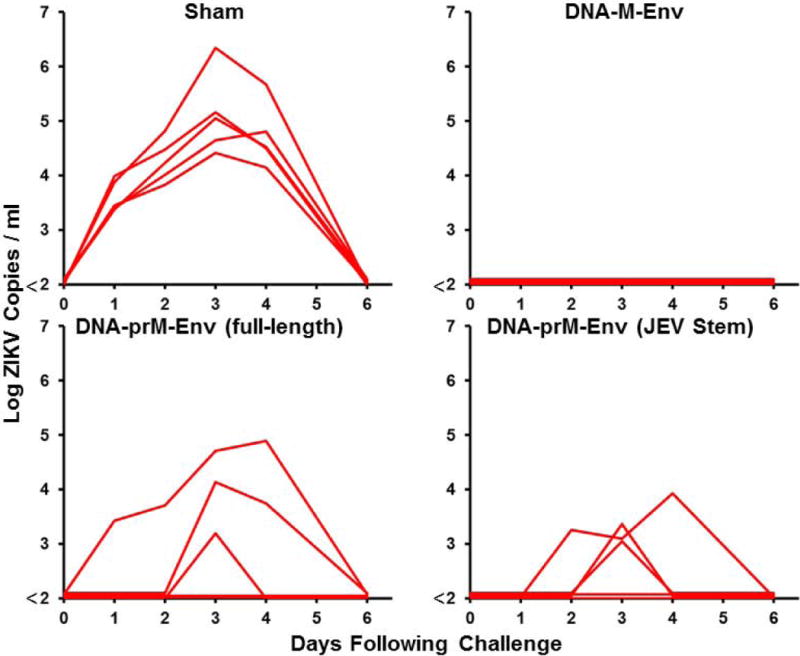
Figure 1. ZIKV prM-Env antigen development
(A) Scheme of the ZIKV prM-Env antigens tested: cleavage peptide-deleted prM-Env (amino acids 216-794; also termed M-Env), full-length prM-Env, and full-length prM-Env with the stem and transmembrane (TM) region of Japanese encephalitis virus (JEV). (B) Expression from DNA vaccines expressing these three antigens by Western blot and immunogenicity in Balb/c mice (N=5/group) by Env-specific ELISA following a single immunization of 50 μg of DNA vaccines expressing M-Env, prM-Env (full-length), or prM-Env (JEV stem). P-values were determined by t-test. The dotted line reflects log ELISA titers of 2.0. Red lines reflect medians. (C) Mice were challenged by the i.v. route with 105 VP (102 PFU) ZIKV-BR. Viral loads were determined in serum on days 0, 1, 2, 3, 4, and 6.
Figure 1
Figure 1. ZIKV prM-Env antigen development
(A) Scheme of the ZIKV prM-Env antigens tested: cleavage peptide-deleted prM-Env (amino acids 216-794; also termed M-Env), full-length prM-Env, and full-length prM-Env with the stem and transmembrane (TM) region of Japanese encephalitis virus (JEV). (B) Expression from DNA vaccines expressing these three antigens by Western blot and immunogenicity in Balb/c mice (N=5/group) by Env-specific ELISA following a single immunization of 50 μg of DNA vaccines expressing M-Env, prM-Env (full-length), or prM-Env (JEV stem). P-values were determined by t-test. The dotted line reflects log ELISA titers of 2.0. Red lines reflect medians. (C) Mice were challenged by the i.v. route with 105 VP (102 PFU) ZIKV-BR. Viral loads were determined in serum on days 0, 1, 2, 3, 4, and 6.
Figure 1
Figure 1. ZIKV prM-Env antigen development
(A) Scheme of the ZIKV prM-Env antigens tested: cleavage peptide-deleted prM-Env (amino acids 216-794; also termed M-Env), full-length prM-Env, and full-length prM-Env with the stem and transmembrane (TM) region of Japanese encephalitis virus (JEV). (B) Expression from DNA vaccines expressing these three antigens by Western blot and immunogenicity in Balb/c mice (N=5/group) by Env-specific ELISA following a single immunization of 50 μg of DNA vaccines expressing M-Env, prM-Env (full-length), or prM-Env (JEV stem). P-values were determined by t-test. The dotted line reflects log ELISA titers of 2.0. Red lines reflect medians. (C) Mice were challenged by the i.v. route with 105 VP (102 PFU) ZIKV-BR. Viral loads were determined in serum on days 0, 1, 2, 3, 4, and 6.
Figure 2
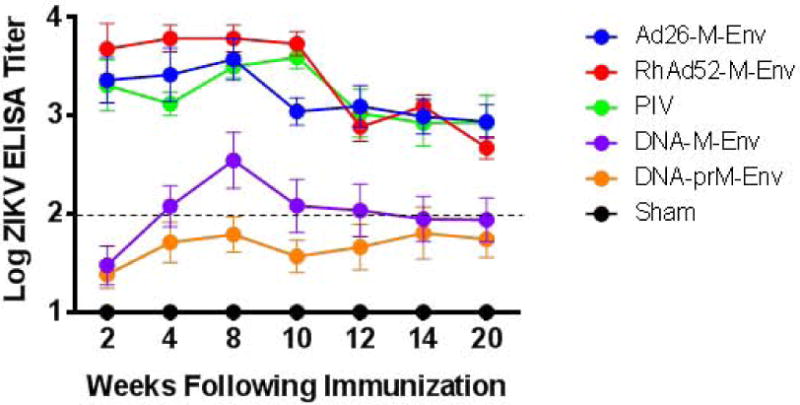
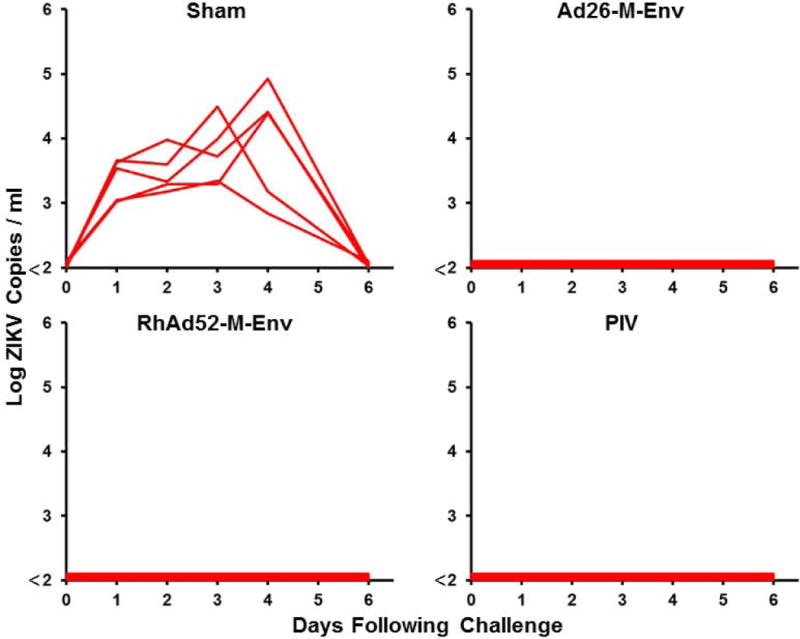
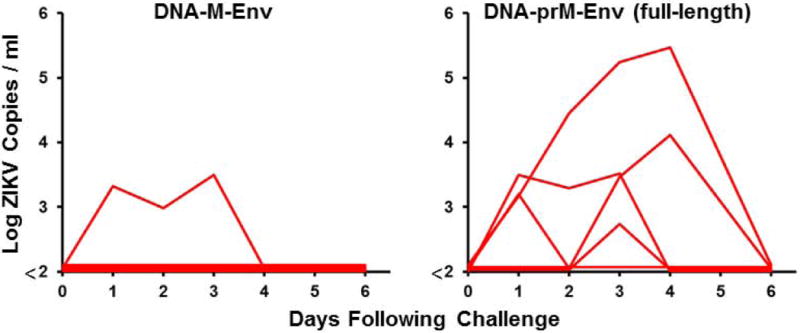
Figure 2. Long-term immunogenicity and protective efficacy of ZIKV vaccines in Balb/c mice
(A) Balb/c mice (N=5/group) were immunized once by the intramuscular route with 109 VP Ad26-M-Env, 109 VP RhAd52-M-Env, 1 μg PIV with alum, 50 μg DNA-M-Env, 50 μg DNA-prM-Env, or sham vaccine. Median Env-specific ELISA titers are shown. Error bars reflect S.E.M. The dotted line reflects log ELISA titers of 2.0. (B, C) Mice were challenged by the i.v. route with 105 VP (102 PFU) ZIKV-BR. Viral loads were determined in serum on days 0, 1, 2, 3, 4, and 6.
Figure 2
Figure 2. Long-term immunogenicity and protective efficacy of ZIKV vaccines in Balb/c mice
(A) Balb/c mice (N=5/group) were immunized once by the intramuscular route with 109 VP Ad26-M-Env, 109 VP RhAd52-M-Env, 1 μg PIV with alum, 50 μg DNA-M-Env, 50 μg DNA-prM-Env, or sham vaccine. Median Env-specific ELISA titers are shown. Error bars reflect S.E.M. The dotted line reflects log ELISA titers of 2.0. (B, C) Mice were challenged by the i.v. route with 105 VP (102 PFU) ZIKV-BR. Viral loads were determined in serum on days 0, 1, 2, 3, 4, and 6.
Figure 2
Figure 2. Long-term immunogenicity and protective efficacy of ZIKV vaccines in Balb/c mice
(A) Balb/c mice (N=5/group) were immunized once by the intramuscular route with 109 VP Ad26-M-Env, 109 VP RhAd52-M-Env, 1 μg PIV with alum, 50 μg DNA-M-Env, 50 μg DNA-prM-Env, or sham vaccine. Median Env-specific ELISA titers are shown. Error bars reflect S.E.M. The dotted line reflects log ELISA titers of 2.0. (B, C) Mice were challenged by the i.v. route with 105 VP (102 PFU) ZIKV-BR. Viral loads were determined in serum on days 0, 1, 2, 3, 4, and 6.
Figure 3
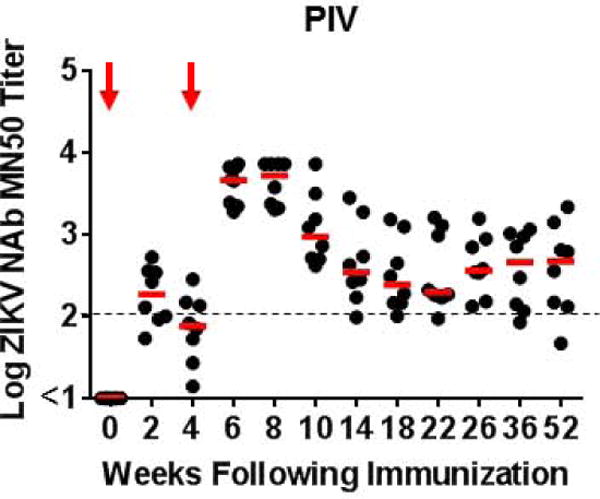
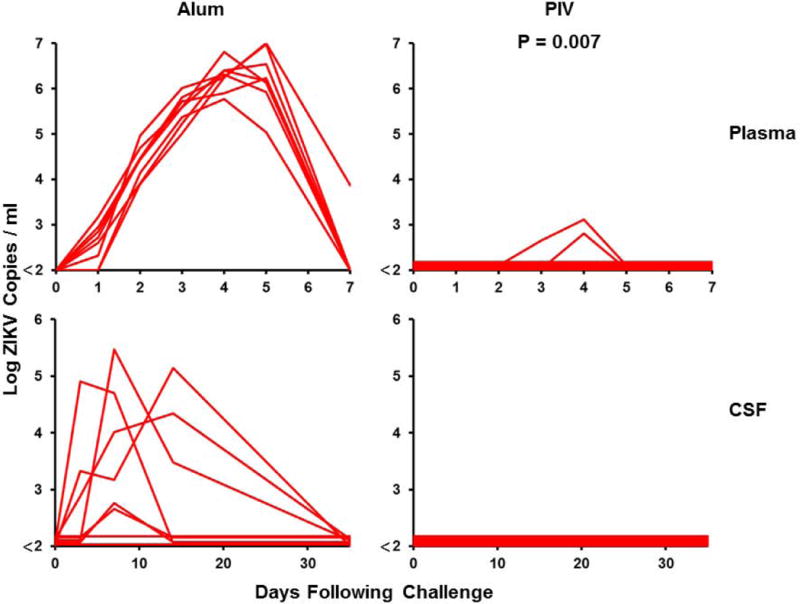
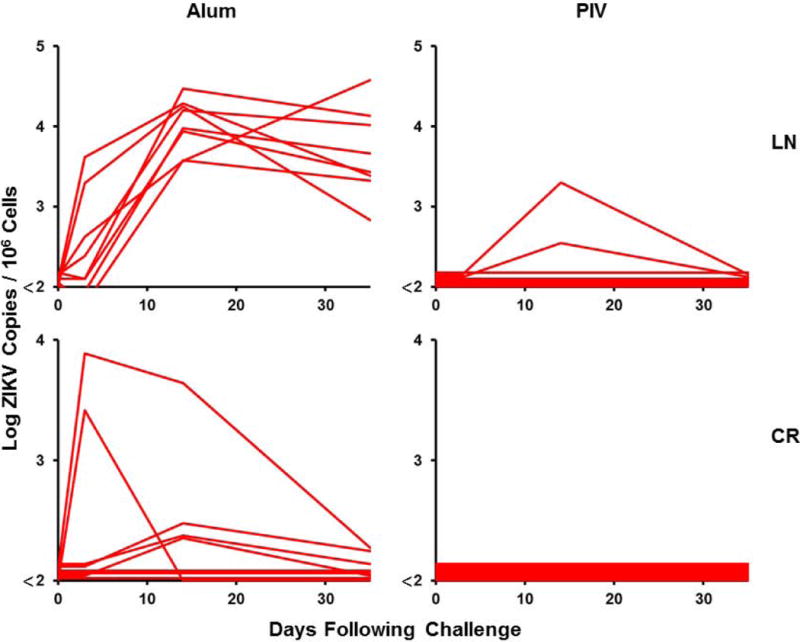
Figure 3. Long-term immunogenicity and protective efficacy of the ZIKV PIV vaccine in rhesus monkeys
(A) Log ZIKV-specific microneutralization (MN50) titers following immunization of rhesus monkeys by the s.c route with 5 μg ZIKV PIV vaccine (N=8) at weeks 0 and 4 (red arrows). The dotted line reflects log MN50 titers of 2.0. Red bars reflect medians. PIV vaccinated and sham control rhesus monkeys (N=8/group) were challenged by the s.c route with 106 VP (103 PFU) ZIKV-BR. Viral loads are shown in (B) plasma, (C) cerebrospinal fluid (CSF), and (D) lymph nodes (LN). Viral loads were determined on days 0, 1, 2, 3, 4, 5, and 7 for the plasma samples and on days 0, 3, 14, and 35 for the other samples. P-value determined by Fisher’s exact test.
Figure 3
Figure 3. Long-term immunogenicity and protective efficacy of the ZIKV PIV vaccine in rhesus monkeys
(A) Log ZIKV-specific microneutralization (MN50) titers following immunization of rhesus monkeys by the s.c route with 5 μg ZIKV PIV vaccine (N=8) at weeks 0 and 4 (red arrows). The dotted line reflects log MN50 titers of 2.0. Red bars reflect medians. PIV vaccinated and sham control rhesus monkeys (N=8/group) were challenged by the s.c route with 106 VP (103 PFU) ZIKV-BR. Viral loads are shown in (B) plasma, (C) cerebrospinal fluid (CSF), and (D) lymph nodes (LN). Viral loads were determined on days 0, 1, 2, 3, 4, 5, and 7 for the plasma samples and on days 0, 3, 14, and 35 for the other samples. P-value determined by Fisher’s exact test.
Figure 3
Figure 3. Long-term immunogenicity and protective efficacy of the ZIKV PIV vaccine in rhesus monkeys
(A) Log ZIKV-specific microneutralization (MN50) titers following immunization of rhesus monkeys by the s.c route with 5 μg ZIKV PIV vaccine (N=8) at weeks 0 and 4 (red arrows). The dotted line reflects log MN50 titers of 2.0. Red bars reflect medians. PIV vaccinated and sham control rhesus monkeys (N=8/group) were challenged by the s.c route with 106 VP (103 PFU) ZIKV-BR. Viral loads are shown in (B) plasma, (C) cerebrospinal fluid (CSF), and (D) lymph nodes (LN). Viral loads were determined on days 0, 1, 2, 3, 4, 5, and 7 for the plasma samples and on days 0, 3, 14, and 35 for the other samples. P-value determined by Fisher’s exact test.
Figure 4
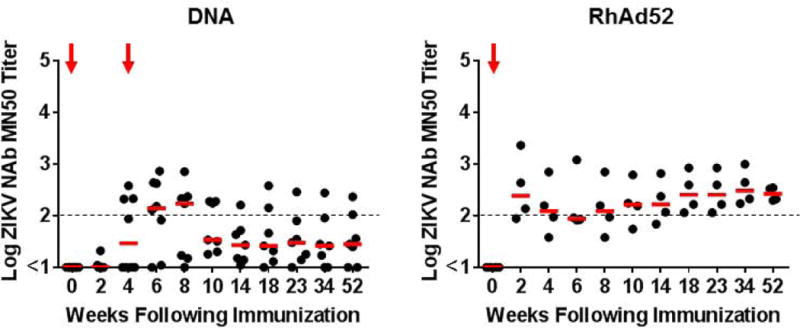
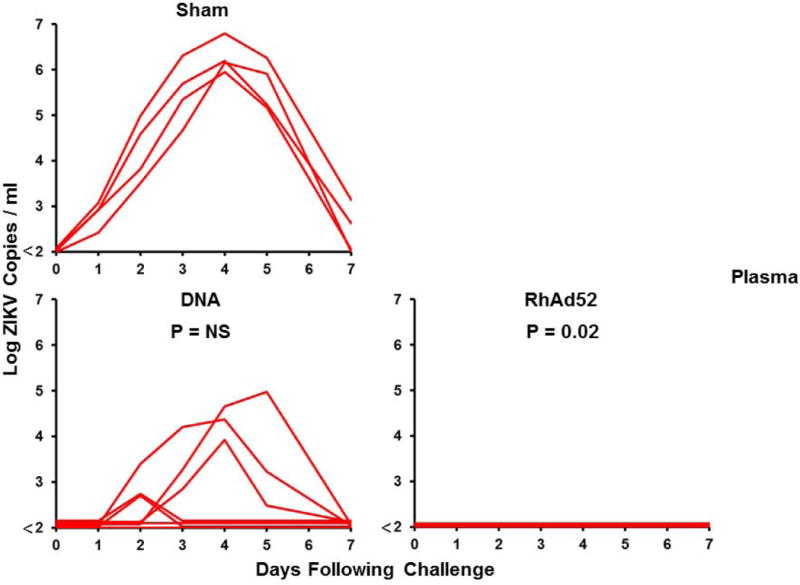
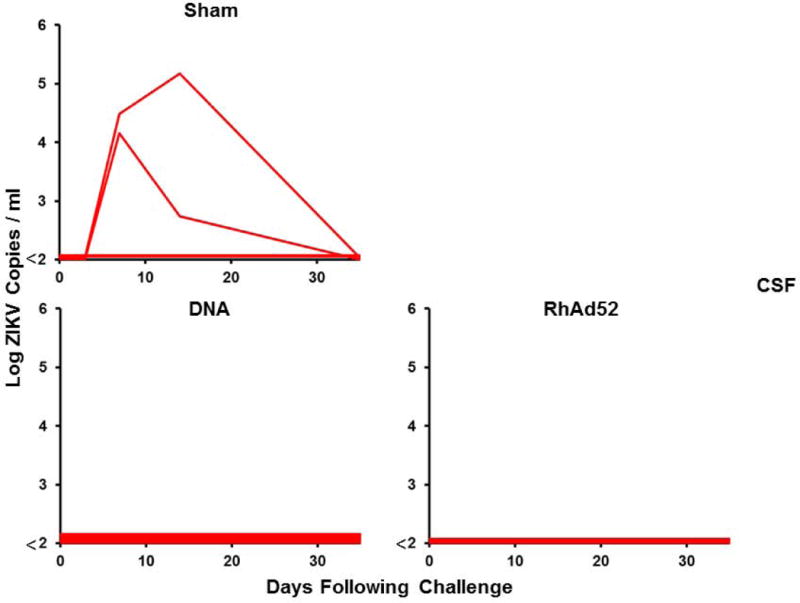
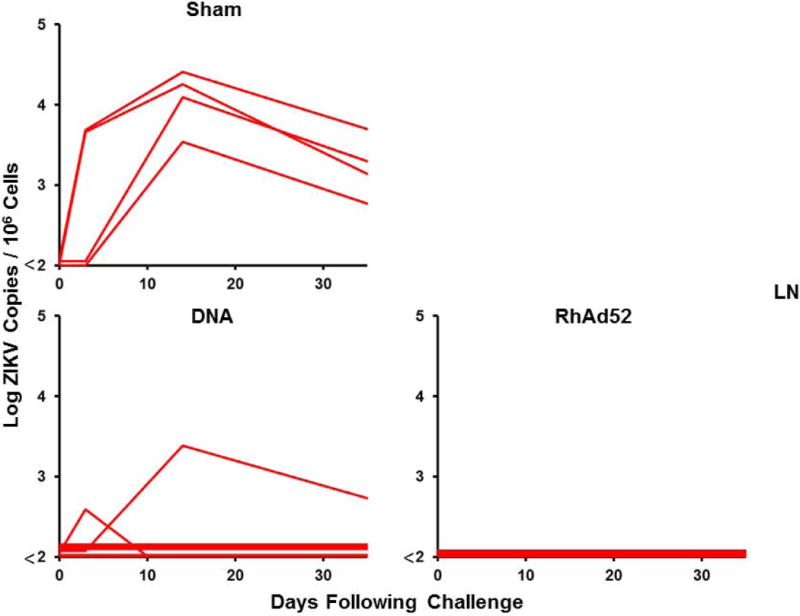
Figure 4. Long-term immunogenicity and protective efficacy of the ZIKV DNA-M-Env and RhAd52-M-Env vaccines in rhesus monkeys
(A) Log ZIKV-specific microneutralization (MN50) titers following immunization of rhesus monkeys by the i.m. with two immunizations of 5 mg DNA-M-Env (N=7) at weeks 0 and 4 (red arrows) or a single-shot immunization of 1011 VP RhAd52-M-Env (N=4) at week 0 (red arrow). The dotted lines reflect log MN50 titers of 2.0. Red bars reflect medians. Vaccinated and sham control rhesus monkeys were challenged by the s.c route with 106 VP (103 PFU) ZIKV-BR. Viral loads are shown in (B) plasma, (C) cerebrospinal fluid (CSF), and (D) lymph nodes (LN). Viral loads were determined on days 0, 1, 2, 3, 4, 5, and 7 for the plasma samples and on days 0, 3, 14, and 35 for the other samples. P-values determined by Fisher’s exact tests.
Figure 4
Figure 4. Long-term immunogenicity and protective efficacy of the ZIKV DNA-M-Env and RhAd52-M-Env vaccines in rhesus monkeys
(A) Log ZIKV-specific microneutralization (MN50) titers following immunization of rhesus monkeys by the i.m. with two immunizations of 5 mg DNA-M-Env (N=7) at weeks 0 and 4 (red arrows) or a single-shot immunization of 1011 VP RhAd52-M-Env (N=4) at week 0 (red arrow). The dotted lines reflect log MN50 titers of 2.0. Red bars reflect medians. Vaccinated and sham control rhesus monkeys were challenged by the s.c route with 106 VP (103 PFU) ZIKV-BR. Viral loads are shown in (B) plasma, (C) cerebrospinal fluid (CSF), and (D) lymph nodes (LN). Viral loads were determined on days 0, 1, 2, 3, 4, 5, and 7 for the plasma samples and on days 0, 3, 14, and 35 for the other samples. P-values determined by Fisher’s exact tests.
Figure 4
Figure 4. Long-term immunogenicity and protective efficacy of the ZIKV DNA-M-Env and RhAd52-M-Env vaccines in rhesus monkeys
(A) Log ZIKV-specific microneutralization (MN50) titers following immunization of rhesus monkeys by the i.m. with two immunizations of 5 mg DNA-M-Env (N=7) at weeks 0 and 4 (red arrows) or a single-shot immunization of 1011 VP RhAd52-M-Env (N=4) at week 0 (red arrow). The dotted lines reflect log MN50 titers of 2.0. Red bars reflect medians. Vaccinated and sham control rhesus monkeys were challenged by the s.c route with 106 VP (103 PFU) ZIKV-BR. Viral loads are shown in (B) plasma, (C) cerebrospinal fluid (CSF), and (D) lymph nodes (LN). Viral loads were determined on days 0, 1, 2, 3, 4, 5, and 7 for the plasma samples and on days 0, 3, 14, and 35 for the other samples. P-values determined by Fisher’s exact tests.
Figure 4
Figure 4. Long-term immunogenicity and protective efficacy of the ZIKV DNA-M-Env and RhAd52-M-Env vaccines in rhesus monkeys
(A) Log ZIKV-specific microneutralization (MN50) titers following immunization of rhesus monkeys by the i.m. with two immunizations of 5 mg DNA-M-Env (N=7) at weeks 0 and 4 (red arrows) or a single-shot immunization of 1011 VP RhAd52-M-Env (N=4) at week 0 (red arrow). The dotted lines reflect log MN50 titers of 2.0. Red bars reflect medians. Vaccinated and sham control rhesus monkeys were challenged by the s.c route with 106 VP (103 PFU) ZIKV-BR. Viral loads are shown in (B) plasma, (C) cerebrospinal fluid (CSF), and (D) lymph nodes (LN). Viral loads were determined on days 0, 1, 2, 3, 4, 5, and 7 for the plasma samples and on days 0, 3, 14, and 35 for the other samples. P-values determined by Fisher’s exact tests.
Figure 5
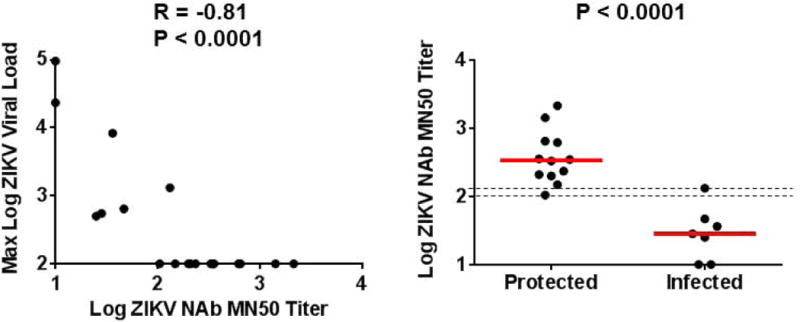
Figure 5. Immune correlates analysis in vaccinated rhesus monkeys
Correlation of maximum log viral loads following ZIKV-BR challenge with log MN50 titers at week 52 prior to challenge (left). P-value determined by Spearman rank-correlation test. Comparison of log MN50 titers at week 52 in protected versus infected animals (right). P-value determined by Wilcoxon rank-sum test. The dotted lines reflect log MN50 titers of 2.0 and 2.1. Red lines reflect medians.

References

    1. Fauci AS, Morens DM. Zika Virus in the Americas–Yet Another Arbovirus Threat. N Engl J Med. 2016;374:601–604. - PubMed
    1. Petersen LR, Jamieson DJ, Powers AM, Honein MA. Zika Virus. N Engl J Med. 2016;374:1552–1563. - PubMed
    1. Barouch DH, Thomas SJ, Michael NL. Prospects for a Zika Virus Vaccine. Immunity. 2017;46:176–182. - PMC - PubMed
    1. Durbin A, Wilder-Smith A. An update on Zika vaccine developments. Expert Rev Vaccines. 2017 - PubMed
    1. Fernandez E, Diamond MS. Vaccination strategies against Zika virus. Current opinion in virology. 2017;23:59–67. - PMC - PubMed