


Effect of population viral load on prospective HIV incidence in a hyperendemic rural African community
- PMID: 29237762
- PMCID: PMC6435884
- DOI: 10.1126/scitranslmed.aam8012
Effect of population viral load on prospective HIV incidence in a hyperendemic rural African community
Abstract
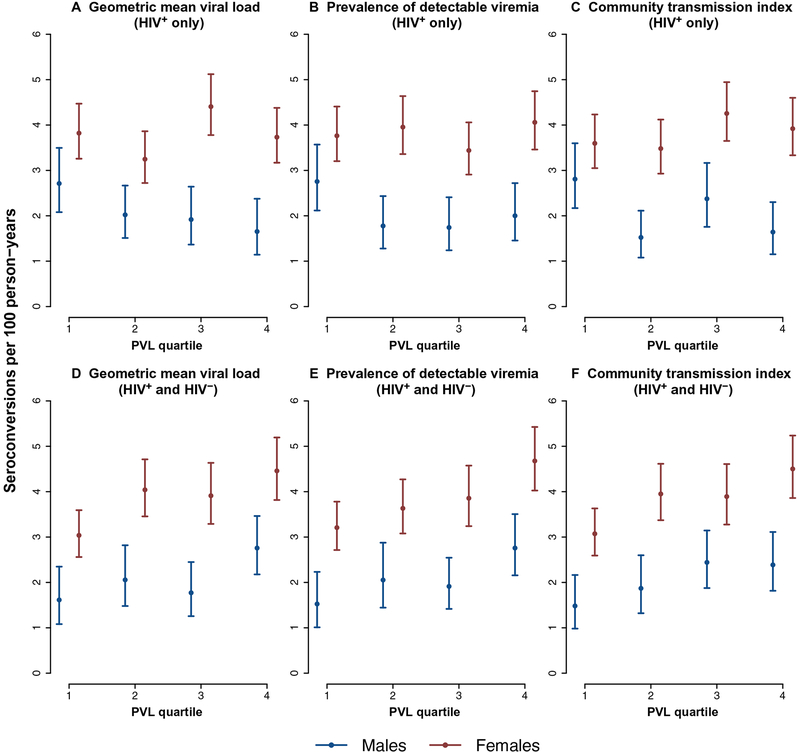
Monitoring HIV population viral load (PVL) has been advocated as an important means of inferring HIV transmission potential and predicting the future rate of new HIV infections (HIV incidence) in a particular community. However, the relationship between PVL measures and directly measured HIV incidence has not been quantified in any setting and, most importantly, in a hyperendemic sub-Saharan African setting. We assessed this relationship using one of Africa's largest population-based prospective population cohorts in rural KwaZulu-Natal, South Africa in which we followed 8732 HIV-uninfected participants between 2011 and 2015. Despite clear evidence of spatial clustering of high viral loads in some communities, our results demonstrate that PVL metrics derived from aggregation of viral load data only from the HIV-positive members of a particular community did not predict HIV incidence in this typical hyperendemic, rural African population. Only once we used modified PVL measures, which combined viral load information with the underlying spatial variation in the proportion of the population infected (HIV prevalence), did we find a consistently strong relationship with future risk of HIV acquisition. For example, every 1% increase in the overall proportion of a population having detectable virus (PDV P ) was independently associated with a 6.3% increase in an individual's risk of HIV acquisition (P = 0.001). In hyperendemic African populations, these modified PVL indices could play a key role in targeting and monitoring interventions in the most vulnerable communities where the future rate of new HIV infections is likely to be highest.
Copyright © 2017 The Authors, some rights reserved; exclusive licensee American Association for the Advancement of Science. No claim to original U.S. Government Works.
Conflict of interest statement
Figures
References
-
- Joint United Nations Programme on HIV/AIDS (UNAIDS), Ending AIDS. Progress towards the 90–90–90 targets, in Global AIDS Update (UNAIDS, 2017).
-
- Montaner JSG, Lima VD, Barrios R, Yip B, Wood E, Kerr T, Shannon K, Harrigan PR, Hogg RS, Daly P, Kendall P, Association of highly active antiretroviral therapy coverage, population viral load, and yearly new HIV diagnoses in British Columbia, Canada: A population-based study. Lancet 376, 532–539 (2010). - PMC - PubMed
-
- UNAIDS, Global AIDS response progress reporting 2013: Construction of core indicators for monitoring the 2011 UN political declaration on HIV/AIDS includes additional WHO/UNICEF universal access health sector indicators (UNAIDS, 2013).
-
- Granich RM, Gilks CF, Dye C, De Cock KM, Williams BG, Universal voluntary HIV testing with immediate antiretroviral therapy as a strategy for elimination of HIV transmission: A mathematical model. Lancet 373, 48–57 (2009). - PubMed
MeSH terms
Grants and funding
LinkOut - more resources
Full Text Sources
Other Literature Sources
Medical
