


The role of astrocytes in amyloid production and Alzheimer's disease
- PMID: 29237809
- PMCID: PMC5746550
- DOI: 10.1098/rsob.170228
The role of astrocytes in amyloid production and Alzheimer's disease
Abstract
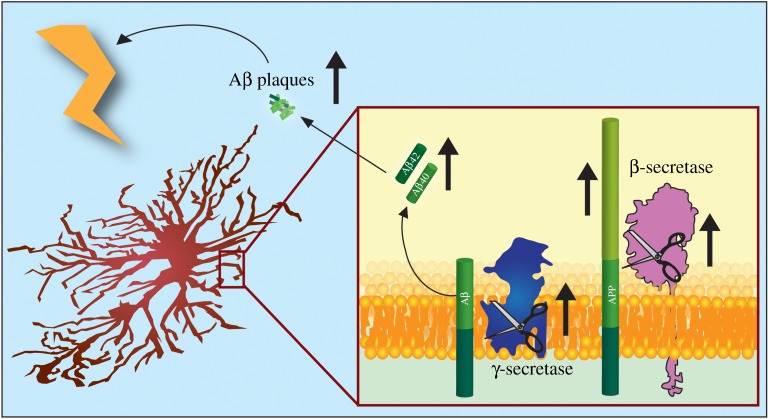
Alzheimer's disease (AD) is marked by the presence of extracellular amyloid beta (Aβ) plaques, intracellular neurofibrillary tangles (NFTs) and gliosis, activated glial cells, in the brain. It is thought that Aβ plaques trigger NFT formation, neuronal cell death, neuroinflammation and gliosis and, ultimately, cognitive impairment. There are increased numbers of reactive astrocytes in AD, which surround amyloid plaques and secrete proinflammatory factors and can phagocytize and break down Aβ. It was thought that neuronal cells were the major source of Aβ. However, mounting evidence suggests that astrocytes may play an additional role in AD by secreting significant quantities of Aβ and contributing to overall amyloid burden in the brain. Astrocytes are the most numerous cell type in the brain, and therefore even minor quantities of amyloid secretion from individual astrocytes could prove to be substantial when taken across the whole brain. Reactive astrocytes have increased levels of the three necessary components for Aβ production: amyloid precursor protein, β-secretase (BACE1) and γ-secretase. The identification of environmental factors, such as neuroinflammation, that promote astrocytic Aβ production, could redefine how we think about developing therapeutics for AD.
Keywords: Alzheimer's disease; amyloid beta; astrogliosis; neuroinflammation.
© 2017 The Authors.
Conflict of interest statement
We declare we have no competing interests.
Figures
References
-
- Beach TG, Walker R, McGeer EG. 1989. Patterns of gliosis in Alzheimer's disease and aging cerebrum. Glia 2, 420–436. (doi:10.1002/glia.440020605) - DOI - PubMed
-
- Morris M, Maeda S, Vossel K, Mucke L. 2011. The many faces of tau. Neuron 70, 410–426. (doi:10.1016/j.neuron.2011.04.009) - DOI - PMC - PubMed
-
- Olabarria M, Noristani HN, Verkhratsky A, Rodríguez JJ. 2010. Concomitant astroglial atrophy and astrogliosis in a triple transgenic animal model of Alzheimer's disease. Glia 58, 831–838. (doi:10.1002/glia.20967) - DOI - PubMed
-
- Nagele RG, D'Andrea MR, Lee H, Venkataraman V, Wang H-Y. 2003. Astrocytes accumulate A beta 42 and give rise to astrocytic amyloid plaques in Alzheimer disease brains. Brain Res. 971, 197–209. (doi:10.1016/S0006-8993(03)02361-8) - DOI - PubMed
-
- Rodríguez JJ, Olabarria M, Chvatal A, Verkhratsky A. 2009. Astroglia in dementia and Alzheimer's disease. Cell Death Differ. 16, 378–385. (doi:10.1038/cdd.2008.172) - DOI - PubMed
Publication types
MeSH terms
Substances
Grants and funding
LinkOut - more resources
Full Text Sources
Other Literature Sources
Medical
