


Molecular Dynamics and Mode of Transmission of Koala Retrovirus as It Invades and Spreads through a Wild Queensland Koala Population
- PMID: 29237837
- PMCID: PMC5809739
- DOI: 10.1128/JVI.01871-17
Molecular Dynamics and Mode of Transmission of Koala Retrovirus as It Invades and Spreads through a Wild Queensland Koala Population
Abstract
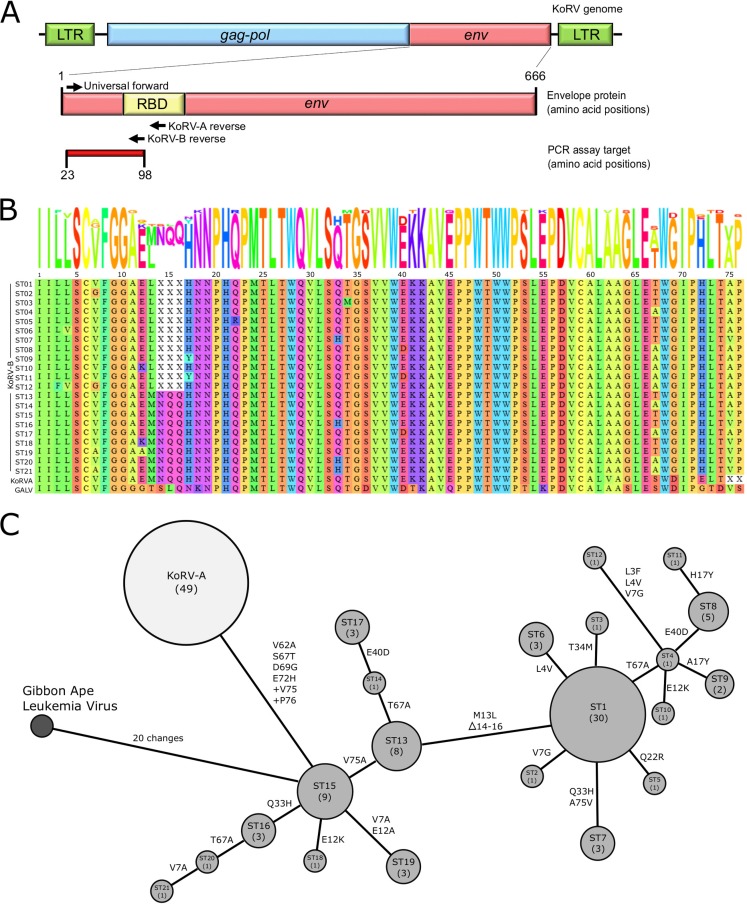
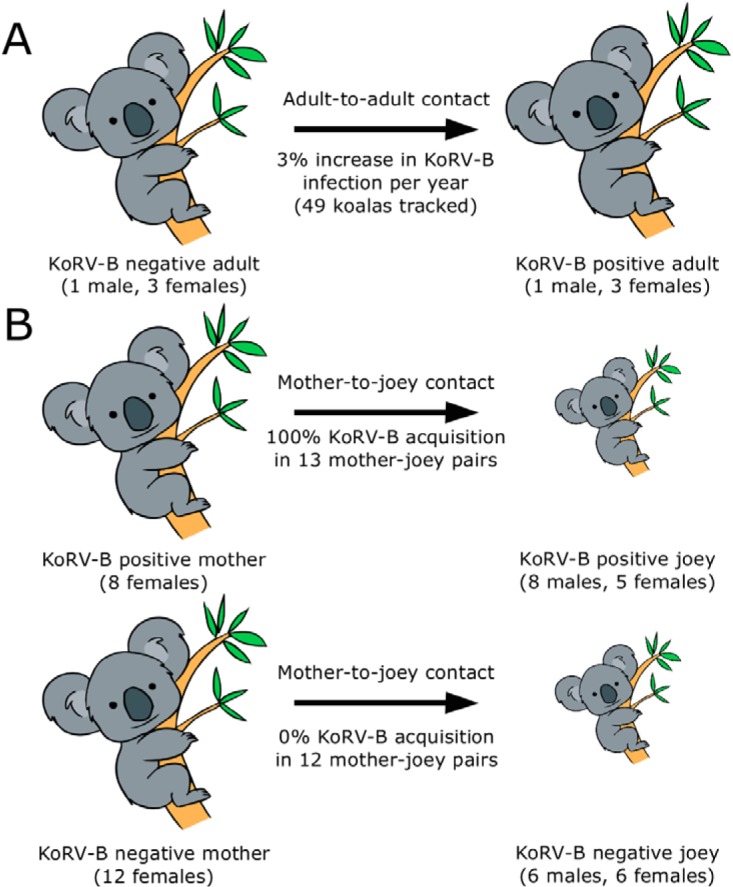
The recent acquisition of a novel retrovirus (KoRV) by koalas (Phascolarctos cinereus) has created new opportunities for retroviral research and new challenges for koala conservation. There are currently two major subtypes of KoRV: KoRV-A, which is believed to be endogenous only in koalas from the northern part of Australia, and KoRV-B, which appears to be exogenous. Understanding and management of these subtypes require population level studies of their prevalence and diversity, especially when coinfected in the same population, and investigations of their modes of transmission in the wild. Toward this end, we studied a wild Queensland koala population of 290 animals over a 5-year period and investigated the prevalence, diversity and mode of transmission of KoRV-A and KoRV-B. We found KoRV-A to have an infection level of 100% in the population, with all animals sharing the same dominant envelope protein sequence. In contrast, the KoRV-B infection prevalence was only 24%, with 21 different envelope protein sequence variants found in the 83 KoRV-B-positive animals. Linked to severe disease outcomes, a significant association between KoRV-B positivity and both chlamydial disease and neoplasia was found in the population. Transmission of KoRV-B was found at a rate of 3% via adult-to-adult contact per year, while there was a 100% rate of KoRV-B-positive mothers transmitting the virus to their joeys. Collectively, these findings demonstrate KoRV-B as the pathogenic subtype in this wild koala population and inform future intervention strategies with subtype variation and transmission data. IMPORTANCE KoRV represents a unique opportunity to study a relatively young retrovirus as it goes through its molecular evolution in both an endogenous form and a more recently evolved exogenous form. The endogenous form, KoRV-A, now appears to have stably and completely established itself in Northern Australian koala populations and is progressing south. Conversely, the exogenous form, KoRV-B, is undergoing continuous mutation and spread in the north and, as yet, has not reached all southern koala populations. We can now link KoRV-B to neoplasia and chlamydial disease in both wild and captive koalas, making it an imminent threat to this already vulnerable species. This work represents the largest study of koalas in a wild population with respect to KoRV-A/KoRV-B-infected/coinfected animals and the linkage of this infection to chlamydial disease, neoplasia, viral evolution, and spread.
Copyright © 2017 American Society for Microbiology.
Figures
References
Publication types
MeSH terms
Substances
LinkOut - more resources
Full Text Sources
Other Literature Sources
Medical
