


Prevalence and predictors of depression, pain, and fatigue in older- versus younger-adult cancer survivors
- PMID: 29239060
- PMCID: PMC7343079
- DOI: 10.1002/pon.4605
Prevalence and predictors of depression, pain, and fatigue in older- versus younger-adult cancer survivors
Abstract
Background: As the number of older adults in the United States continues to grow, there will be increasing demands on health care providers to address the needs of this population. Cancer is of particular importance, with over half of all cancer survivors older than 65 years. In addition, depression, pain, and fatigue are concerns for older adults with cancer and have been linked to poorer physical outcomes.
Methods: For this retrospective chart review, 1012 eligible participants were identified via a query of the Electronic Medical Record for all patients referred to 1 of 4 Survivorship Clinics at Memorial Sloan Kettering Cancer Center. All patients were between the ages of 30 to 55 (younger adults) and >65 (older adults). Depression was measured using the Patient Health Questionnaire-9 (PHQ-9).
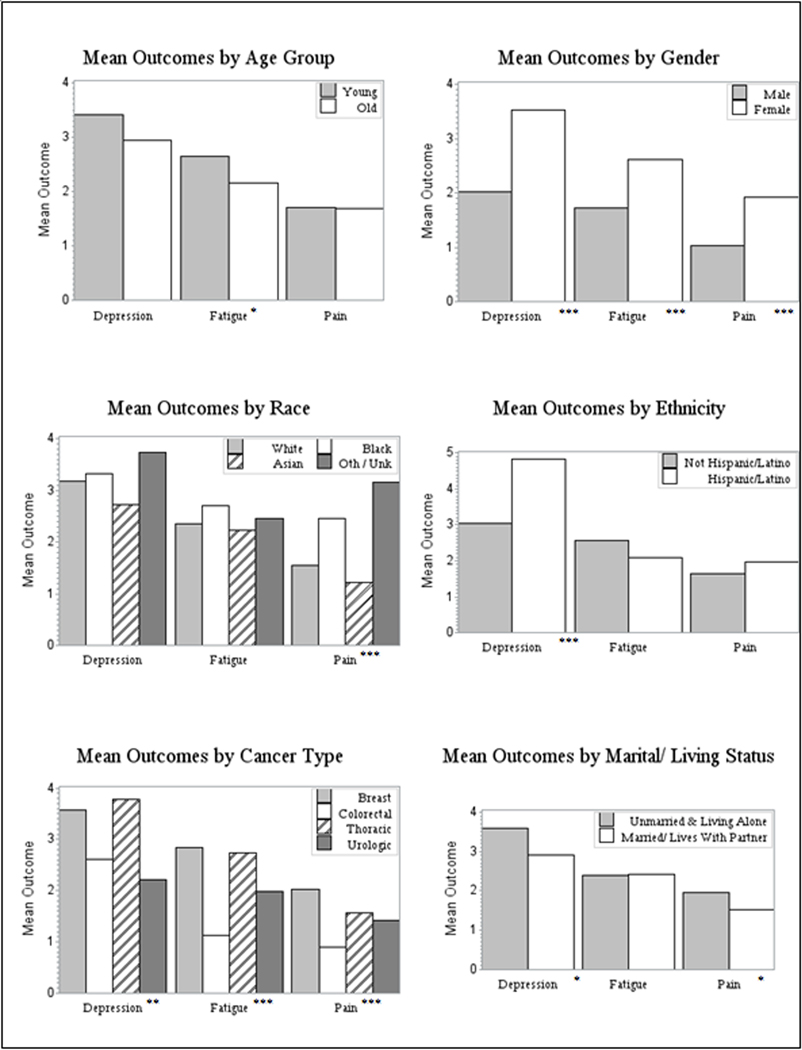
Results: The overall rate of depression in this sample of adult cancer survivors was 9.3%. There were no differences in the rates of clinically significant depression (defined as PHQ-9 score ≥10) between younger and older adult cohorts. However, there was a small trend toward higher mean PHQ-9 scores in the younger adult cohort (3.42 vs 2.95; t = 1.763, P = .10). Women reported greater rates of depression and higher pain and fatigue scores. Hispanic/Latino patients also reported significantly greater rates of depression.
Conclusion: There were no observed differences in depression between older and younger adult cancer survivors. Gender and ethnic discrepancies in depression were observed. Future research should focus on understanding the nature of these differences and targeting interventions for the groups most vulnerable to depression after cancer treatment.
Keywords: PHQ-9; cancer; depression; fatigue; gender; geriatrics; oncology; pain; survivorship.
Copyright © 2017 John Wiley & Sons, Ltd.
Conflict of interest statement
CONFLICTS OF INTEREST
The authors report no conflicts of interest.
Figures
References
-
- Levit L, Balogh E, Nass S, Ganz PA. Delivering High-Quality Cancer Care: Charting a New Course for a System in Crisis. Washington (DC)2013. - PubMed
-
- Medicine Io. Delivering High-Quality Cancer Care: Charting a New Course for a System in Crisis. In: Levit L, Balogh E, Nass S, Ganz PA, editors. Washington (DC): National Academies; 2013. - PubMed
-
- Institute of Medicine. From Cancer Patient to Cancer Survivor: Lost in Transition. Washington DC: The National Academies; 2005.
-
- Djernes JK. Prevalence and predictors of depression in populations of elderly: a review. Acta psychiatrica Scandinavica. 2006;113(5):372–87. - PubMed
Publication types
MeSH terms
Grants and funding
LinkOut - more resources
Full Text Sources
Other Literature Sources
Medical
Research Materials
