Drug resistance and treatment failure in leishmaniasis: A 21st century challenge
- PMID: 29240765
- PMCID: PMC5730103
- DOI: 10.1371/journal.pntd.0006052
Drug resistance and treatment failure in leishmaniasis: A 21st century challenge
Abstract
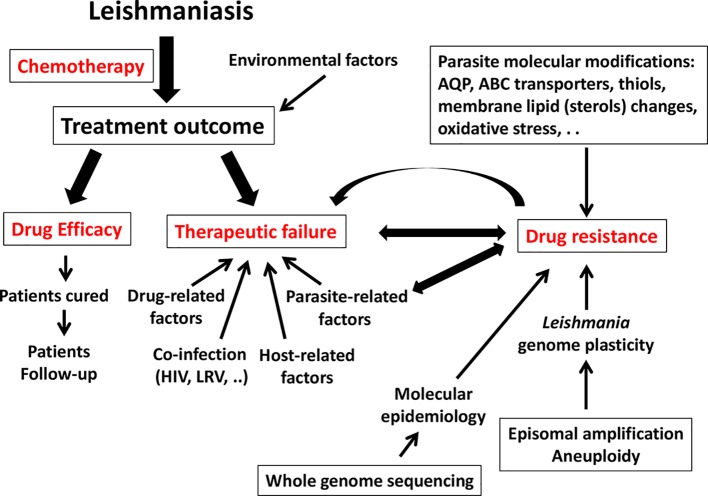
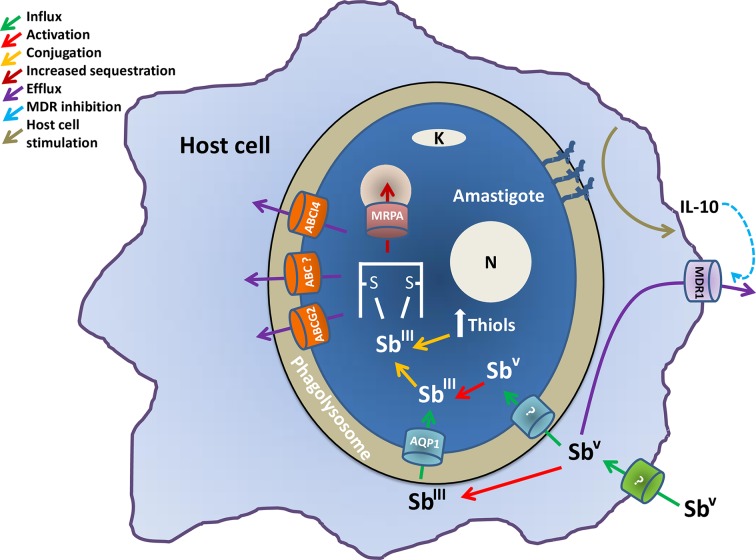
Reevaluation of treatment guidelines for Old and New World leishmaniasis is urgently needed on a global basis because treatment failure is an increasing problem. Drug resistance is a fundamental determinant of treatment failure, although other factors also contribute to this phenomenon, including the global HIV/AIDS epidemic with its accompanying impact on the immune system. Pentavalent antimonials have been used successfully worldwide for the treatment of leishmaniasis since the first half of the 20th century, but the last 10 to 20 years have witnessed an increase in clinical resistance, e.g., in North Bihar in India. In this review, we discuss the meaning of "resistance" related to leishmaniasis and discuss its molecular epidemiology, particularly for Leishmania donovani that causes visceral leishmaniasis. We also discuss how resistance can affect drug combination therapies. Molecular mechanisms known to contribute to resistance to antimonials, amphotericin B, and miltefosine are also outlined.
Conflict of interest statement
The authors have declared that no competing interests exist.
Figures
References
-
- WHO (http://www.who.int/leishmaniasis/en/). Accessed on 10 May 2017.
-
- Ostyn B, Gidwani K, Khanal B, Picado A, Chappuis F, Singh SP, et al. Incidence of symptomatic and asymptomatic Leishmania donovani infections in high-endemic foci in India and Nepal: a prospective study. PLoS Negl Trop Dis. 2011;5(10):e1284 doi: 10.1371/journal.pntd.0001284 - DOI - PMC - PubMed
-
- Andrade-Narvaez FJ, Loría-Cervera EN, Sosa-Bibiano EI, Van Wynsberghe NR. Asymptomatic infection with American cutaneous leishmaniasis: epidemiological and immunological studies. Mem Inst Oswaldo Cruz. 2016;111(10):599–604. doi: 10.1590/0074-02760160138 - DOI - PMC - PubMed
-
- Croft SL, Olliaro P. Leishmaniasis chemotherapy—challenges and opportunities. Clin Microbiol Infect. 2011;17(10):1478–83. doi: 10.1111/j.1469-0691.2011.03630.x - DOI - PubMed
-
- Mitropoulos P1, Konidas P, Durkin-Konidas M. New World cutaneous leishmaniasis: updated review of current and future diagnosis and treatment. J Am Acad Dermatol. 2010;63(2):309–22. doi: 10.1016/j.jaad.2009.06.088 - DOI - PubMed
Publication types
MeSH terms
Substances
Grants and funding
LinkOut - more resources
Full Text Sources
Other Literature Sources
Medical