Review
doi: 10.1371/journal.ppat.1006680.
eCollection 2017 Dec.
False friends: Phagocytes as Trojan horses in microbial brain infections
Affiliations
- PMID: 29240825
- PMCID: PMC5730104
- DOI: 10.1371/journal.ppat.1006680
Item in Clipboard
Review
False friends: Phagocytes as Trojan horses in microbial brain infections
PLoS Pathog.
.
No abstract available
Conflict of interest statement
The authors have declared that no competing interests exist.
Figures
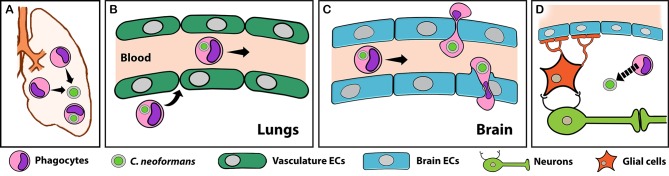
Most neuroinvasive pathogens first infect organs outside the CNS, such as the lungs or the intestines. Cryptococcus neoformans infection of the lungs is shown here as an example. Once infection is established, phagocytes (pink cells) are recruited to these sites (A), where they engulf the pathogen. Some infected phagocytes leave the site of infection and enter the bloodstream, facilitated by the highly permeable vasculature (green) of peripheral organs (B). Through a process that is poorly understood, many of these home to the CNS. Once there, infected phagocytes may act as Trojan horses, traversing the BBB (blue cells) with the pathogen as a passenger (C). Although both paracellular (top) and transcellular (bottom) transmigration can occur, the latter is most likely due to the presence of tight junctions in the BBB (C). Once inside the brain, pathogens can potentially exit their Trojan horses and infect other neural structures (D). Parts of this model (A and B) also apply to phagocyte-assisted dissemination and infection outside of the CNS (see text). BBB, blood–brain barrier; CNS, central nervous system; ECs, endothelial cells. Arrows indicate movement; broken arrow indicates fungal egress.
References
-
- Engelhardt B, Vajkoczy P, Weller RO. The movers and shapers in immune privilege of the CNS. Nat Immunol. 2017;18(2):123–31. Epub 2017/01/17. doi: 10.1038/ni.3666 - DOI - PubMed
-
- Vestweber D. How leukocytes cross the vascular endothelium. Nat Rev Immunol. 2015;15(11):692–704. Epub 2015/10/17. doi: 10.1038/nri3908 - DOI - PubMed
-
- Daneman R, Prat A. The blood-brain barrier. Cold Spring Harb Perspect Biol. 2015;7(1):a020412 Epub 2015/01/07. doi: 10.1101/cshperspect.a020412 - DOI - PMC - PubMed
-
- Aspelund A, Antila S, Proulx ST, Karlsen TV, Karaman S, Detmar M, et al. A dural lymphatic vascular system that drains brain interstitial fluid and macromolecules. J Exp Med. 2015;212(7):991–9. Epub 2015/06/17. doi: 10.1084/jem.20142290 - DOI - PMC - PubMed
-
- Louveau A, Smirnov I, Keyes TJ, Eccles JD, Rouhani SJ, Peske JD, et al. Structural and functional features of central nervous system lymphatic vessels. Nature. 2015;523(7560):337–41. Epub 2015/06/02. doi: 10.1038/nature14432 - DOI - PMC - PubMed
Publication types
MeSH terms
Grants and funding
LinkOut - more resources
Full Text Sources
Other Literature Sources
Medical