Clinical Trial
. 2018 Mar;141(3):1036-1049.e5.
doi: 10.1016/j.jaci.2017.10.041. Epub 2017 Dec 11.

Long-term follow-up of IPEX syndrome patients after different therapeutic strategies: An international multicenter retrospective study

Federica Barzaghi  1 Laura Cristina Amaya Hernandez  2 Benedicte Neven  3 Silvia Ricci  4 Zeynep Yesim Kucuk  5 Jack J Bleesing  5 Zohreh Nademi  6 Mary Anne Slatter  6 Erlinda Rose Ulloa  7 Anna Shcherbina  8 Anna Roppelt  8 Austen Worth  9 Juliana Silva  10 Alessandro Aiuti  11 Luis Murguia-Favela  12 Carsten Speckmann  13 Magda Carneiro-Sampaio  14 Juliana Folloni Fernandes  15 Safa Baris  16 Ahmet Ozen  16 Elif Karakoc-Aydiner  16 Ayca Kiykim  16 Ansgar Schulz  17 Sandra Steinmann  17 Lucia Dora Notarangelo  18 Eleonora Gambineri  19 Paolo Lionetti  20 William Thomas Shearer  21 Lisa R Forbes  21 Caridad Martinez  22 Despina Moshous  3 Stephane Blanche  3 Alain Fisher  3 Frank M Ruemmele  23 Come Tissandier  23 Marie Ouachee-Chardin  24 Frédéric Rieux-Laucat  25 Marina Cavazzana  26 Waseem Qasim  27 Barbarella Lucarelli  28 Michael H Albert  29 Ichiro Kobayashi  30 Laura Alonso  31 Cristina Diaz De Heredia  31 Hirokazu Kanegane  32 Anita Lawitschka  33 Jong Jin Seo  34 Marta Gonzalez-Vicent  35 Miguel Angel Diaz  35 Rakesh Kumar Goyal  36 Martin G Sauer  37 Akif Yesilipek  38 Minsoo Kim  39 Yesim Yilmaz-Demirdag  39 Monica Bhatia  40 Julie Khlevner  41 Erick J Richmond Padilla  42 Silvana Martino  43 Davide Montin  43 Olaf Neth  44 Agueda Molinos-Quintana  45 Justo Valverde-Fernandez  46 Arnon Broides  47 Vered Pinsk  48 Antje Ballauf  49 Filomeen Haerynck  50 Victoria Bordon  50 Catharina Dhooge  50 Maria Laura Garcia-Lloret  51 Robbert G Bredius  52 Krzysztof Kałwak  53 Elie Haddad  54 Markus Gerhard Seidel  55 Gregor Duckers  49 Sung-Yun Pai  56 Christopher C Dvorak  57 Stephan Ehl  58 Franco Locatelli  28 Frederick Goldman  59 Andrew Richard Gennery  6 Mort J Cowan  57 Maria-Grazia Roncarolo  2 Rosa Bacchetta  60 Primary Immune Deficiency Treatment Consortium (PIDTC) and the Inborn Errors Working Party (IEWP) of the European Society for Blood and Marrow Transplantation (EBMT)
Affiliations
Clinical Trial

Long-term follow-up of IPEX syndrome patients after different therapeutic strategies: An international multicenter retrospective study

Federica Barzaghi et al. J Allergy Clin Immunol. 2018 Mar.

Abstract

Background: Immunodysregulation polyendocrinopathy enteropathy x-linked (IPEX) syndrome is a monogenic autoimmune disease caused by FOXP3 mutations. Because it is a rare disease, the natural history and response to treatments, including allogeneic hematopoietic stem cell transplantation (HSCT) and immunosuppression (IS), have not been thoroughly examined.

Objective: This analysis sought to evaluate disease onset, progression, and long-term outcome of the 2 main treatments in long-term IPEX survivors.

Methods: Clinical histories of 96 patients with a genetically proven IPEX syndrome were collected from 38 institutions worldwide and retrospectively analyzed. To investigate possible factors suitable to predict the outcome, an organ involvement (OI) scoring system was developed.

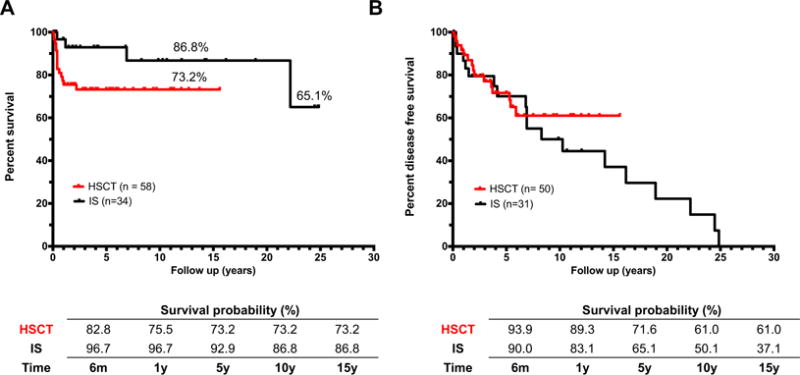
Results: We confirm neonatal onset with enteropathy, type 1 diabetes, and eczema. In addition, we found less common manifestations in delayed onset patients or during disease evolution. There is no correlation between the site of mutation and the disease course or outcome, and the same genotype can present with variable phenotypes. HSCT patients (n = 58) had a median follow-up of 2.7 years (range, 1 week-15 years). Patients receiving chronic IS (n = 34) had a median follow-up of 4 years (range, 2 months-25 years). The overall survival after HSCT was 73.2% (95% CI, 59.4-83.0) and after IS was 65.1% (95% CI, 62.8-95.8). The pretreatment OI score was the only significant predictor of overall survival after transplant (P = .035) but not under IS.

Conclusions: Patients receiving chronic IS were hampered by disease recurrence or complications, impacting long-term disease-free survival. When performed in patients with a low OI score, HSCT resulted in disease resolution with better quality of life, independent of age, donor source, or conditioning regimen.

Keywords: FOXP3; IPEX; Treg cells; enteropathy; genetic autoimmunity; hematopoietic stem cell transplantation; immunosuppression; neonatal diabetes; primary immune deficiency; rapamycin.


Conflict of interest statement

Disclosure of potential conflict of interest:

The rest of the authors declare that they have no relevant conflicts of interest.

Figures

FIG 1
FIG 1
Patients’ demographics and disease-related characteristics. A, Diagnostic delay scatter plot displaying correlation between age at diagnosis and age at onset (n = 96). Spearman’s rank correlation ρ = 0.456, P < .001. B, Histogram distribution of number of patients diagnosed between 2001 and 2015. Overlaid density distribution showed in blue. C, Heat map of number of symptoms at onset grouped by age at onset. Symptoms present in each age group (indicated by rows) were scaled (z-score or standardized score) and then converted to colors from yellow (low = less frequent) to red (high = highly frequent). Data were not available (NA) for 3 patients; 1 patient has the mutation but has not yet experienced the onset; and for 2 patients, the first symptom is unknown. D, Bar graph comparing frequency of symptoms at onset and later during disease evolution. Every bar indicates number of patients presenting each symptom. However, each patient can exhibit >1 symptom at once. E, Uncommon manifestations. Every bar indicates number of patients presenting each symptom. F, Scatter plot of FOXP3 gene mutations grouped by domain, indicating age at onset (circles) and number of symptoms at onset (asterisks), with median (n = 87; for 10 patients, cDNA FOXP3 mutations were not specified). Gene structure: N-terminal proline-rich (PRR) domain (orange), zinc-finger (ZF) domain (green), leucine-zipper (LZ) domain (blue), LZ-FKH loop (yellow), and FKH domain (red). Mutations were grouped as follows: <c.1 to c.570> 5 E1-5 N-terminal domain, <c.591 to c.666> = E5-6 ZF domain, <c.717 to c.780> = E6-7 LZ domain, <c.781 to c.1010> = E7-9 LZ-FKH loop domain, <c.1011 to c.1251> = E9-11 FKH domain. AIHA, Autoimmune hemolytic anemia; AIN, autoimmune neutropenia; AT, autoimmune thyroiditis; FTT, failure to thrive; ITP, idiopathic thrombocytopenic purpura; Neph, nephropathy; LN, lymphadenopathy; PRR, proline-rich region; UTR, untranslated region.
FIG 2
FIG 2
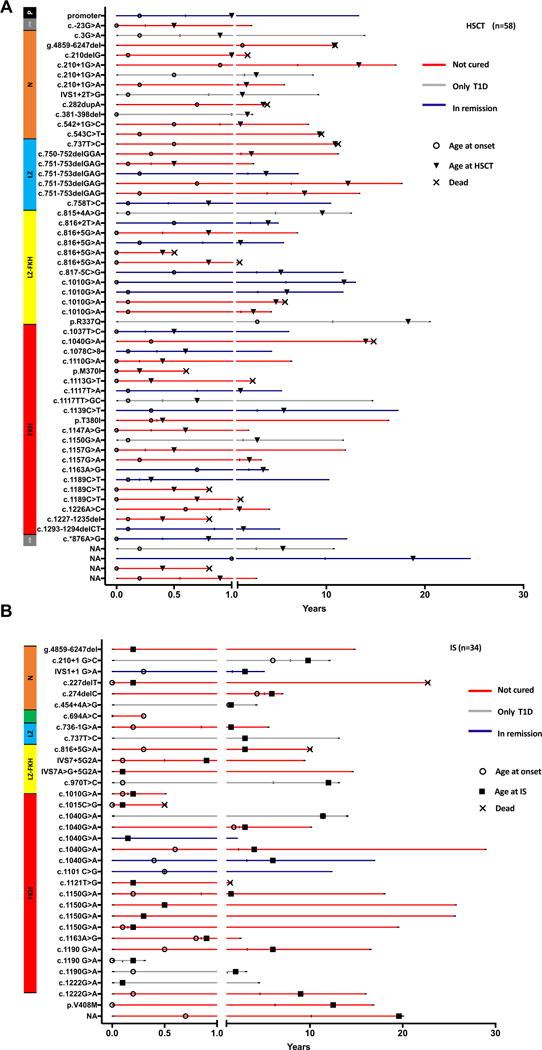
Timeline of natural history and disease evolution. Patients undergoing HSCT (A) and IS (B). Each line represents a patient identified by his FOXP3 mutation in order of localization on the gene. The end on the line represents the last day of follow-up, and different symbols represent age at onset (circles) and age at HSCT (triangles) or the beginning of IS. An X at the end of the line indicates the age of death. The color of the line indicates the disease status after treatment, whether the patient went into remission (blue), was still diabetic (gray) or not cured (red). NA, Not available.
FIG 3
FIG 3
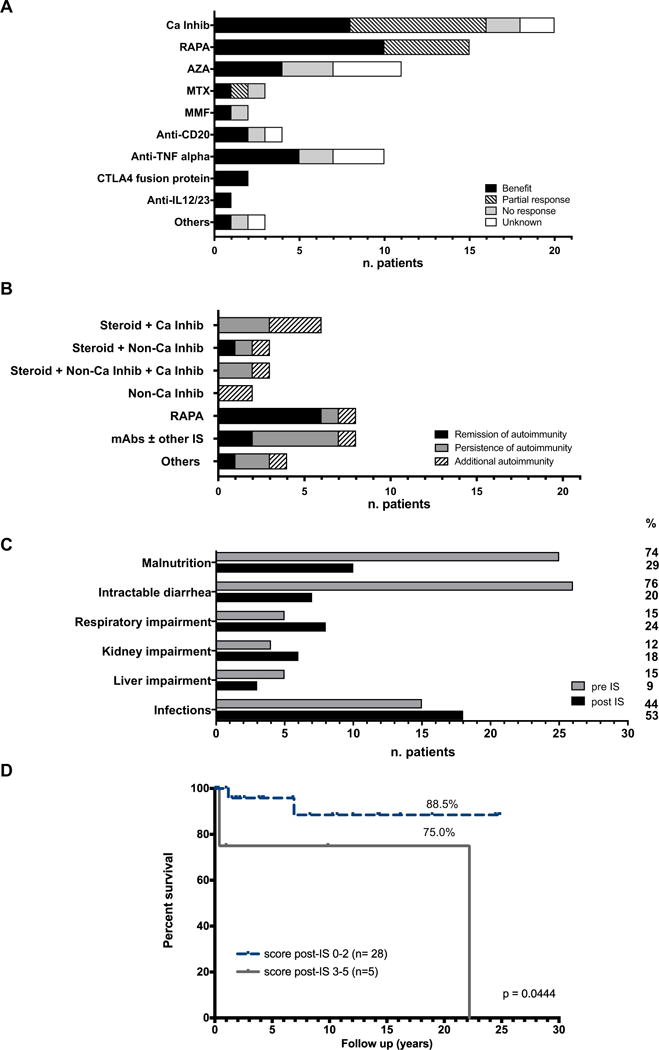
Immunosuppressive therapy. A, Bar graph indicating numbers of patients exhibiting response, partial benefit, or no response according to a specific immunosuppressive drug administered (n = 34; however, each patient received >1 drug). B, Bar graph indicating each patient’s outcome after treatment with a combination of drugs, as last treatment. Each bar represents the number of patients receiving the treatment, distinguishing those in remission from those with additional or persistent autoimmunity (n = 34). C, Pre- and post-IS patients’ conditions, each bar represents the number of patients presenting each condition. On the right side, the relative percentage is reported (n = 34; however, each patient could present with >1 condition at once). D, Percentage of survival for patients undergoing IS (n = 34) according to score post-IS (P = .0444). AZA, Azathioprine; Ca Inhib, calcineurin inhibitors; CTLA, cytotoxic T lymphocyte–associated antigen; MTX, methotrexate; MMF, mycophenolate mofetil; “others”, any different IS (eg, 6-mercaptopurina, mesalazine); RAPA, rapamycin.
FIG 4
FIG 4
Survival analysis of patients undergoing HSCT. Percentage of survival of patients undergoing HSCT (n = 58) according to conditioning (log-rank test, P = .234) (A), donor type (P = .886) (B), age at HSCT (P = .359) (C), score pre-HSCT (P = .003) (D), score and conditioning (P = .010) (E), and score and age at HSCT (P = .019) (F). A survival probability table accompanies those plots that show significant differences (time points: 6 months, and 1, 3, 5, and 10 years). Full C, Full conditioning regimen; MMRD, mismatched related donor; MMUCB, mismatched unrelated cord blood; MMUD, mismatched unrelated donor; MSD, matched sibling donor; MUD, matched unrelated donor.
FIG 5
FIG 5
Probability of survival and disease status after treatment. A, Survival analysis of IPEX patients undergoing HSCT or IS (n = 92, P = .055). B, Disease-free survival analysis of IPEX patients undergoing IS or HSCT censored for deaths (n = 81, P = .419).

References

    1. Powell BR, Buist NR, Stenzel P. An x-linked syndrome of diarrhea, polyendocrinopathy, and fatal infection in infancy. J Pediatr. 1982;100:731–7. - PubMed
    1. Bennett CL, Christie J, Ramsdell F, Brunkow ME, Ferguson PJ, Whitesell L, et al. The immune dysregulation, polyendocrinopathy, enteropathy, x-linked syndrome (IPEX) is caused by mutations of FOXP3. Nat Genet. 2001;27:20–1. - PubMed
    1. Wildin RS, Ramsdell F, Peake J, Peake J, Faravelli F, Casanova JL, Buist N, et al. X-linked neonatal diabetes mellitus, enteropathy and endocrinopathy syndrome is the human equivalent of mouse scurfy. Nat Genet. 2001;27:18–20. - PubMed
    1. Barzaghi F, Passerini L, Bacchetta R. Immune dysregulation, polyendocrinopathy, enteropathy, x-linked syndrome: a paradigm of immunodeficiency with autoimmunity. Front Immunol. 2012;3:211. - PMC - PubMed
    1. Bacchetta R, Barzaghi F, Roncarolo Mg. From IPEX syndrome to FOXP3 mutation: a lesson on immune dysregulation. Ann N Y Acad Sci. 2016 Feb 25; [E-pub ahead of print]. - PubMed

Publication types

MeSH terms

Substances

Supplementary concepts