


doi: 10.1039/c7cc08619a.
Phenylamino derivatives of tris(2-pyridylmethyl)amine: hydrogen-bonded peroxodicopper complexes
Affiliations
- PMID: 29242872
- PMCID: PMC5780194
- DOI: 10.1039/c7cc08619a
Item in Clipboard
Phenylamino derivatives of tris(2-pyridylmethyl)amine: hydrogen-bonded peroxodicopper complexes
Chem Commun (Camb).
.
Abstract
A series of copper complexes bearing new 6-substituted tris(2-pyridylmethyl)amine ligands (LR) appended with NH(p-R-C6H4) groups (R = H, CF3, OMe) were prepared. These ligands are electronically tunable (ΔE1/2 = 160 mV) and CuI(LR)+ complexes react with oxygen to form hydrogen bonded (trans-1,2-peroxo)dicopper species.
Figures
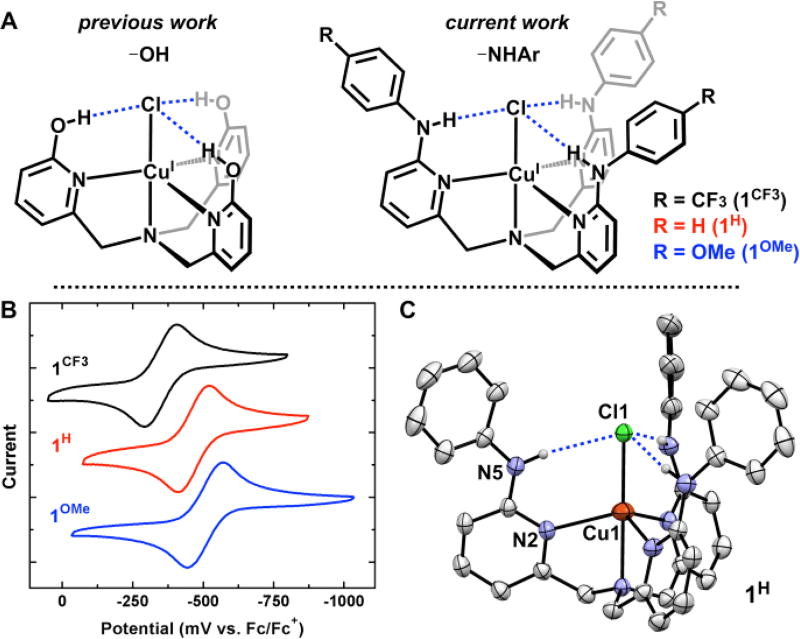
CuICl complexes derived from H3thpa and LR (A). Cyclic voltammetry of 1H, 1CF3 and 1OMe ((B) 0.1 M NBu4PF6 CH2Cl2). Crystal structure of 1H ((C) 30% ellipsoids, H atoms not involved in H-bonding omitted for clarity).
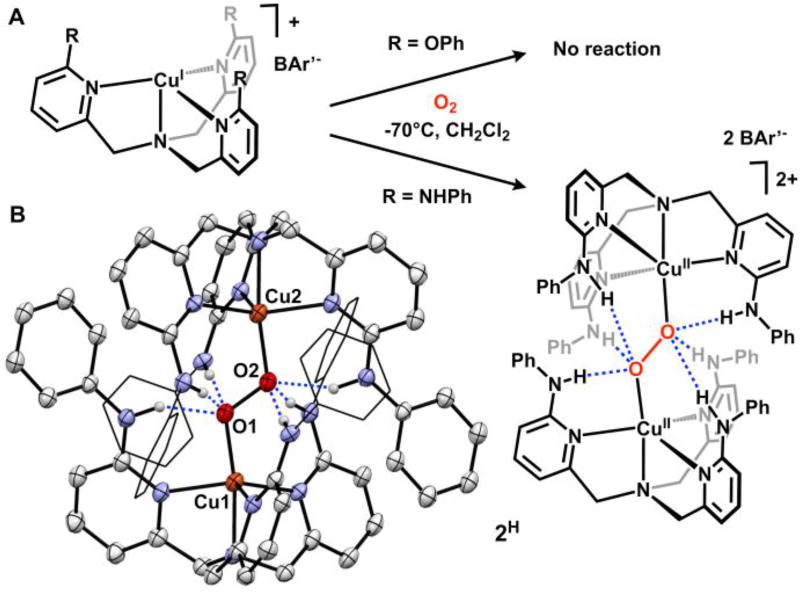
Reactivity of Cu(I) complexes toward O2 (A). Crystal structure of 2H ((B) 30% ellipsoids, some atoms represented in wireframe, H atoms not involved in H-bonding and BAr’ counteranions omitted for clarity).
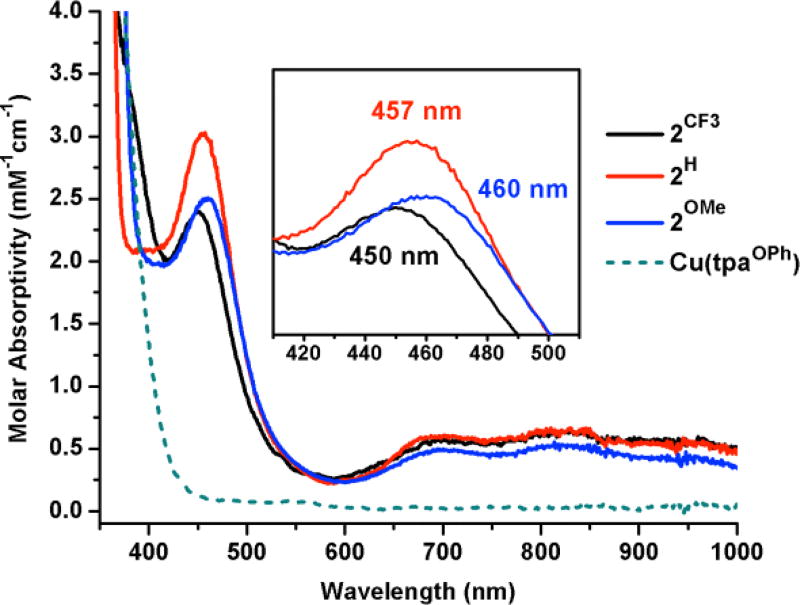
UV-Vis overlay of 2H, 2CF3, 2OMe (1:1 CH2Cl2/acetone, −70°C), and the reaction of [Cu(tpaOPh)]BAr’ with O2 at −70°C. Inlay shows λmax of O to Cu LMCT in 2R.
References
-
- Suzuki M. Acc. Chem. Res. 2007;40:609–617. - PubMed
- Hatcher LQ, Karlin KD. In: Adv. Inorg. Chem. van Eldik R, Reedijk J, editors. Vol. 58. Academic Press; 2006. pp. 131–184.
- Elwell CE, Gagnon NL, Neisen BD, Dhar D, Spaeth AD, Yee GM, Tolman WB. Chem. Rev. 2017;117:2059–2107. - PMC - PubMed
- Lewis EA, Tolman WB. Chem. Rev. 2004;104:1047–1076. - PubMed
- Mirica LM, Ottenwaelder X, Stack TDP. Chem. Rev. 2004;104:1013–1046. - PubMed
- Quist DA, Diaz DE, Liu JJ, Karlin KD. J. Biol. Inorg. Chem. 2017;22:253–288. - PMC - PubMed
- Kitajima N, Moro-oka Y. Chem. Rev. 1994;94:737–757.
-
- Jacobson RR, Tyeklar Z, Farooq A, Karlin KD, Liu S, Zubieta J. J. Am. Chem. Soc. 1988;110:3690–3692.
-
- Borovik AS. Acc. Chem. Res. 2005;38:54–61. - PubMed
-
- Fujii T, Yamaguchi S, Funahashi Y, Ozawa T, Tosha T, Kitagawa T, Masuda H. Chem. Commun. 2006:4428–4430. - PubMed
- Fujii T, Yamaguchi S, Hirota S, Masuda H. Dalton Trans. 2008:164–170. - PubMed
- Yamaguchi S, Wada A, Funahashi Y, Nagatomo S, Kitagawa T, Jitsukawa K, Masuda H. Eur. J. Inorg. Chem. 2003;2003:4378–4386. - PubMed
- Kim S, Saracini C, Siegler MA, Drichko N, Karlin KD. Inorg. Chem. 2012;51:12603–12605. - PMC - PubMed
- Maiti D, Woertink JS, Narducci Sarjeant AA, Solomon EI, Karlin KD. Inorg. Chem. 2008;47:3787–3800. - PubMed
- Wada A, Honda Y, Yamaguchi S, Nagatomo S, Kitagawa T, Jitsukawa K, Masuda H. Inorg. Chem. 2004;43:5725–5735. - PubMed
- Peterson RL, Ginsbach JW, Cowley RE, Qayyum MF, Himes RA, Siegler MA, Moore CD, Hedman B, Hodgson KO, Fukuzumi S, Solomon EI, Karlin KD. J. Am. Chem. Soc. 2013;135:16454–16467. - PMC - PubMed
Grants and funding
LinkOut - more resources
Full Text Sources
Other Literature Sources
