Review
. 2018 Jan;83(1):13-26.
doi: 10.1002/ana.25119.

B-cell Therapy for Multiple Sclerosis: Entering an era

Affiliations
Review

B-cell Therapy for Multiple Sclerosis: Entering an era

Ariele L Greenfield et al. Ann Neurol. 2018 Jan.

Abstract

Monoclonal antibodies that target CD20 expressing B cells represent an important new treatment option for patients with multiple sclerosis (MS). B-cell-depleting therapy is highly effective against relapsing forms of the disease and is also the first treatment approach proven to protect against disability worsening in primary progressive MS. Moreover, evolving clinical experience with B-cell therapy, combined with a more sophisticated understanding of humoral immunity in preclinical models and in patients with MS, has led to major progress in deciphering the immune pathogenesis of MS. Here, we review the nuanced roles of B cells in MS autoimmunity, the clinical data supporting use of ocrelizumab and other anti-CD20 therapies in the treatment of MS, as well as safety and practical considerations for prescribing. Last, we summarize remaining unanswered questions regarding the proper role of anti-CD20 therapy in MS, its limitations, and the future landscape of B-cell-based approaches to treatment. Ann Neurol 2018;83:13-26.


Conflict of interest statement

Potential Conflicts of Interest:

No other disclosures were reported.

Figures
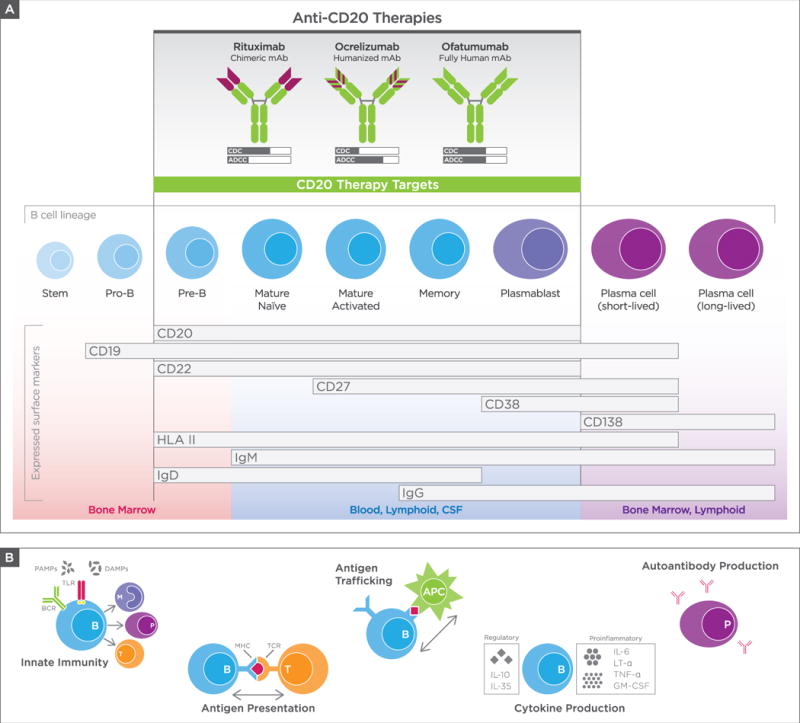
Figure 1
Figure 1. Landscape of B-cell therapies and possible mechanisms of action
(A) Anti-CD20 mAbs in clinical use and summary of expression of CD20 and other B-cell surface antigens. Top: Structure of anti-CD20 mAbs in clinical use, with mechanisms of action summarized as relative degrees of complement-dependent cytotoxicity (CDC) and antibody-dependent cell-mediated cytotoxicity (ADCC). Middle: B-cell maturation stages, defined by cell-surface antigens, highlighting B-cell subsets most depleted by anti-CD20 therapies (shaded region in center). Bottom: Common tissue locations for B-cell subsets. Of note: heterogeneity in surface-marker expression across previously defined B-cell subsets is recognized, as are exceptions to defined tissue locations of B-cell subsets. (B) Diverse functional roles of B cells in immunity and autoimmunity. The many roles of B cells, including participation in innate immunity, antigen presentation, antigen trafficking, cytokine production, and autoantibody production. The mechanism(s) responsible for the rapid onset and nearly complete protection against development of new focal lesions in MS is/are unknown, but may be attributed to effects of anti-CD20 therapy on antigen presentation and cytokine production. APC = antigen-presenting cell; BCR = B-cell receptor; CSF = cerebrospinal fluid; DAMPs = damage-associated molecular pattern molecules; GM-CSF = granulocyte-macrophage colony-stimulating factor; HLA = human leukocyte antigen; IgG = immunoglobulin G; IL = interleukin; LT-α = lymphotoxin-alpha; MHC = major histocompatibility complex; PAMPs = pathogen-associated molecular pattern molecules; TCR = T-cell receptor; TLR = Toll-like receptor; TNFα, tumor necrosis factor alpha.
Figure 2
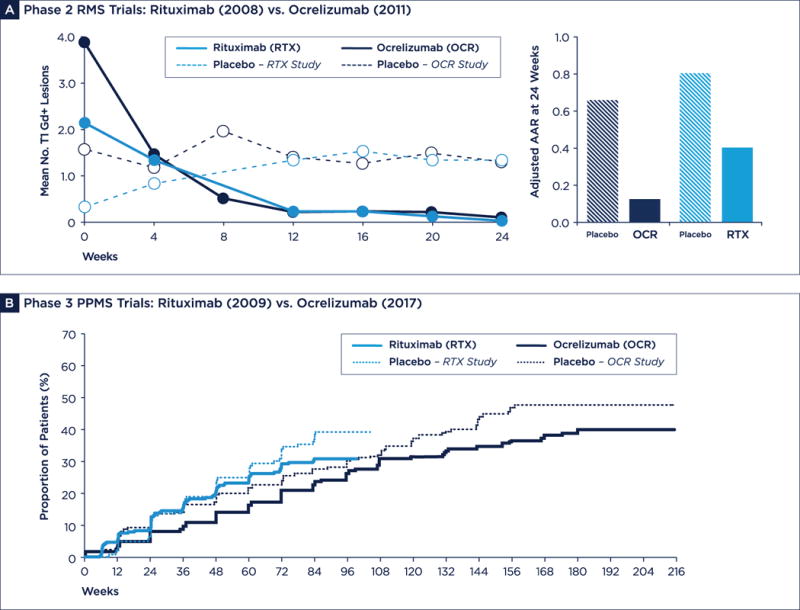
Figure 2. Cross-trial comparisons of placebo-controlled trials of rituximab and ocrelizumab for RMS, and PPMS.,
(A) Phase 2 RMS trials (600mg arm of OCR phase 2 trial). Gadolinium enhanced lesion counts at different time points are shown (left), and annualized relapse rates (ARR) (right). Data show similar levels of suppression of gadolinium disease activity, and also significant suppression of clinically observed relapse activity (arguably with a possible advantage favoring ocrelizumab)*. (B) Phase 3 PPMS trials. Disability progression confirmed at 12 weeks (CDP-12) show similar effect sizes on Kaplan-Meyer survival plots; however, the benefit of ocrelizumab was statistically significant (p = 0.03), whereas rituximab was not (p = 0.14), possibly attributed to differences in the size of the studies. *In the OCR trial, ARR was adjusted for exposure time. In the RTX trial, ARR was adjusted for exposure time, baseline EDSS, and previous exposure to glatiramer acetate or interferon. Gd+ = gadolinium positive; PPMS = primary progressive multiple sclerosis; RMS = relapsing multiple sclerosis.

References

    1. Hauser SL, Waubant E, Arnold DL, et al. B-cell depletion with rituximab in relapsing-remitting multiple sclerosis. The New England journal of medicine. 2008 Feb 14;358(7):676–88. - PubMed
    1. Montalban X, Hauser SL, Kappos L, et al. Ocrelizumab versus Placebo in Primary Progressive Multiple Sclerosis. The New England journal of medicine. 2017 Jan 19;376(3):209–20. - PubMed
    1. Hauser SL, Bar-Or A, Comi G, et al. Ocrelizumab versus Interferon Beta-1a in Relapsing Multiple Sclerosis. The New England journal of medicine. 2017 Jan 19;376(3):221–34. - PubMed
    1. Hauser SL. The Charcot Lecture | beating MS: a story of B cells, with twists and turns. Multiple sclerosis (Houndmills, Basingstoke, England) 2015 Jan;21(1):8–21. - PMC - PubMed
    1. Dalakas MC. B cells as therapeutic targets in autoimmune neurological disorders. Nature clinical practice Neurology. 2008 Oct;4(10):557–67. - PubMed

Publication types