


Development of the Precision Link Biobank at Boston Children's Hospital: Challenges and Opportunities
- PMID: 29244735
- PMCID: PMC5748633
- DOI: 10.3390/jpm7040021
Development of the Precision Link Biobank at Boston Children's Hospital: Challenges and Opportunities
Abstract
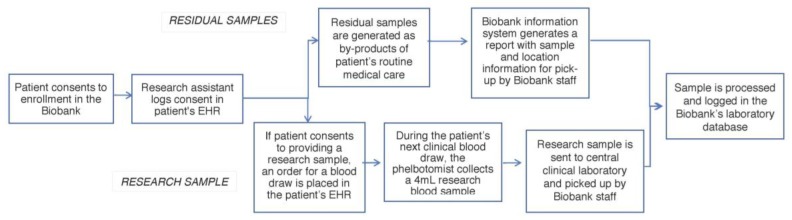
Increasingly, biobanks are being developed to support organized collections of biological specimens and associated clinical information on broadly consented, diverse patient populations. We describe the implementation of a pediatric biobank, comprised of a fully-informed patient cohort linking specimens to phenotypic data derived from electronic health records (EHR). The Biobank was launched after multiple stakeholders' input and implemented initially in a pilot phase before hospital-wide expansion in 2016. In-person informed consent is obtained from all participants enrolling in the Biobank and provides permission to: (1) access EHR data for research; (2) collect and use residual specimens produced as by-products of routine care; and (3) share de-identified data and specimens outside of the institution. Participants are recruited throughout the hospital, across diverse clinical settings. We have enrolled 4900 patients to date, and 41% of these have an associated blood sample for DNA processing. Current efforts are focused on aligning the Biobank with other ongoing research efforts at our institution and extending our electronic consenting system to support remote enrollment. A number of pediatric-specific challenges and opportunities is reviewed, including the need to re-consent patients when they reach 18 years of age, the ability to enroll family members accompanying patients and alignment with disease-specific research efforts at our institution and other pediatric centers to increase cohort sizes, particularly for rare diseases.
Keywords: biorepository; biospecimens; pediatric biobank.
Conflict of interest statement
The authors declare no conflict of interest.
Figures
References
Publication types
LinkOut - more resources
Full Text Sources
Other Literature Sources
