Review
. 2018 Jan;20(1):99-117.
doi: 10.1016/j.neo.2017.10.010. Epub 2017 Dec 12.

The GDNF Family: A Role in Cancer?

Affiliations
Review

The GDNF Family: A Role in Cancer?

Graeme C Fielder et al. Neoplasia. 2018 Jan.

Abstract

The glial cell line-derived neurotrophic factor (GDNF) family of ligands (GFLs) comprising of GDNF, neurturin, artemin, and persephin plays an important role in the development and maintenance of the central and peripheral nervous system, renal morphogenesis, and spermatogenesis. Here we review our current understanding of GFL biology, and supported by recent progress in the area, we examine their emerging role in endocrine-related and other non-hormone-dependent solid neoplasms. The ability of GFLs to elicit actions that resemble those perturbed in an oncogenic phenotype, alongside mounting evidence of GFL involvement in tumor progression, presents novel opportunities for therapeutic intervention.


Figures

Figure 1
Figure 1
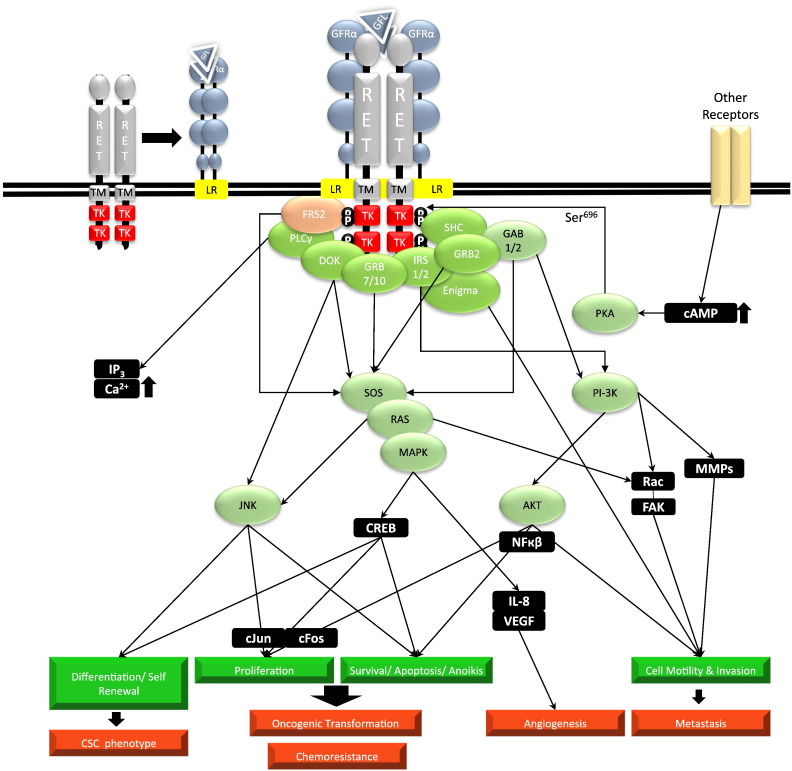
Traditional RET-dependent signaling pathways of GFLs with physiological and oncogenic consequences. Upon binding of the GFL dimer to its respective GFRα pair, the complex induces RET dimerization and consequently tyrosine kinase domain (TK) autophosphorylation. A series of SH2 (Src Homology 2) domain adapter proteins (green) including FRS2 (fibroblast growth factor receptor substrate 2), PLCγ (phospholipase C gamma), DOK (downstream of kinase) 4/5, GRB (growth factor receptor-bound protein) 7/10, IRS 1/2 (insulin receptor substrate 1 or 2), GRB2 (growth receptor binding protein 2), SHC (Src homology 2 domain containing), and Enigma binds to their respective phosphorylated tyrosine residues, predominantly Tyr 905, Tyr1015, Tyr1062, or Tyr1096. The signaling cascade activates downstream effector molecules (orange and black), resulting in functional responses such as differentiation, self-renewal, proliferation, survival, apoptosis, and cell motility. When perturbed, these processes become the driving facets of oncogenesis. Arrows are not restricted to only direct interactions. GFL, GDNF family ligand; TK, tyrosine kinase domain; TM, transmembrane domain; LR, lipid raft; P, phosphorylated tyrosine residue; GFRα, GDNF family receptor alpha; PI3K, phosphatidylinositol 3 kinase; AKT, protein kinase B; IP3, Inositol triphosphate; SOS, Son of Sevenless; MAPK, mitogen activate protein kinase; FAK, focal adhesion kinase; MMPs, matrix metalloproteinases; cAMP, cyclic adenosine mono phosphate; PKA, protein kinase A; JNK, c-Jun N-terminal Kinase; CREB, cAMP response element binding; NFB, nuclear factor-kappa beta; IL-8, interleukin 8; GAB1, GRB2 associated binding protein 1; CSC, cancer stem cell.
Figure 2
Figure 2
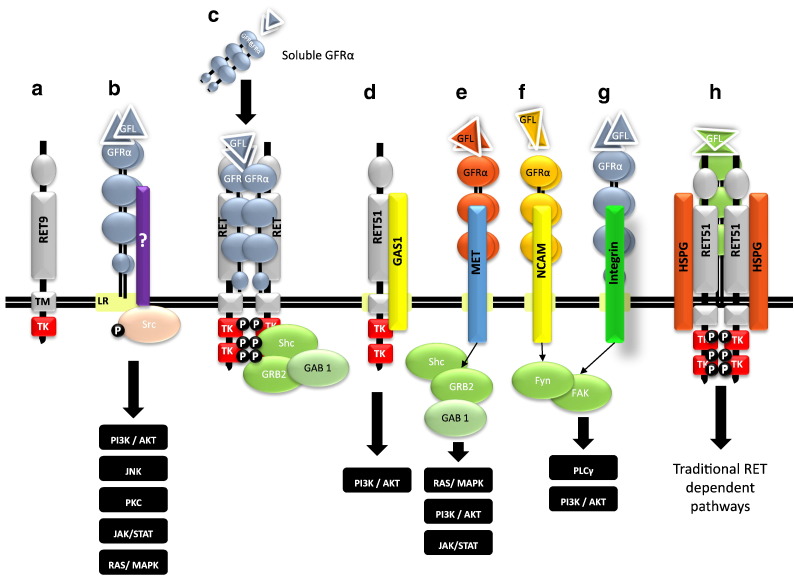
Alternative signaling pathways of GFLs. In addition to the traditional GFL:GFRα:RET51 pathway, several other novel pathways have been discovered to modulate GFL signaling [from left to right]. (a) Alternative RET isoforms, e.g., RET9 (ret proto-oncogene isoforms c); (b) activated Src (v-src sarcoma viral oncogene homolog) signaling associated with lipid rafts (LR) by means of yet an unknown transmembrane protein; (c) soluble GFRα responsible for RET activation outside lipid rafts; (d) GAS1 (growth arrest-specific 1), a recent GFRα alternative receptor; (e) MET (met proto-oncogene); (f) NCAM (neural cell adhesion molecule); (g) integrins; and (h) HSPGs (heparan sulfate proteoglycans) are essential for RET activity. TM, transmembrane domain; TK, tyrosine kinase domain; Fyn, p59fyn kinase; FAK, focal adhesion kinase; GAB1, GRB2 associated binding protein 1;GRB2, growth receptor binding protein 2; PI3K, phosphatidylinositol 3 kinase; AKT, protein kinase B; JAK, Janus kinase; STAT, signal transducer and activator of transcription; SHC, Src homology 2 domain containing.

References

    1. Airaksinen MS, Holm L, Hätinen T. Evolution of the GDNF family ligands and receptors. Brain Behav Evol. 2006;68(3):181–190. - PubMed
    1. Airaksinen MS, Saarma M. The GDNF family: signalling, biological functions and therapeutic value. Nat Rev Neurosci. 2002;3(5):383–394. - PubMed
    1. Airaksinen MS, Titievsky A, Saarma M. GDNF family neurotrophic factor signaling: four masters, one servant? Mol Cell Neurosci. 1999;13(5):313–325. - PubMed
    1. Enomoto H. Regulation of neural development by glial cell line–derived neurotrophic factor family ligands. Anat Sci Int. 2005;80(1):42–52. - PubMed
    1. Rangasamy SB, Soderstrom K, Bakay RA, Kordower JH. Neurotrophic factor therapy for Parkinson's disease. Prog Brain Res. 2010;184:237–264. - PubMed

Publication types

LinkOut - more resources