


Severe infections in sarcoidosis: Incidence, predictors and long-term outcome in a cohort of 585 patients
- PMID: 29245251
- PMCID: PMC5728866
- DOI: 10.1097/MD.0000000000008846
Severe infections in sarcoidosis: Incidence, predictors and long-term outcome in a cohort of 585 patients
Abstract
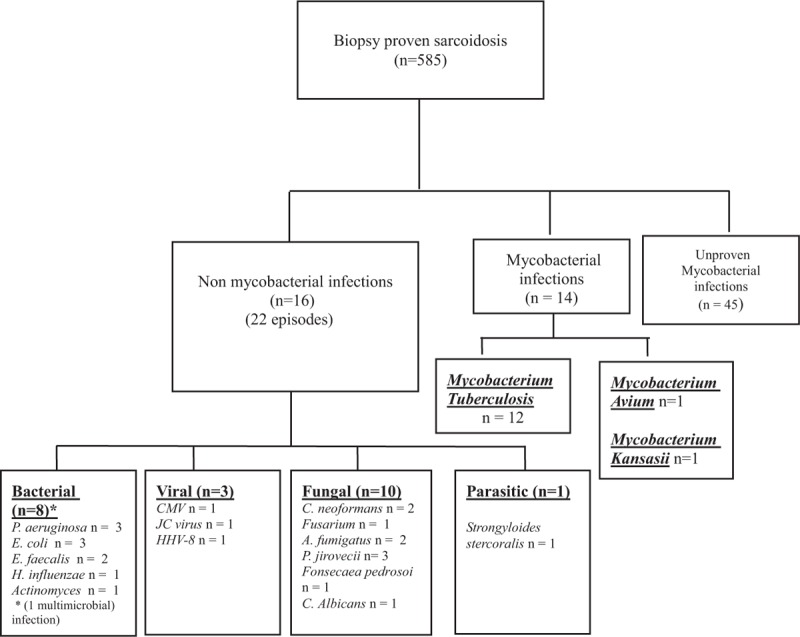
Sarcoidosis is associated with cell-mediated immunodeficiency and treatment of symptomatic sarcoidosis usually includes systemic immunosuppressants. Data relative to incidence, prognosis factors, and outcome of infections are scarce.Retrospective cohort study of 585 patients with biopsy proven sarcoidosis in a tertiary referral specialist clinic, with a nested case-control analysis. Twenty nine patients (4.9%) with severe infections were compared to 116 controls subjects with sarcoidosis, matched according to their gender, ethnicity, age at diagnosis, and treatment with corticosteroids.After a median follow-up of 8 years [range; 1-46], 38 severe infections [mycobacterial infections (n = 14), fungal infections (n = 10), bacterial (n = 8), viral (n = 3) and parasitic (n = 1)] were observed in 30 patients. The incidence of severe infections was 0.71% persons-year (CI 95% 0.5-0.98) and 0.43% persons-year (CI 95% 0.27-0.66). Patients with severe infection were more frequently of male gender (60% vs 46%) and were more likely treated by ≥ 3 immunosuppressive agents (OR = 3.8, IC 95% [1.5-9.64], P = .005) and by cyclophosphamide (OR = 5.55, IC 95% [1.9-16.1], P = .002), and with neurological (OR = 3.36 CI 95% [1.37-8.25], P = .008), or cardiac (OR = 2.65 CI 95% [1.09-6.43], P = .031) involvement of the sarcoidosis, compared to the controls. Two patients died within the 6 months following infection, due to progressive multifocal leucoencephalopathy (n = 1), and of peritonitis (n = 1).Severe infections are observed in 5.1% of our patients with sarcoidosis after a median follow-up of 8 years. Risk factors for severe infections included neurological or cardiac involvement of sarcoidosis, the use of immunosuppressive agents and mainly cyclophosphamide.
Conflict of interest statement
The authors have no conflicts of interest to disclose.
Figures
References
-
- Valeyre D, Prasse A, Nunes H, et al. Sarcoidosis. Lancet 2014;383:1155–67. - PubMed
-
- Newman LS, Rose CS, Bresnitz EA, et al. A case control etiologic study of sarcoidosis. Am J Respir Crit Care Med 2004;170:1324–30. - PubMed
-
- Iannuzzi MC, Fontana JR. Sarcoidosis: clinical presentation, immunopathogenesis, and therapeutics. JAMA 2011;305:391–9. - PubMed
-
- Dixon WG, Watson K, Lunt M, et al. British Society for Rheumatology Biologics Register Control Centre Consortium. Rates of serious infection, including site-specific and bacterial intracellular infection, in rheumatoid arthritis patients receiving anti-tumor necrosis factor therapy: results from the British Society for Rheumatology Biologics Register. Arthritis Rheum 2006;54:2368–76. - PubMed
MeSH terms
Substances
LinkOut - more resources
Full Text Sources
Other Literature Sources
Medical
