


Regional lymph node involvement and outcomes in appendiceal neuroendocrine tumors: a SEER database analysis
- PMID: 29245922
- PMCID: PMC5725113
- DOI: 10.18632/oncotarget.20362
Regional lymph node involvement and outcomes in appendiceal neuroendocrine tumors: a SEER database analysis
Abstract
Background: Appendiceal neuroendocrine neoplasms are most often diagnosed incidentally during appendectomy. The need for subsequent right hemicolectomy (RHC) is determined based on the risk of regional lymph node (LN) involvement. Tumor size has historically been used as an indicator of this risk, but controversy remains regarding its cut off. Furthermore, the impact of RHC on survival is unclear.
Methods: We used the SEER database to identify patients diagnosed with appendiceal neuroendocrine tumors.
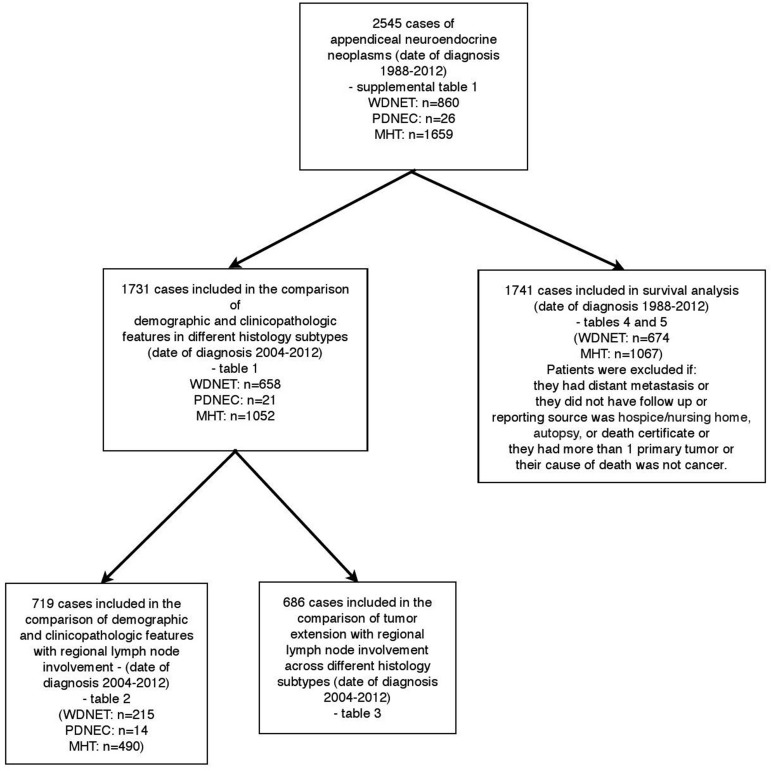
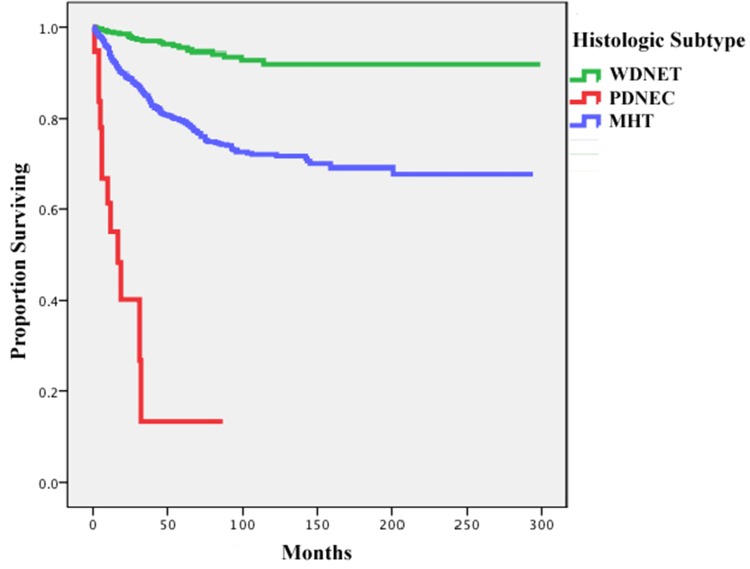
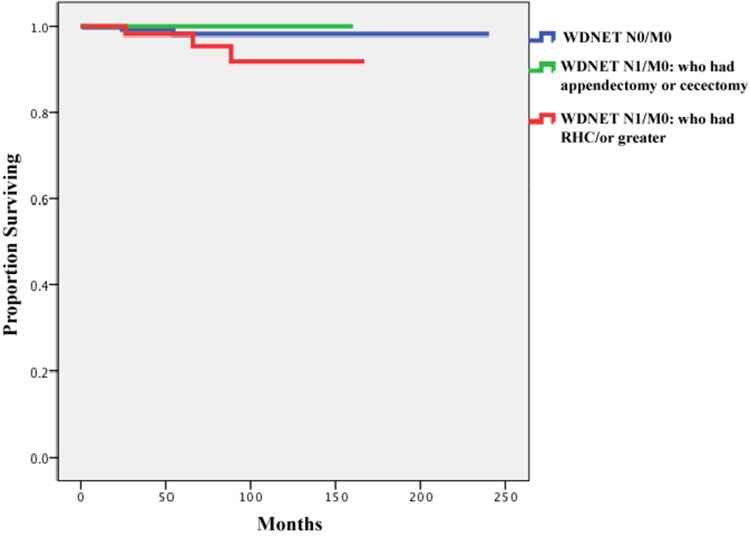
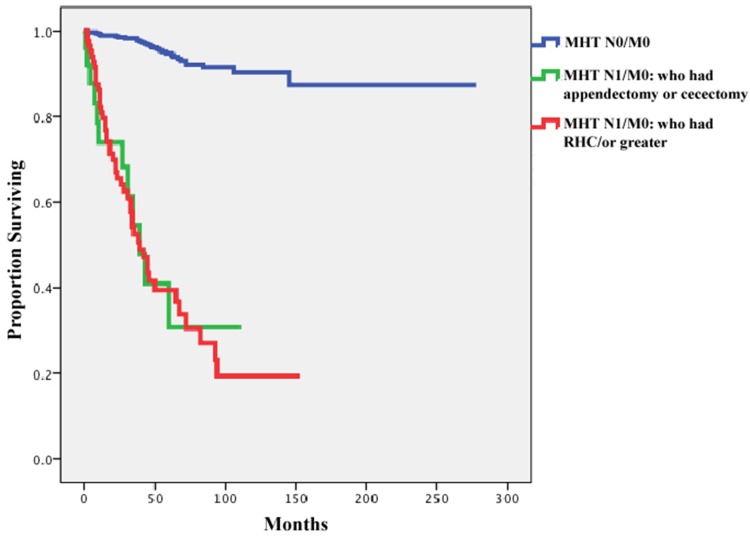
Results: Of 1731 patients, 38.0% had well-differentiated neuroendocrine tumors (WDNETs), 60.8% had mixed histology tumors (MHTs), and 1.2% had poorly differentiated neuroendocrine carcinomas (PDNECs). In patients with WDNETs and MHTs who had adequate lymphadenectomy, higher rates of LN involvement were noted for tumors size 11-20 mm than ≤10 mm (56.8% vs. 11.6%, p <0.001; 32.9% vs. 10.4%, p=0.004, respectively). The type of surgery did not affect OS in cases with MHTs with LN involvement (HR 1.00; 95% CI, 0.53-1.89; p =0.99). Patients with regionally advanced WDNET showed excellent survival and only 3 patients (out of 118) died from cancer within 10 years.
Conclusions: 10 mm appears to be a more appropriate cutoff than 20 mm for predicting LN metastasis in appendiceal NETs. Cases with WDNETs and nodal involvement demonstrate overall excellent prognosis irrespective of type of surgery (i.e. RHC may not improve outcome). In MHTs with LN metastases, survival is markedly worse in spite of RHC. The role of adjuvant therapy should be evaluated in this subset.
Keywords: appendix; neuroendocrine; right hemicolectomy; survival; tumor size.
Conflict of interest statement
CONFLICTS OF INTEREST The authors declare that they have no conflicts of interest.
Figures
References
-
- Rindi G, Arnold R, Bosman FT, Capella FT, Klimstra DS, Kloppel G, Komminoth P, Solcia E. Nomenclature and classification of neuroendocrine neoplasms of the digestive system. In: Bosman TF, Hruban RH, Theise ND, editors. WHO Classification of Tumours of the Digestive System. International Agency for Research on Cancer (IARC); Lyon: 2010.
-
- Mullen JT, Savarese DM. Carcinoid tumors of the appendix: a population-based study. J Surg Oncol. 2011;104:41–44. - PubMed
-
- Godwin JD., 2nd Carcinoid tumors. An analysis of 2,837 cases. Cancer. 1975;36:560–69. - PubMed
-
- Komminoth PA, Capella C, Klimstra DS, Klӧppel G, Solcia E, Rindi G. Neuroendocrine neoplasms of the appendix. WHO classification of tumours of the digestive system. 4th ed. Lyon: IARC Press; 2010.
-
- La Rosa S, Marando A, Furlan D, Sahnane N, Capella C. Colorectal poorly differentiated neuroendocrine carcinomas and mixed adenoneuroendocrine carcinomas: insights into the diagnostic immunophenotype, assessment of methylation profile, and search for prognostic markers. Am J Surg Pathol. 2012;36:601–11. - PubMed
LinkOut - more resources
Full Text Sources
Other Literature Sources
