


Possible interference between seasonal epidemics of influenza and other respiratory viruses in Hong Kong, 2014-2017
- PMID: 29246199
- PMCID: PMC5732536
- DOI: 10.1186/s12879-017-2888-5
Possible interference between seasonal epidemics of influenza and other respiratory viruses in Hong Kong, 2014-2017
Abstract
Background: Unlike influenza viruses, little is known about the prevalence and seasonality of other respiratory viruses because laboratory surveillance for non-influenza respiratory viruses is not well developed or supported in China and other resource-limited countries. We studied the interference between seasonal epidemics of influenza viruses and five other common viruses that cause respiratory illnesses in Hong Kong from 2014 to 2017.
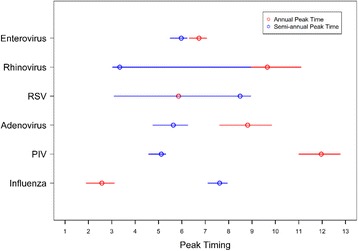
Methods: The weekly laboratory-confirmed positive rates of each virus were analyzed from 2014 to 2017 in Hong Kong to describe the epidemiological trends and interference between influenza viruses, respiratory syncytial virus (RSV), parainfluenza virus (PIV), adenovirus, enterovirus and rhinovirus. A sinusoidal model was established to estimate the peak timing of each virus by phase angle parameters.
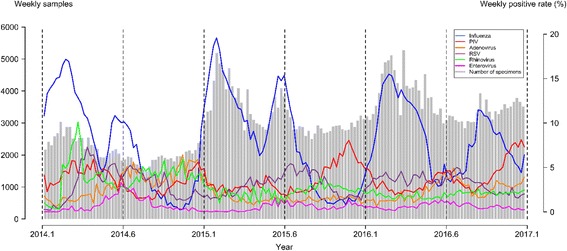
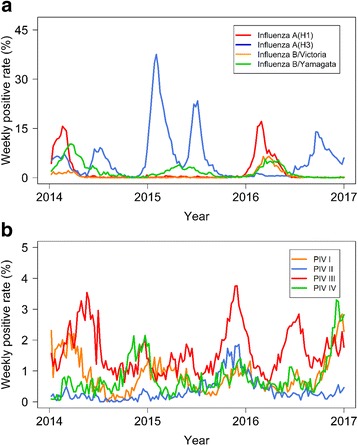
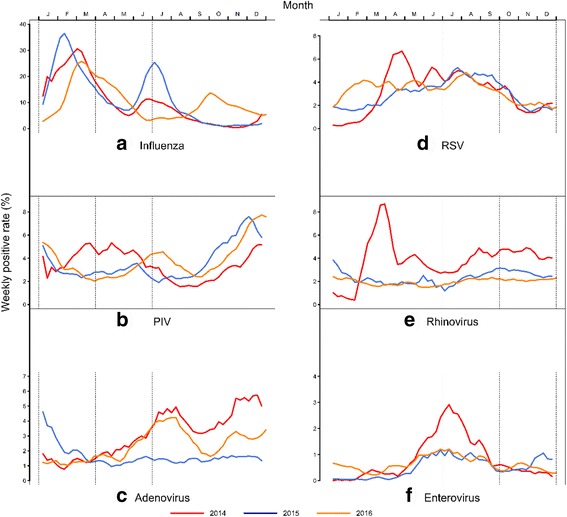
Results: Seasonal features of the influenza viruses, PIV, enterovirus and adenovirus were obvious, whereas annual peaks of RSV and rhinovirus were not observed. The incidence of the influenza viruses usually peaked in February and July, and the summer peaks in July were generally caused by the H3 subtype of influenza A alone. When influenza viruses were active, other viruses tended to have a low level of activity. The peaks of the influenza viruses were not synchronized. An epidemic of rhinovirus tended to shift the subsequent epidemics of the other viruses.
Conclusion: The evidence from recent surveillance data in Hong Kong suggests that viral interference during the epidemics of influenza viruses and other common respiratory viruses might affect the timing and duration of subsequent epidemics of a certain or several viruses.
Keywords: Influenza; Interference; Respiratory viruses; Seasonal epidemics.
Conflict of interest statement
Ethics approval and consent to participate
Not applicable.
Consent for publication
Not applicable.
Competing interests
The authors declare that they have no competing interests.
Publisher’s Note
Springer Nature remains neutral with regard to jurisdictional claims in published maps and institutional affiliations.
Figures
References
-
- Nair H, Brooks WA, Katz M, Roca A, Berkley JA, Madhi SA, Simmerman JM, Gordon A, Sato M, Howie S, et al. Global burden of respiratory infections due to seasonal influenza in young children: a systematic review and meta-analysis. Lancet. 2011;378(9807):1917–1930. doi: 10.1016/S0140-6736(11)61051-9. - DOI - PubMed
-
- Galindo-Fraga A, Ortiz-Hernandez AA, Ramirez-Venegas A, Vazquez RV, Moreno-Espinosa S, Llamosas-Gallardo B, Perez-Patrigeon S, Salinger M, Freimanis L, Huang CY, et al. Clinical characteristics and outcomes of influenza and other influenza-like illnesses in Mexico City. Int J Infect Dis. 2013;17(7):e510–e517. doi: 10.1016/j.ijid.2013.01.006. - DOI - PMC - PubMed
MeSH terms
Grants and funding
LinkOut - more resources
Full Text Sources
Other Literature Sources
Medical
